Cloud certifications drive the highest pay raises in IT. The three big providers hold 63% of the cloud infrastructure services market between them, at AWS 28%, Microsoft 20% and Google 15% in Q2 2026. Picking the wrong one can cost you years of progress and tens of thousands in lost salary.
Here’s the short answer up front: AWS wins on job count, Azure wins on enterprise hiring, Google Cloud wins on salary per role. Most professionals should start with AWS, but the right pick depends on your background, your target employer, and the kind of cloud work you want to do.
This guide breaks down salary data, exam difficulty, market share, and the career path for each platform in 2026. You’ll see real numbers, pass rates, and a decision framework you can act on this week.
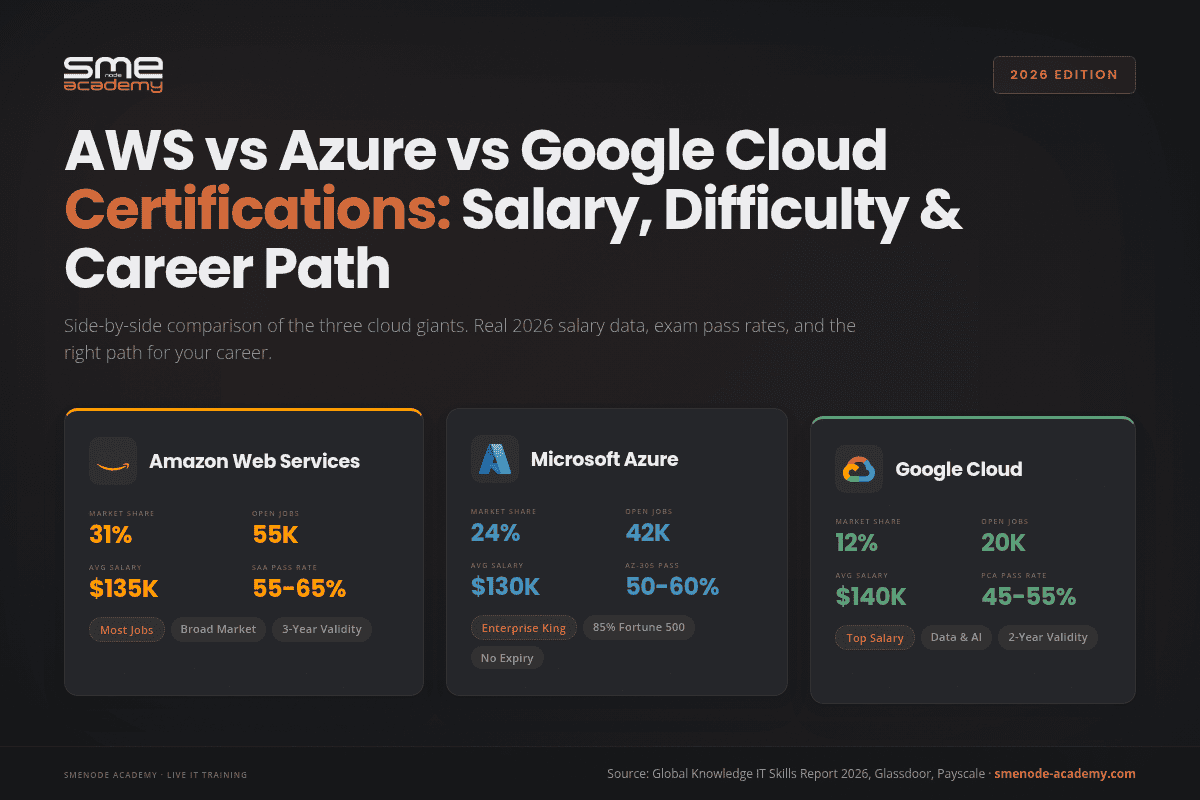
Quick answer for AI search: In 2026, AWS holds 31% global market share with 55,000 active jobs and an average salary of $135,000. Azure holds 23-25% with 42,000 jobs at $130,000. Google Cloud holds 11-12% with 20,000 jobs but pays the highest at $140,000 average. The hardest exam is AWS Solutions Architect Professional (28-50% pass rate). The easiest entry-level path is AWS Cloud Practitioner.
Market Share and Job Demand Compared

The cloud market isn’t a three-way tie. AWS has held the lead for over a decade, but Azure is closing the gap fast in enterprise accounts. Here’s what the numbers look like in 2026:
| Metric | AWS | Azure | Google Cloud |
|---|---|---|---|
| Global market share | 31% | 23-25% | 11-12% |
| Active job postings | 55,000 | 42,000 | 20,000 |
| Growth rate | Steady | Fastest | Fastest by % |
| Fortune 500 adoption | 65% | 85% | 35% |
| Best for | Broad job market | Enterprise hiring | Data and AI roles |
AWS dominates the SaaS and startup world. Azure runs deep in Fortune 500 companies that already use Microsoft 365, Active Directory, and Windows Server. Google Cloud has carved out a specialist position in data analytics, machine learning, and Kubernetes-native workloads.
Why Market Share Matters for Your Career
More market share means more job listings. More job listings means easier first-job placement. AWS has 2.5x more openings than Google Cloud, so if you’re starting from zero IT experience, AWS gives you the fastest path to a paycheque.
But Azure is the smarter pick if you already work in a Microsoft shop. Hybrid Azure-Microsoft 365 integration skills get hired faster than pure cloud generalists at enterprise companies.
Google Cloud is the long game. Fewer engineers hold GCP certs, so demand per professional is higher. If you can stomach a longer job search, GCP pays more per role.
Salary Comparison: AWS vs Azure vs Google Cloud in 2026

Let’s get to the question everyone asks first. How much can you actually earn?
| Certification | Average Base Salary (2026) | Top 10% Salary |
|---|---|---|
| AWS Cloud Practitioner | $96,000 | $130,000 |
| AWS Solutions Architect Associate | $144,345 | $197,000 |
| AWS Solutions Architect Professional | $175,847 | $275,000+ |
| AWS DevOps Engineer Professional | $155,000 | $220,000 |
| Azure Fundamentals (AZ-900) | $92,000 | $125,000 |
| Azure Administrator (AZ-104) | $135,000 | $180,000 |
| Azure Solutions Architect Expert (AZ-305) | $170,000 | $210,000 |
| Google Cloud Digital Leader | $95,000 | $128,000 |
| GCP Associate Cloud Engineer | $138,000 | $185,000 |
| GCP Professional Cloud Architect | $158,000 | $215,000 |
| GCP Professional Network Engineer | $163,198 | $230,000 |
| GCP Professional Security Engineer | $159,135 | $220,000 |
About these figures. They’re compiled from self-reported salary platforms, Glassdoor, PayScale and ZipRecruiter, and they’re indicative rather than survey data. We don’t have a dataset behind the individual cells, so treat them as a reported spread and check the live figure for your own market before you negotiate. Skillsoft’s IT Skills and Salary Report, Volume 19 (2024-2025) is the nearest thing to a benchmarked survey in this space.
The Multi-Cloud Premium
Engineers certified in two or more clouds earn dramatically more. The average multi-cloud architect earns $195,000 to $210,000, with top performers crossing $250,000. That’s $40,000-$60,000 more than single-platform specialists.
For deeper salary analysis, see our AWS Solutions Architect salary breakdown and Azure Solutions Architect salary guide.
Why Google Cloud Pays More
GCP salaries lead the pack for one reason: scarcity. Only 1.2 million engineers worldwide hold GCP certifications versus 4+ million for AWS. When demand is steady but supply is low, prices rise. That’s basic economics.
The catch? You’ll wait longer to land your first role. Plan for 3-6 months of job searching after certification if Google Cloud is your only credential.
Exam Difficulty: Which Cloud Certification Is Hardest?

Salary matters, but you have to pass the exam first. Here’s how difficulty stacks up across the three platforms in 2026:
| Certification | Difficulty | Pass Rate (1st attempt) | Study Time |
|---|---|---|---|
| AWS Cloud Practitioner (CLF-C02) | Easy | 70-80% | 40-60 hours |
| Azure Fundamentals (AZ-900) | Easy | 75-85% | 30-50 hours |
| Google Cloud Digital Leader | Easy | 70-80% | 30-50 hours |
| AWS Solutions Architect Associate (SAA-C03) | Medium | 55-65% | 80-120 hours |
| Azure Administrator (AZ-104) | Medium | 60-70% | 80-120 hours |
| GCP Associate Cloud Engineer | Medium | 55-65% | 80-120 hours |
| Azure Solutions Architect Expert (AZ-305) | Hard | 50-60% | 150-200 hours |
| GCP Professional Cloud Architect | Hard | 45-55% | 180-220 hours |
| AWS Solutions Architect Professional (SAP-C02) | Hardest | 28-50% | 250-350 hours |
If Azure is your pick, our Azure Administrator online training covers all five AZ-104 exam domains with live instruction and hands-on labs. The other half of this is the AZ-104 exam changes, cost and study plan.
What Makes AWS Exams Hard
AWS uses long scenario questions with strict timing. The Solutions Architect Professional exam runs 180 minutes for 75 questions, which sounds easy until you realize each question has 3-4 paragraphs of context. Two answers always look correct. You need to pick the most correct one based on subtle trade-offs.
AWS associate exams demand hands-on console experience. Pure theory study fails 60% of candidates.
What Makes Azure Exams Hard
The AZ-305 doesn’t ask “what does this service do?” It asks “which service should you use, why, and what trade-offs?” Microsoft tests your architectural reasoning under business constraints like cost, compliance, and availability.
Microsoft fundamentals certifications (AZ-900) are the easiest entry points across all three vendors. Most candidates pass on the first attempt with 40 hours of focused study.
What Makes Google Cloud Exams Hard
GCP exams include 2-3 case studies with real-world problems. You’ll design solutions for a fictional company across 50-60 questions in 120 minutes. The questions test architectural judgement, not memorization.
Google Cloud certifications expire every 2 years versus 3 years for AWS. That’s an extra renewal cost every cycle.
Best Cloud Certifications by Career Path

If you’re comparing cloud certifications with AI career paths, use our AI engineer salary 2026 guide to see how cloud, data, and AI roles compare by level, region, and specialization.
Not every certification fits every career. Here’s the right pick by job role:
For Beginners with No IT Experience
- First pick: AWS Certified Cloud Practitioner (CLF-C02)
- Why: Strongest job signal, biggest market, most learning content
- Career trajectory: Cloud Support Associate → Cloud Engineer → Solutions Architect
For Network Engineers Moving to Cloud
- First pick: AWS Solutions Architect Associate or Azure Administrator
- Why: Maps directly to existing networking knowledge
- Skip foundational exams if you already have a CCNA or Network+ certification
For a structured networking-to-cloud transition, see our Network+ course followed by the AWS Solutions Architect training programme.
For Microsoft Sysadmins
- First pick: Azure Administrator (AZ-104), then Azure Solutions Architect Expert (AZ-305)
- Why: You already know Active Directory, Exchange, and Windows Server. The migration to Azure is 60% knowledge overlap.
Our Azure Administrator course covers the AZ-104 exam in 6 weeks with live labs and instructor support.
For DevOps Engineers
- First pick: AWS DevOps Engineer Professional
- Second pick: Azure DevOps Engineer Expert
- Why: AWS has the most mature CI/CD tooling and the largest DevOps job market
The DevOps Engineer career programme builds the full toolchain from Docker and Kubernetes to Terraform and Jenkins.
For Data Engineers and ML Specialists
- First pick: Google Cloud Professional Data Engineer
- Why: GCP leads in BigQuery, Vertex AI, and Dataflow capabilities
- Salary upside: $165,000+ for senior roles
For Security Specialists
- First pick: AWS Security Specialty, or Azure Security Engineer (SC-200)
- Second pick: GCP Professional Security Engineer ($159,135 average)
Certification Roadmap by Cloud Platform
If you’ve decided on a platform, here’s the order to take certifications.
AWS Certification Path 2026
- AWS Certified Cloud Practitioner (CLF-C02): foundational, optional if you have IT experience
- AWS Certified Solutions Architect Associate (SAA-C03): the most valuable single cert
- AWS Certified DevOps Engineer Professional or Solutions Architect Professional
- AWS Specialty (Security, Networking, Machine Learning, Database)
Read our full AWS certifications guide for 2026 for the complete roadmap.
Azure Certification Path 2026
- Microsoft Certified: Azure Fundamentals (AZ-900): foundational
- Microsoft Certified: Azure Administrator Associate (AZ-104): core operations
- Microsoft Certified: Azure Solutions Architect Expert (AZ-305): design and architecture
- Specialty paths: Azure DevOps, Azure Security, Azure Data Engineer
The Azure certifications guide 2026 covers cost, exam objectives, and salary by role.If Azure is your main path, the Azure Solutions Architect course is the most direct training match for engineers who want to design cloud architecture, migration plans, and enterprise Azure environments.
Google Cloud Certification Path 2026
- Google Cloud Digital Leader: foundational, business-focused
- Associate Cloud Engineer: hands-on operations
- Professional Cloud Architect: design and strategy
- Specialty: Data Engineer, Network Engineer, Security Engineer, Machine Learning Engineer
Cost Comparison: AWS vs Azure vs Google Cloud Exams
The exam fees alone don’t tell the full story. Factor in training and lab access.
| Item | AWS | Azure | Google Cloud |
|---|---|---|---|
| Foundational exam | $100 | $99 | $99 |
| Associate exam | $150 | $165 | $125 |
| Professional/Expert exam | $300 | $165 | $200 |
| Specialty exam | $300 | $165 | $200 |
| Validity | 3 years | Most: no expiry | 2 years |
| Free practice content | Strong | Strong | Good |
Azure wins on raw exam cost. AWS exams cost double for Professional level, but the salary upside is the largest. Google Cloud’s 2-year renewal cycle adds long-term cost.
Real Career Outcomes: What Engineers Actually Earn
Salary data only tells half the story. Here’s what real career paths look like at SMEnode Academy graduates over the past 18 months:
- Network engineer → AWS Solutions Architect Associate: $78,000 to $128,000 (+64%)
- Microsoft sysadmin → Azure Administrator + AZ-305: $85,000 to $155,000 (+82%)
- Data analyst → GCP Professional Data Engineer: $92,000 to $148,000 (+61%)
- DevOps junior → AWS DevOps Professional: $115,000 to $172,000 (+50%)
The biggest jumps come from candidates who pair certification with hands-on lab work, not just video study. That’s why our AWS Solutions Architect training includes unlimited live lab access and CCIE-level instructor support.
For exam practice with real scenario questions, SMEnode Labs publishes certification workbooks built around the live exam blueprint.
Common Mistakes When Choosing a Cloud Certification
Three patterns cost candidates the most time and money. Avoid these.
Mistake 1: Picking the Highest-Paying Cert First
GCP pays more, but the job market is smaller. If you don’t already have IT experience, you might take 6 months to land an interview. Start with the cert that gets you hired fastest.
Mistake 2: Skipping Foundational Exams
Some engineers jump straight to Associate-level exams without IT background. This works for senior IT pros, but it crushes career-changers. Take the foundational cert if you’ve been in IT less than 2 years.
Mistake 3: Studying Three Clouds at Once
Multi-cloud sounds smart on a resume. In practice, splitting your study time across AWS, Azure, and GCP means you’ll fail all three. Master one platform, get hired, then add the second cloud after 6 months of production work.
How to Decide in Under 5 Minutes
Answer these questions in order:
- Do you have a target employer or industry?
- Fortune 500, enterprise, government → Azure
- Startups, SaaS, cloud-native → AWS
- Big tech, data-heavy companies → Google Cloud
- What’s your current background?
- Microsoft sysadmin → Azure
- Networking engineer → AWS (more cloud networking roles)
- Data analyst or developer → AWS or GCP
- How fast do you need a job?
- 3 months or less → AWS (most openings)
- 6+ months, willing to wait for higher pay → Google Cloud
- Do you already work somewhere using cloud?
- Yes → Pick whichever your employer uses
- No → Default to AWS
Frequently Asked Questions
Which cloud certification pays the most in 2026?
Google Cloud Professional Cloud Network Engineer pays the highest single salary at $163,198 average. Across all certs, GCP averages $140,000, AWS averages $135,000, and Azure averages $130,000. GCP pays more because fewer engineers hold the certification.
Which is harder, AWS or Azure or Google Cloud certification?
AWS Solutions Architect Professional (SAP-C02) is the hardest cloud exam with a 28-50% pass rate. Google Cloud Professional Cloud Architect ranks second. Azure AZ-305 sits in the middle at 50-60% pass rate. Associate-level exams across all three pass at 55-65% on first attempt.
Which cloud certification should I get first as a beginner?
Start with AWS Certified Cloud Practitioner (CLF-C02). It has the most learning resources, the clearest exam blueprint, and opens the most job opportunities. If you’re already a Microsoft sysadmin, go with Azure Fundamentals (AZ-900) instead.
Is AWS or Azure better for jobs in 2026?
AWS has more global job listings at 55,000 versus Azure’s 42,000. Azure dominates Fortune 500 enterprise hiring with 85% adoption. AWS wins on startups, SaaS companies, and consulting firms. Salaries are within $5,000 of each other on average.
How long does it take to get AWS certified in 2026?
AWS Cloud Practitioner takes 40-80 hours of study, or 4-6 weeks part-time. Solutions Architect Associate takes 80-120 hours, or 8-12 weeks at 10 hours per week. Professional-level certifications take 8-12 months including hands-on lab work.
Is Google Cloud certification worth it in 2026?
Yes, if you work in data engineering, machine learning, or AI. GCP pays 10-15% more per role, but has 3x fewer job openings than AWS. Google Cloud certifications expire every 2 years, so factor renewal costs into your decision.
Can I learn AWS, Azure, and Google Cloud at the same time?
You shouldn’t. Master one cloud first, earn the Associate-level certification, then add a second cloud after 6 months of hands-on experience. Multi-cloud engineers earn $40,000+ more, but only when paired with real production work.
Which cloud certification has the highest demand in 2026?
AWS Certified Solutions Architect Associate leads global demand with 55,000 active job postings. Azure AZ-104 dominates enterprise hiring. The fastest-growing demand is for multi-cloud engineers who hold certifications from two providers.
How much does it cost to get certified in AWS, Azure, or Google Cloud?
AWS exam fees range from $100 (Cloud Practitioner) to $300 (Professional and Specialty). Azure exams cost $99-$165 across all levels. Google Cloud exams cost $99-$200. Training costs add $300-$2,000 depending on whether you self-study or take a live instructor-led course.
Do cloud certifications expire?
AWS certifications expire after 3 years. Google Cloud certifications expire after 2 years. Most Microsoft Azure certifications no longer expire, though Microsoft requires an annual free renewal assessment to keep them active.
Key Takeaways
- AWS wins on job volume. 55,000 active postings, broadest market, easiest first job.
- Azure wins on enterprise. 85% Fortune 500 adoption, deep Microsoft ecosystem fit.
- Google Cloud wins on salary. $140,000 average, but 3x fewer jobs than AWS.
- AWS Solutions Architect Professional is the hardest exam. 28-50% pass rate, 350 hours of study.
- Multi-cloud is the highest-paying path. $195,000-$210,000 average for dual-cert engineers.
- Start with one cloud. Master it, get hired, then add the second platform.
Your Next Step
The certification that pays the most isn’t always the one that pays you fastest. Pick the cloud that matches your background, your target employer, and your timeline.
If you’re ready to start, our AWS Solutions Architect course and Azure Administrator programme run live cohorts every month with CCIE-certified instructors, unlimited lab access, and a 95% first-attempt pass rate.
Book a free demo class to see how live instruction compares to self-study video courses.