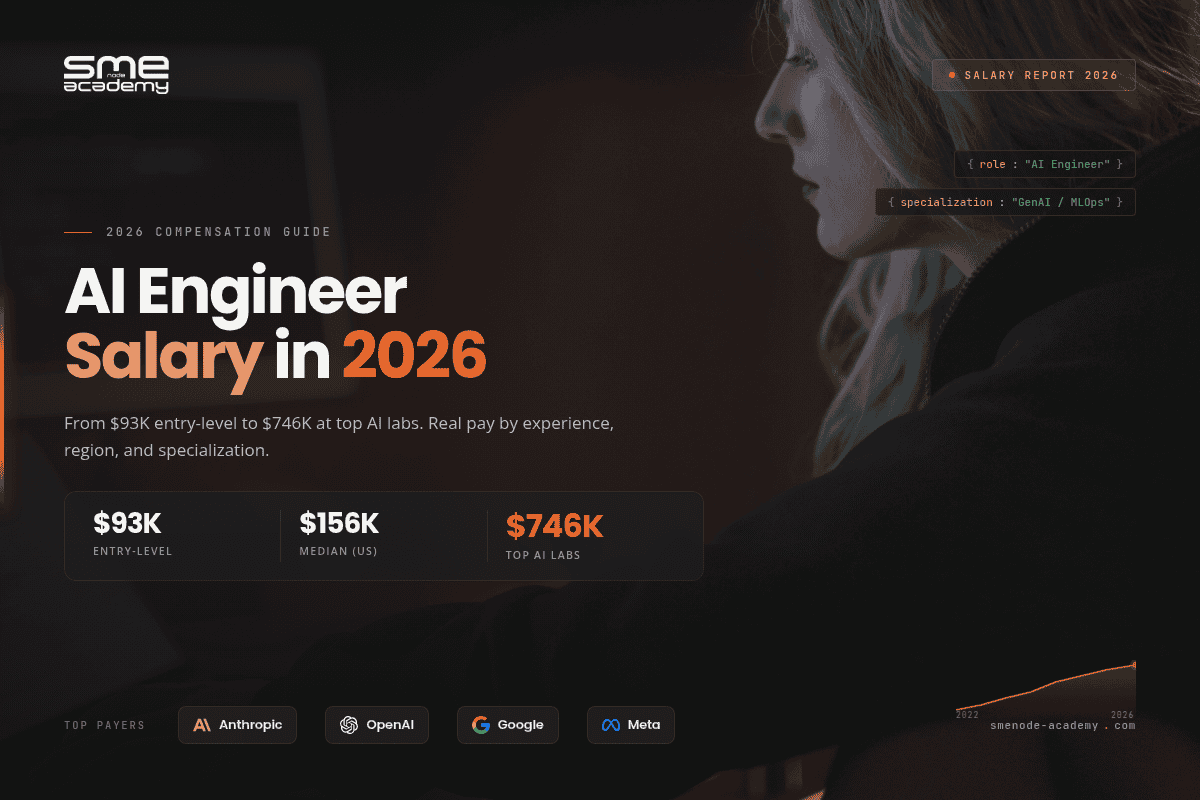
There’s no official median AI engineer salary in the United States, because the Bureau of Labor Statistics doesn’t track “AI engineer” as an occupation at all. The two closest official ones are Data Scientists, at a $120,230 median (SOC 15-2051, May 2025), and Computer and Information Research Scientists, at $140,300 (SOC 15-1221, May 2025). Self-reported platforms put AI-titled roles above both. So here’s what pay actually looks like by level, region and specialisation, with the scope attached to every figure.
Senior engineers at Anthropic? They’re pulling $746,403 in total comp. Research scientists at OpenAI? Up to $685,000 in base pay alone. And yes, those are real federal filings, not LinkedIn rumours.
So what’s the honest AI engineer salary in 2026?
It depends on three things. Your level, where you live, and what kind of AI you actually build. Get all three right and you’re in the top 1% of tech earners. Get them wrong and you’re stuck at $90K writing scikit-learn pipelines that nobody uses.
This guide gives you the real numbers. Pulled from BLS, Glassdoor, Levels.fyi, ZipRecruiter, and Indeed. Broken down by experience, city, country, and specialization. Plus, what skills actually move the needle on your offer letter.
Let’s get into it.
AI Engineer Salary in 2026: The Quick Answer
The average AI engineer salary in 2026 sits between $145,000 and $190,000 in base pay across major US tech hubs. Total compensation, including bonus and equity, runs $200,000 to $500,000+ at top tech firms.
Why the gap between $106K and $746K? Two reasons. First, ZipRecruiter pulls a wider job pool that includes junior and adjacent roles. Second, Levels.fyi captures actual offer letters from FAANG and AI labs, which skews higher.
The middle of the market for a real AI engineer with 3-5 years of production experience? Around $182,500 globally and $200,000+ in the US.
Pretty solid. But the spread tells you everything about where AI engineering is headed in 2026.
Why Every AI Engineer Salary Source Gives a Different Number
You’ll see figures ranging from $100K to $310K depending on where you look. They’re all technically correct – they just measure different things.
| Source | What It Measures | Why It Skews |
|---|---|---|
| BLS (Bureau of Labor Statistics) | W-2 tax filings, all US workers | Lags 12-18 months behind market |
| Glassdoor | Self-reported by employees | San Francisco bias, total comp often missing |
| Levels.fyi | Verified offer letters | FAANG-heavy, skews high |
| Indeed / ZipRecruiter | Job posting midpoints | Listed ranges, not accepted offers |
| LinkedIn Salary | User-reported, unverified | Wide variance, self-selection bias |
The most reliable number for your situation:
- Negotiating an offer at a FAANG? → Use Levels.fyi
- Evaluating a mid-size company offer? → Use Glassdoor + Indeed combined
- Career planning or school research? → BLS is the safest baseline
This guide uses BLS as the baseline, Levels.fyi for top-of-market, and Glassdoor for mid-market ranges. Where numbers conflict, we’ve listed both.
AI Engineer Salary by Experience Level (2026)

Experience drives more variance in AI pay than any other factor. A senior generative AI engineer can earn 3x what an entry-level engineer makes for the same job title.
Here’s how it breaks down in 2026:
| Level | Years of Experience | Base Salary | Total Compensation |
|---|---|---|---|
| Entry-level (L3) | 0-2 years | $93,000 – $120,000 | $100,000 – $173,000 |
| Mid-level (L4) | 3-5 years | $140,000 – $200,000 | $180,000 – $260,000 |
| Senior (L5) | 5-8 years | $195,000 – $275,000 | $275,000 – $400,000 |
| Staff (L6) | 8-12 years | $250,000 – $340,000 | $400,000 – $600,000 |
| Principal / Distinguished (L7+) | 12+ years | $310,000 – $500,000 | $600,000 – $943,000+ |
A few things to know about these numbers.
Entry-level pay is climbing. New grads with strong portfolios are landing $120K base in 2026, up from $90K just two years ago. That’s a 33% jump driven entirely by the GenAI boom.
Mid-level saw the biggest gain. Engineers with 3-5 years of production AI work got a 9.2% year-over-year salary bump in 2026, the highest of any level. Companies are paying up to keep them from jumping to AI labs.
Senior to staff is where total comp explodes. Going from $275K base to $340K base sounds like a $65K bump. But total comp typically jumps from $400K to $600K because equity grants scale faster than salary at L6.
Principal pay is uncapped at AI labs. Anthropic and OpenAI have offered $1M+ packages for distinguished AI engineers. Most of that is restricted stock that vests over four years.
Sound like a stretch? In our AIOps for Networks training, we’ve watched students go from $85K network roles to $145K AIOps positions in under 18 months. The path exists. It just takes the right skills.
AI Engineer Salary by Region
Where you work matters. A lot.
A San Francisco-based AI engineer at the same company can earn 60% more than the Nashville version of themselves doing identical work. Cost of living explains some of that. Talent competition explains the rest.
AI Engineer Salary by US City (2026)
| City | Average AI Engineer Salary |
|---|---|
| San Jose, CA | $206,706 |
| Boston, MA | $189,318 |
| New York, NY | $189,274 |
| Santa Clara, CA | $186,734 |
| San Francisco, CA | $185,000 – $250,000 |
| Seattle, WA | $175,000 – $220,000 |
| Austin, TX | $165,000 – $195,000 |
| Nashville, TN | $158,077 |
| Dallas, TX | $145,000 – $170,000 |
| Atlanta, GA | $140,000 – $165,000 |
Notice something? The Bay Area and Boston dominate, but Nashville cracking $158K shows AI pay is spreading beyond traditional tech hubs. Remote-first AI labs have changed the geographic map.
Remote AI Engineer Salary in 2026
Remote AI engineering is no longer a pay cut. The average remote AI engineer in the US earns $180,173 per year – that’s 17% above the national average for on-site roles, according to Built In’s 2026 salary data.
Senior remote ML engineers hit a median of $206,600, putting them on par with in-office engineers in Austin or Boston.
| Work Arrangement | Average Base Salary | vs. National Average |
|---|---|---|
| Remote (US-based) | $180,173 | +17% |
| On-site (national avg) | $154,000 | baseline |
| Hybrid | $165,000–$175,000 | +7–13% |
Why does remote pay more? Companies competing for remote talent drop location-based pay adjustments to keep top engineers from leaving. If your role is remote and your employer is still paying you the “regional” rate, that’s a negotiation opportunity.
One caveat: remote roles at Series A-B startups often pay $20K–$40K less than listed above. The premium applies mainly to publicly traded companies and Series C+ startups.
AI Engineer Salary in Canada (2026)
Canadian AI pay runs 35–45% below US numbers in absolute terms – but cost of living, no state income tax in Alberta, and a growing AI ecosystem in Toronto and Vancouver change that equation fast.
| City | Average (CAD) | Range (CAD) | US Dollar Equiv. |
|---|---|---|---|
| Toronto, ON | $138K–$156K | $120K–$250K+ | ~$102K–$115K USD |
| Vancouver, BC | $115K–$140K | $95K–$185K | ~$85K–$103K USD |
| Montreal, QC | $105K–$125K | $85K–$160K | ~$77K–$92K USD |
| Calgary, AB | $110K–$130K | $90K–$170K | ~$81K–$96K USD |
| National avg | $103,409 | $79,898–$138,194 | ~$76K–$102K USD |
Toronto is the outlier. Senior AI engineers at Canadian banks (RBC, TD, CIBC), Shopify, and BlackBerry’s AI division hit $200K+ CAD in total compensation. That’s competitive with mid-tier US companies once you factor in universal healthcare and lower housing costs outside the GTA.
The remote option: Many Canadian AI engineers take US-dollar remote roles while living in Canada. A US company paying $180K USD to a remote Canadian engineer is increasingly common – and legal under standard contractor arrangements. That effectively doubles the CAD purchasing power.
If you’re in Canada and targeting AI engineering, the SMEnode Academy AIOps for Networks programme is built for the Canadian market – covering tools used by Canadian banks, telecoms, and government agencies.
AI Engineer Salary Globally
| Region | Mid-Level Base Salary | Senior Base Salary |
|---|---|---|
| United States | $145K – $200K | $275K – $400K |
| United Kingdom | £75K – £120K (~$95K – $150K) | £140K – £220K |
| Germany | €70K – €110K (~$76K – $120K) | €130K – €180K |
| Singapore | SGD $110K – $180K | SGD $200K – $320K |
| India | ₹15L – ₹35L (~$18K – $42K) | ₹50L – ₹120L |
| UAE | AED 280K – 450K | AED 600K – 950K |
The gap between the US and everywhere else is real. American AI engineers earn 2-4x more than equivalent European peers, mostly because of equity. Base salaries are closer than the headlines suggest.
Looking for a Canadian career path into AI? Our how to become a Network Engineer in 2026 guide walks through the entry points that lead to AI infrastructure roles.
AI Engineer Salary by Specialization
Generalist AI engineers are getting squeezed in 2026. The premium is on domain experts. Specialists in generative AI, MLOps, and large language models earn 20% to 50% more than general AI engineers with the same years of experience.
Here’s the specialization breakdown.
Generative AI Engineer Salary
| Level | Base Salary | Notes |
|---|---|---|
| Mid-level | $174,727 (avg) | 18% higher than traditional ML |
| Senior | $220,000 – $280,000 | Demand up 135.8% YoY |
| Top labs | $300,000+ | Anthropic, OpenAI, Cohere |
GenAI is the highest-paying AI specialization in 2026. If you can fine-tune LLMs, design RAG systems, and ship production GenAI products, you’re in the top 10% of pay.
LLM Engineer Salary
LLM specialists who fine-tune, prompt-engineer, and build agentic workflows command $195,000 to $250,000 base. Top firms pay $280K+ for engineers who shipped production LLM products.
MLOps Engineer Salary
| Level | Base Salary |
|---|---|
| Mid-level | $175,000 – $220,000 |
| Senior | $200,000 – $250,000 |
| Lead / Staff | $260,000 – $340,000 |
MLOps roles pay 10-15% above standard ML positions. Reason? Scaling models in production is the bottleneck for most enterprise AI teams. If you know Kubernetes, Kubeflow, and SageMaker pipelines, you’re golden.
Want to get into MLOps? It’s basically the AI version of DevOps. Our DevOps Engineer training covers the CI/CD, container, and cloud orchestration foundation that MLOps demands. From there, layer on ML pipelines and you’re hireable.
NLP Engineer Salary
NLP specialists earn a median of $188,600 in 2026, with senior NLP engineers at $200K – $312K. Multilingual NLP and low-resource language work pay even more, especially in academic-adjacent roles.
Computer Vision Engineer Salary
Computer Vision Engineers earn $165,000 to $226,000 in 2026. Robotics-adjacent CV roles pay 15-25% more thanks to autonomous vehicle and surgical robotics demand.
AIOps Engineer Salary
AIOps engineers, who use AI to automate IT operations and network management, earn $130,000 to $185,000 in 2026. This is the fastest-growing AI specialization for IT and network professionals because the entry barrier is lower than pure ML roles.
If you already work in networks or systems? AIOps is the most realistic on-ramp into AI engineering. Our AIOps certification course is built specifically for IT pros pivoting from traditional ops into AI-driven roles. You don’t need a programming degree to start.
Top-Paying Companies for AI Engineers in 2026

Compensation at AI labs has fundamentally rewritten the FAANG playbook. Here’s the senior engineer total comp leaderboard for 2026, pulled from Levels.fyi:
| Rank | Company | Senior Engineer Total Comp |
|---|---|---|
| 1 | Anthropic | $746,403 |
| 2 | Notion | $630,000 |
| 3 | OpenAI | $620,000 |
| 4 | Databricks | $609,250 |
| 5 | Broadcom | $600,000 |
| 6 | Roblox | $552,000 |
| 7 | Snap | $552,000 |
| 8 | Meta | $480,000 (top end) |
| 9 | $420,000 – $550,000 | |
| 10 | Microsoft | $355,000 – $500,000 |
Notice anything? No Google, Meta, or Amazon in the top five. That’s new. And it’s because between 2022 and 2024, FAANG laid off over 70,000 engineers. When you’re cutting 70K people, you’re not winning bidding wars for senior AI talent.
Meanwhile Anthropic’s revenue grew over 400% in a year. OpenAI hit $13 billion in annualized revenue. The money follows the growth. And the growth is in AI labs.
For more enterprise-focused AI roles, Indeed’s California data shows the top non-lab payers:
- Zeta Global: $350,000
- F5: $349,100
- DoorDash: $348,450
- ACT-IT Consulting: $275,000
- Block: $274,000
These are companies hiring AI engineers to run production systems, not push frontier research. And they’re paying senior AI lab money for them.
AI Engineer Salary by Company Size
The company you join matters almost as much as your level. Here’s how base salary ranges break down by stage:
| Company Stage | Base Salary Range | Equity Upside | Notes |
|---|---|---|---|
| Pre-seed / Seed | $90K–$130K | High (0.1–0.5%) | Risk vs. reward play |
| Series A–B | $120K–$160K | Medium (0.05–0.2%) | Growing fast, equity may vest |
| Series C–D | $155K–$210K | Lower (0.01–0.05%) | More stable, better benefits |
| Public (non-FAANG) | $165K–$230K | RSUs, predictable | Lyft, Snowflake, Databricks range |
| Big Tech / FAANG | $185K–$310K+ | RSUs + refreshers | Total comp often 1.5-2x base |
Early-stage startups pay less in cash but more in equity. The catch: 80%+ of startup equity ends up worth nothing. Unless you’re joining a company with clear IPO or acquisition momentum, the Series C+ range typically gives you the best risk-adjusted total compensation.
What Skills Push Your AI Engineer Salary Higher in 2026
Not all AI skills are equal. Here are the skills that actually move offer letters in 2026, ranked by salary impact:
Tier 1 (adds $40K+ to base):
- LLM fine-tuning (LoRA, QLoRA, full fine-tune)
- Production RAG architecture
- Agentic systems and multi-agent orchestration
- Distributed training (Megatron, DeepSpeed, FSDP)
- CUDA / Triton kernel optimization
Tier 2 (adds $20-40K to base):
- MLOps and model serving (Triton, vLLM, TGI)
- Vector database engineering (Pinecone, Weaviate, pgvector)
- Prompt engineering at scale
- Reinforcement learning from human feedback (RLHF)
- ML observability (Arize, WhyLabs, Fiddler)
Tier 3 (adds $10-20K to base):
- PyTorch and JAX
- AWS SageMaker, Azure ML, Vertex AI
- Kubernetes and container orchestration
- Python performance optimization
- Distributed systems fundamentals
If you’re starting from a network or systems background, the Tier 3 skills are your fastest path. Cloud platform expertise alone can move you from $90K to $130K. Add MLOps and you’re at $160K+. Our AWS Solutions Architect training and Azure Solutions Architect course build the cloud foundation that ML engineering recruiters actually scan for.
For automation skills that bridge into AIOps, our Network Automation Engineer course and CCIE Automation training cover the Python, Ansible, and API skills that AIOps roles demand.
AI Engineer vs Other Tech Roles: 2026 Salary Comparison

Wondering how AI pay stacks up against other senior tech roles? Here’s the head-to-head for 2026 mid-senior levels:
| Role | Median Base | Top 25% |
|---|---|---|
| AI Engineer | $156,000 | $250,000+ |
| Machine Learning Engineer | $190,000 | $290,000 |
| Data Scientist | $145,000 | $210,000 |
| Cloud Architect (AWS / Azure) | $165,000 | $230,000 |
| DevOps Engineer | $135,000 | $185,000 |
| Cybersecurity Engineer | $130,000 | $180,000 |
| Network Engineer (CCIE) | $135,000 | $200,000 |
| Software Engineer (general) | $140,000 | $200,000 |
A few takeaways. ML engineer technically pays more than AI engineer at the median. Why? “ML Engineer” includes a lot of senior ML lab roles, while “AI Engineer” pulls in a broader job pool with more entry-level postings.
Cybersecurity engineers earn less than AI engineers at every level, but the gap narrows for principal-level roles. AI typically wins by 15-25% at senior+, mostly because of equity at AI labs.
For a deeper comparison with cloud roles, see our AWS Solutions Architect salary guide and Azure Solutions Architect salary breakdown. For DevOps comparisons, the DevOps salary guide has detailed numbers.
How to Break Into AI Engineering and Hit Six Figures
Most career-change advice for AI engineering is wildly unrealistic. “Just learn PyTorch and apply.” Sure. Try that with no production experience.
Here’s the realistic path that’s actually working in 2026:
1. Build a real cloud and infrastructure foundation.
Companies hiring AI engineers want people who can ship to production, not just train models in notebooks. Cloud certifications, container skills, and IaC experience matter as much as ML knowledge for entry-level roles.
2. Pick a specialization early.
GenAI, MLOps, and AIOps are the three highest-impact specializations in 2026. Pick one based on your background. Network or systems pros should look at AIOps. Software engineers should look at MLOps. Researchers and full-stack devs should look at GenAI.
3. Ship something real.
A GitHub portfolio with three production-grade AI projects beats a master’s degree from a no-name program. Top hiring signals in 2026: deployed RAG application, fine-tuned open-source LLM, evaluation framework you actually built.
4. Get the certifications that matter.
For AI engineering specifically? The valuable ones are AWS Machine Learning Specialty, Azure AI Engineer Associate, and the AIOps Foundation cert. Honestly though, certs alone won’t get you hired. Combine them with shipped projects.
5. Network into AI labs and AI-first companies.
The talent market is small. Most senior AI offers come through warm intros, not Greenhouse applications. Attend NeurIPS, ICML, or local AI meetups. Even one good connection can move your offer by $50K.
For more on the broader job market trajectory, our DevOps job market trends post tracks the same hiring patterns affecting AI roles.
Following a similar path? SMEnode Academy’s AIOps for Networks training is the fastest on-ramp from a traditional IT or networking role into AI-driven operations. Live instruction, hands-on labs with Splunk ITSI, Datadog, and Dynatrace, plus free 1-on-1 mentorship throughout the programme. No prior ML experience needed.
For data centre engineers eyeing AI infrastructure roles, our CCIE Data Center training now covers RoCE v2 for AI/ML workloads, GPU networking, and the high-performance fabrics powering modern AI clusters.
For practice between live sessions, pair the course with the related workbooks at SMEnode Labs. Our students consistently outperform on certification exams when they combine live training with structured self-study.
AI Engineer Salary Trends to Watch in 2026 and 2027
A few patterns shaping AI engineer pay heading into 2027:
AI lab compensation is splitting the market. Frontier labs (Anthropic, OpenAI, Mistral, xAI) are paying 50-100% more than enterprise AI teams. Expect this gap to widen as labs raise more capital.
Equity is becoming the dominant comp driver. Base salaries have plateaued at most companies. Equity grants at AI labs are 2-3x base salary at senior+ levels. Read your offer letter carefully.
Remote AI roles are getting cut. Most top AI labs require in-person work in SF, NYC, or London. Fully remote AI engineering jobs at frontier labs are rare in 2026 and trending rarer.
Specialization premiums are growing. Generalist AI engineers face the most wage compression. Domain experts in healthcare AI, finance AI, robotics, and biotech AI are pulling away from the median.
AIOps and AI-for-IT roles are exploding. This is the single fastest-growing entry point into AI for non-ML backgrounds. Expect 20%+ salary growth in AIOps roles through 2027.
Frequently Asked Questions
Do I need a degree to be an AI engineer?
No, you don’t strictly need a degree to be an AI engineer in 2026. About 38% of AI engineers hired at non-FAANG companies don’t have a CS or ML master’s. What you do need: a portfolio of shipped AI projects, strong Python skills, cloud platform experience, and at least one specialization (GenAI, MLOps, NLP, computer vision, or AIOps). FAANG and top AI labs still strongly prefer master’s or PhD degrees, but enterprise AI teams care more about production experience than credentials.
Do AI engineers make good money?
Yes, well above the tech industry average. One caveat on the numbers though: the BLS doesn’t publish an “AI engineer” occupation, so any figure attributed to it isn’t really from BLS. The nearest official medians are $120,230 for Data Scientists and $140,300 for Computer and Information Research Scientists, both May 2025. Self-reported platforms put AI-titled roles higher, and senior total compensation at the frontier labs runs into the high six figures, but those are self-reported and skew toward equity-heavy packages.
What engineers make $500,000?
Engineers earning $500,000+ in 2026 are typically senior to staff-level engineers at top AI labs (Anthropic, OpenAI, Notion, Databricks), distinguished engineers at FAANG, or specialists in high-demand niches like LLM infrastructure, GPU optimization, and reinforcement learning. Specifically, senior engineers at Anthropic average $746,000 total comp, OpenAI senior engineers earn $620,000, and FAANG L7+ AI specialists clear $600,000. Total compensation at this level is mostly stock equity, not base salary.
Which pays more, AI or cyber security?
AI engineering pays more than cybersecurity at every experience level in 2026. Median AI engineer salary is $145,000 to $156,000 versus $130,000 for cybersecurity engineers. The gap widens at senior levels, where senior AI engineers earn $275,000+ versus $180,000 for senior cybersecurity engineers. AI engineers at top labs earn 3-4x what comparable cybersecurity engineers earn, mostly because of equity at AI-first companies. That said, cybersecurity has more job security across more industries and lower educational barriers.
Is it hard to get a job in AI?
Yes and no. Entry-level AI roles are harder to get than entry-level software engineer roles because of credential expectations and competition from CS PhDs. But mid-level and senior AI roles are easier to land than equivalent software roles because demand exceeds supply. AI job postings are up 68% since 2022. The hardest part for career changers? The first AI job. Once you have one production AI role on your resume, the second is significantly easier. AIOps, MLOps, and AI infrastructure roles are the most accessible entry points for non-ML backgrounds.
Is AI a stressful job?
AI engineering can be moderately stressful, depending on the role. Frontier AI lab work is high-pressure, with long hours and tight competitive deadlines, but compensated accordingly. Enterprise AI engineering roles are typically less stressful, with normal 40-50 hour weeks and standard project timelines. The most stressful AI roles are at startups racing to ship GenAI products, where 60+ hour weeks are common. AIOps and ML infrastructure roles are usually the lowest-stress AI specializations because they involve building stable, repeatable systems rather than racing on the research frontier.
What is the entry-level AI engineer salary in 2026?
Entry-level AI engineers in the US earn $93,000 to $120,000 in base salary, with total compensation reaching $100,000 to $173,000 when bonuses and starting equity are included. New grads from top CS programs at FAANG and AI labs can start as high as $185,000 base plus $50,000+ in signing bonus and equity. Outside major tech hubs, entry-level AI roles pay $75,000 to $95,000.
How much does an AI engineer make per month?
It depends which figure you start from, and there’s no official one for this job title. On the BLS Data Scientists median of $120,230 (May 2025), that’s about $10,020 per month gross, or roughly $7,100 to $7,600 net after federal and California state tax. On the Computer and Information Research Scientists median of $140,300, it’s about $11,690 gross. Senior engineers on a $275,000 base bring in about $22,920 per month gross, and equity vesting at a frontier lab can push total monthly compensation well past that.
How much does an AI engineer make per hour?
The average AI engineer in the US earns $51 to $75 per hour based on a 40-hour work week. Mid-level AI engineers earn approximately $70 to $96 per hour, and senior AI engineers earn $130 to $190 per hour. Contractors and consultants in AI engineering charge $150 to $400 per hour for specialized GenAI and LLM work.
What is the AI engineer salary at Google?
AI engineers at Google earn $185,000 to $300,000 in base salary, with total compensation ranging from $250,000 to $550,000 across L4 to L6 levels in 2026. Senior AI engineers (L5) at Google average $320,000 total comp. Staff (L6) average $480,000, and Principal (L7) engineers can exceed $700,000. Google AI roles in DeepMind tend to pay 10-15% more than standard Google AI roles.
What is the AI engineer salary at OpenAI?
OpenAI software engineers earn $249,000 to $1,280,000+ in total compensation in 2026, according to Levels.fyi data. Research scientists at OpenAI earn up to $685,000 in base salary alone, per recent federal filings. Median senior engineer total comp at OpenAI is $620,000. The wide range reflects the heavy equity component, which fluctuates with OpenAI’s tender offers and valuation
Bottom Line on AI Engineer Salary in 2026
The honest answer? AI engineering is the highest-paying specialization in tech right now, but the spread between the median and the top is brutal. A generalist AI engineer makes $145K. A senior LLM engineer at Anthropic makes $746K. Same job title, 5x the pay.
What gets you to the top end? Specialization, location, and shipped production work. Generalist AI engineers are getting squeezed. Domain experts in GenAI, MLOps, NLP, and AIOps command 20-50% premiums.
If you’re starting from a networking, systems, or DevOps background? AIOps is your fastest path. If you’re a software engineer, target MLOps. If you’re a researcher or full-stack dev, go for GenAI specialization.
The market is wide open in 2026. AI job postings are up 68% since 2022 and growing. But the bar is rising too. Get the right specialization, build a portfolio, and pick your geography carefully. The math works out to a six-figure career within 18 months for most career-changers who follow this playbook.
The fastest path to an AI engineer salary isn’t a computer science degree. It’s building hands-on skills in the exact tools companies are hiring for right now – LLM pipelines, MLOps, and AI-driven operations.
SMEnode Academy’s AIOps for Networks training is a 16-week live programme built for IT and network pros making the move into AI. You’ll work with Splunk ITSI, Datadog, and Dynatrace in real lab environments – the same tools on the job descriptions of $150K+ roles.