The AZ-104 exam costs $165 USD in the United States. You already knew that, because Google put it above the results before you clicked anything.
Here’s what the answer box leaves out. Fail twice and Microsoft locks you out for 14 days. Fail five times and you’re barred from the exam for a full year from your first attempt. Your certification also expires after 12 months, and the reminder email goes to a folder you’ve stopped checking.
That’s the part that costs people money. Not the $165.
Priya, a Windows sysadmin in Mississauga, had six weeks of notes built from a 2025 study guide. She saw “exam updated” in a forum thread, assumed her material was dead, and bought a new course for $180.
She didn’t need to. Her notes were about 95% still accurate.
So here’s the honest version, checked against Microsoft Learn today.
What the AZ-104 certification covers
The AZ-104 certification is Microsoft’s role-based credential for Azure administrators. It proves you can run an Azure environment day to day: identity, storage, compute, networking and monitoring. It’s the cert hiring managers actually screen for on infrastructure roles.
| Detail | Value |
|---|---|
| Full name | Microsoft Certified: Azure Administrator Associate |
| Exam code | AZ-104 |
| Exam fee | $165 USD in the US, priced by region |
| Duration | 100 minutes |
| Passing score | 700 or higher (out of 1000) |
| Domains | 5 functional groups |
| Blueprint last updated | 17 April 2026 |
| Renewal | Every 12 months, free online assessment |
| Delivery | Online proctored or at a test centre, via Pearson VUE |
| Languages | English plus 9 others |
Source: Microsoft AZ-104 study guide and the Azure Administrator Associate certification page.
That’s the whole answer. Everything below is detail.
Worth knowing before you read on: Microsoft doesn’t publish a question count. Third-party prep sites report 40 to 60 questions, heavy on scenarios and case studies. Treat that as an estimate, not a Microsoft figure.
The retake maths nobody shows you
Most cost pages stop at "$165, or $330 if you fail once." That undercounts the damage, because the real cost of failing isn't only money. It's calendar time, and the waits get steep fast.

Microsoft's retake policy, in full.| Attempt | Wait before you can sit it | Running cost |
|---|---|---|
| 1st | None | $165 |
| 2nd | 24 hours after the first fail | $330 |
| 3rd | 14 days | $495 |
| 4th | 14 days | $660 |
| 5th | 14 days | $825 |
| 6th | Not allowed. 12 months from your first attempt | $825 so far |
Read the last row twice. Five attempts is a hard ceiling per 12-month window, counted from the date of your first attempt, not your last. Burn all five in a bad quarter and the exam is closed to you until that first-attempt anniversary.
Now stack that against the renewal clock. Your certification expires 12 months after you pass. If you’re re-certifying a lapsed AZ-104 and you fail repeatedly, you can end up locked out of the exam that would restore a credential your CV already claims.
Rare? Yes. Recoverable? Not quickly.
The practical rule that falls out of this: the 24-hour retake is a trap. It’s there for people who ran out of time on a knowledge base they already had. If you failed because you hadn’t done the labs, booking the next day just spends $165 to prove it twice. Take the 14 days you’d have been forced into anyway.
One exception worth knowing. If your exam died from a connectivity or equipment failure and Pearson VUE opened a case, you can request a waiver of the waiting period. You need the case number.
What actually changed on 17 April 2026
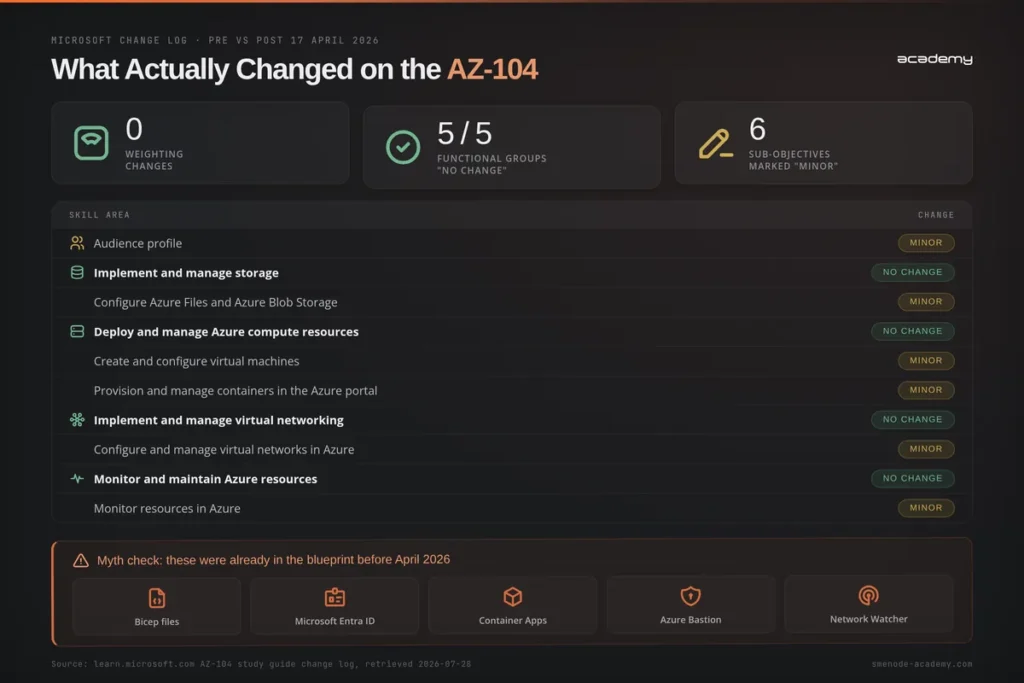
Not much. Here’s Microsoft’s own change log, reproduced exactly.
| Skill area prior to 17 April 2026 | Skill area as of 17 April 2026 | Change |
|---|---|---|
| Audience profile | Audience profile | Minor |
| Implement and manage storage | Implement and manage storage | No change |
| Configure Azure Files and Azure Blob Storage | Configure Azure Files and Azure Blob Storage | Minor |
| Deploy and manage Azure compute resources | Deploy and manage Azure compute resources | No change |
| Create and configure virtual machines | Create and configure virtual machines | Minor |
| Provision and manage containers in the Azure portal | Provision and manage containers in the Azure portal | Minor |
| Implement and manage virtual networking | Implement and manage virtual networking | No change |
| Configure and manage virtual networks in Azure | Configure and manage virtual networks in Azure | Minor |
| Monitor and maintain Azure resources | Monitor and maintain Azure resources | No change |
| Monitor resources in Azure | Monitor resources in Azure | Minor |
Read the bold rows. Every functional group says “No change.” Six sub-objectives got minor edits. The identity and governance group isn’t in the log at all, meaning Microsoft flagged nothing there.
And the weightings held. Same five domains, same percentage bands as before.
Now the myth. A lot of pages will tell you Bicep, Microsoft Entra ID, Azure Container Apps, Azure Bastion and Network Watcher are “new for 2026.” They aren’t. All five were already in the blueprint before April. If a page tells you otherwise, close it.
So can you still use a 2024 or 2025 study guide? Mostly, yes. Spot-check four areas against the current objective list: blob lifecycle management and versioning, VM encryption at host, Azure Container Apps scaling, and Network Watcher plus Connection monitor. Those sit inside the sub-objectives that took edits.
Don’t bin your notes. Just diff them.
AZ-104 exam cost in 2026
The AZ-104 cost is $165 USD in the United States. Microsoft prices regionally, so the number changes depending on where you’re proctored. Microsoft’s certification page says only “price based on the country or region in which the exam is proctored,” so check your local Pearson VUE listing before you budget.
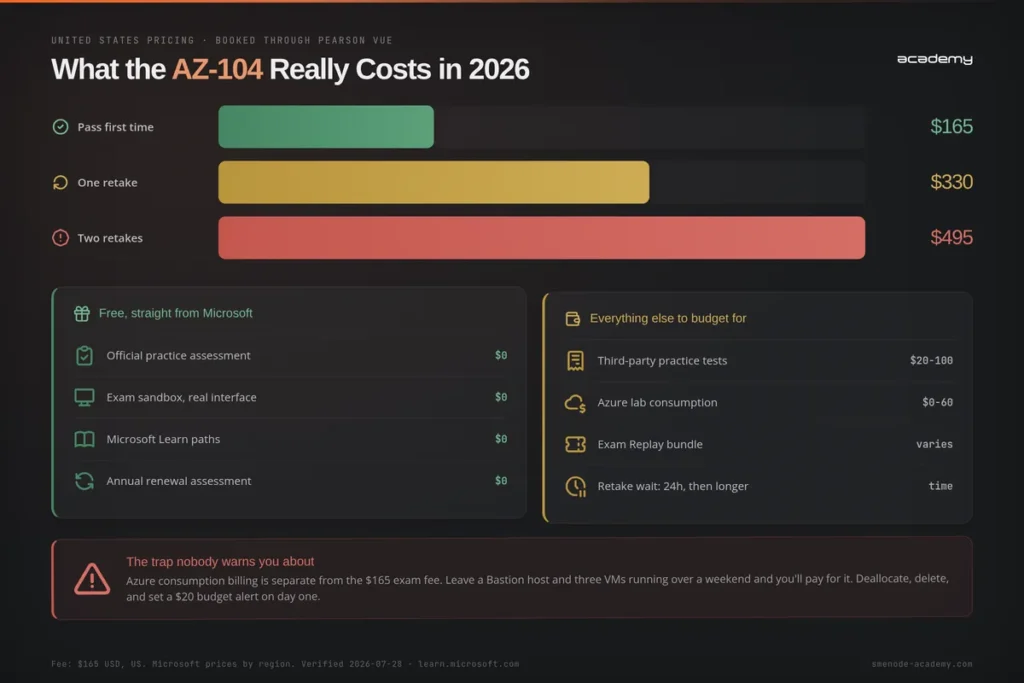
Here’s the real total, not the sticker price.
| Scenario | Cost |
|---|---|
| Pass on the first attempt | $165 |
| One retake | $330 |
| Two retakes | $495 |
| Microsoft practice assessment | Free |
| Exam sandbox | Free |
| Microsoft Learn paths | Free |
| Third-party practice tests | $20 to $100 |
| Azure lab spend during study | $0 to $60 if you’re careless |
Fail once and your cost doubles. That’s the whole argument for not booking early.
Two ways to pay less. Microsoft runs an Exam Replay offer that bundles a retake at a discount, and Microsoft periodically issues free exam vouchers through Cloud Skills Challenge events. Voucher availability isn’t guaranteed and the events come and go, so don’t build your plan around one.
One more thing on retakes. You can rebook 24 hours after a first fail. Later retakes carry longer waits, so a second failure can push you back weeks.
The five AZ-104 domains and how much each one counts
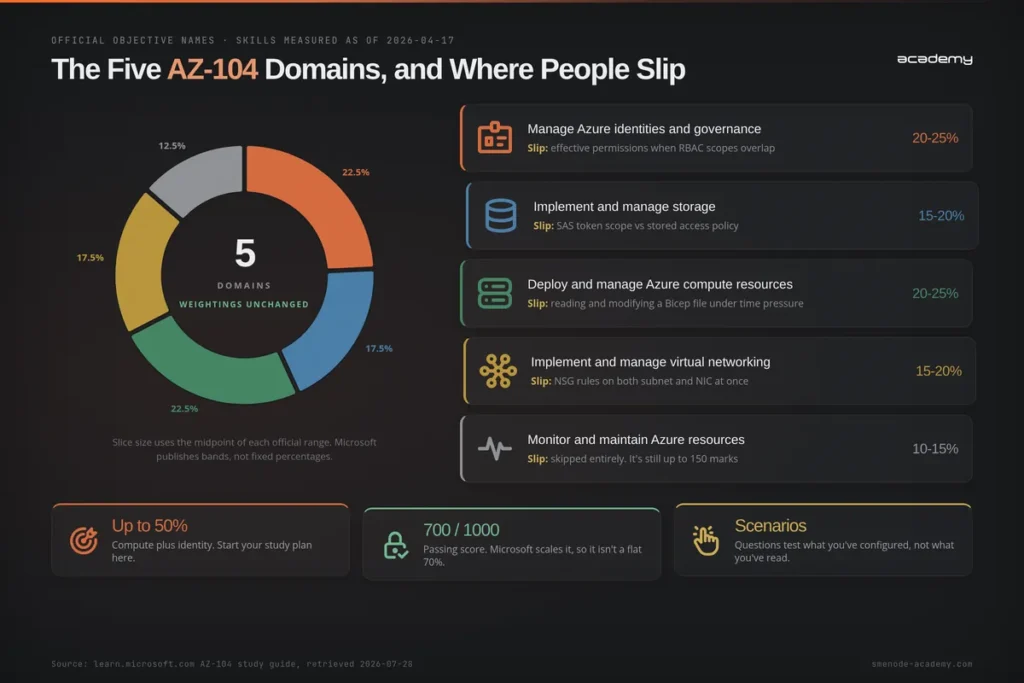
These are Microsoft’s official objective names, quoted exactly.
| Domain | Weighting |
|---|---|
| Manage Azure identities and governance | 20 to 25% |
| Implement and manage storage | 15 to 20% |
| Deploy and manage Azure compute resources | 20 to 25% |
| Implement and manage virtual networking | 15 to 20% |
| Monitor and maintain Azure resources | 10 to 15% |
Manage Azure identities and governance (20 to 25%). Microsoft Entra users and groups, RBAC role assignments at different scopes, Azure Policy, resource locks, tags, management groups and cost alerts. Trouble spot: reading an access assignment and working out the effective permission when role scopes overlap. People memorise the built-in roles and still get this wrong.
Implement and manage storage (15 to 20%). Storage firewalls, SAS tokens, stored access policies, redundancy options, object replication, encryption, Azure Files, Blob Storage, tiers, soft delete, lifecycle management and versioning. Trouble spot: SAS token scope versus stored access policy. Know which one you can revoke without rotating keys.
Deploy and manage Azure compute resources (20 to 25%). ARM templates and Bicep, VM creation and sizing, disks, availability zones and sets, Virtual Machine Scale Sets, Container Registry, Container Instances, Container Apps and App Service. Trouble spot: reading a Bicep file under time pressure. You don’t have to write one from scratch. You do have to interpret and modify one.
Implement and manage virtual networking (15 to 20%). VNets and subnets, peering, public IPs, user-defined routes, NSGs and application security groups, Azure Bastion, service endpoints, private endpoints, Azure DNS and load balancers. Trouble spot: evaluating effective security rules when an NSG sits on both the subnet and the NIC. That’s a classic scenario question.
Monitor and maintain Azure resources (10 to 15%). Azure Monitor metrics and logs, KQL queries, alert rules and action groups, Insights, Network Watcher, Recovery Services vaults, Backup policies and Site Recovery failover. Smallest domain, and the one people skip. Don’t. Ten to fifteen percent is 100 to 150 marks.
Full objective list: Microsoft’s AZ-104 study guide.
How hard is the AZ-104?
Moderate. Harder than AZ-900, well short of AZ-305.
The difficulty isn’t the volume of content. It’s that the questions are scenario-based, so knowing what a feature does won’t save you if you’ve never configured it. You get a situation, four plausible answers, and the right one depends on a detail you only notice if you’ve clicked through the portal yourself.
Passing score is 700 out of 1000. That’s not 70% of questions correct, since Microsoft scales the score, but it’s a useful mental target.
How long? Training providers and community posts converge on 4 to 12 weeks part-time, at roughly 6 to 10 hours a week. Experienced sysadmins who already work in Azure daily report the low end, 4 to 6 weeks.
Coming from on-prem only? Plan for the top of that range.
There’s a well-worn community rule of thumb that AZ-104 prep runs 10 to 20 times the effort of AZ-900. That’s community consensus, not a Microsoft figure, but it matches what we see.
Honest read: most first-time failures aren’t knowledge failures. They’re lab-hours failures.
Should you take AZ-900 or AZ-104 first?
They’re not alternatives. AZ-900 is a fundamentals cert covering cloud concepts and Azure pricing at a high level. AZ-104 is the role-based cert employers filter CVs on.
There’s no prerequisite. You can sit AZ-104 without ever touching AZ-900.
Skip AZ-900 if you already work in infrastructure, understand virtualisation and networking, and can explain what a subscription and a resource group are. Take it first if you’re career-changing into IT, or if your employer pays per cert and you want an early win. For a sysadmin with two years under their belt, AZ-900 is mostly a $99 confidence exercise.
For the full ladder, see our Azure certifications guide 2026.
An AZ-104 study plan that fits around a full-time job
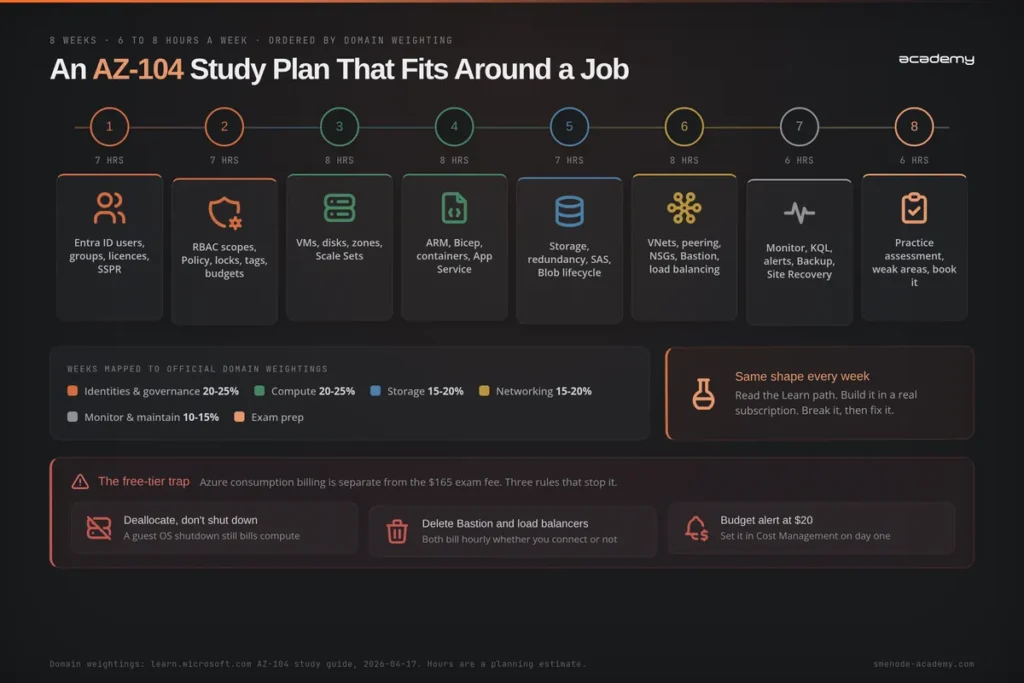
Eight weeks, six to eight hours a week, ordered by domain weighting so the heaviest material gets the freshest attention.
| Week | Focus | Hours |
|---|---|---|
| 1 | Entra ID users, groups, licences, external users, SSPR | 7 |
| 2 | RBAC scopes, Azure Policy, locks, tags, management groups, cost alerts | 7 |
| 3 | VMs, disks, sizing, availability zones and sets, Scale Sets | 8 |
| 4 | ARM templates and Bicep, containers, App Service | 8 |
| 5 | Storage accounts, redundancy, SAS, Azure Files, Blob lifecycle | 7 |
| 6 | VNets, peering, NSGs, UDRs, Bastion, private endpoints, load balancing | 8 |
| 7 | Azure Monitor, KQL, alerts, Backup, Site Recovery | 6 |
| 8 | Practice assessment, weak-area labs, exam sandbox, book the exam | 6 |
Every week follows the same shape. Read the Microsoft Learn path, then build the thing in a real subscription, then break it and fix it. Reading alone won’t get you past scenario questions.
The five labs that decide your result
If you only have time to build five things properly, build these. Each one maps to a trouble spot above, and each one is a scenario question you'll otherwise guess at.Numbered list:
- Two NSGs, one VM. Put one NSG on the subnet and one on the NIC with conflicting rules. Then use the effective security rules view to work out which wins. This is the single most common networking question format.
- A SAS token you can revoke. Issue an ad-hoc SAS, then issue one tied to a stored access policy. Revoke the second without rotating your account keys. Now you understand the difference permanently.
- A Bicep file you didn’t write. Export an existing resource group as an ARM template, convert it to Bicep, change two parameters, redeploy. You’re being tested on reading and modifying, not authoring.
- Overlapping RBAC scopes. Assign Reader at subscription and Contributor at resource group to the same user. Predict the effective permission, then verify it. Most people predict wrong the first time.
- An alert that actually fires. Build a metric alert with an action group and force it to trigger. The monitoring domain is small and skipped, which makes it cheap marks.
That's roughly 10 hours of lab work. It's the highest-return 10 hours in the whole plan.Watch the free-tier trap. This one catches people constantly. Azure’s free account gives you $200 in credit for 30 days plus a set of always-free services. Your study labs run on Azure consumption billing, which is completely separate from the $165 exam fee. Leave a Standard_D2s_v3 VM and a load balancer running over a long weekend and you’ll wake up to a real charge.
Dan, a network admin in Calgary, spun up a three-VM lab on a Friday to practise VNet peering. He deployed a Bastion host, which bills hourly whether you connect or not. Monday morning: $41 gone, and he hadn’t even opened the portal since Friday.
Cheap lesson. Others have made it more expensive.
Three rules that fix it. Deallocate VMs, don’t just shut down the guest OS. Delete Bastion hosts and public load balancers after each lab. Set a budget alert at $20 in Cost Management on day one.
Two ways to get hands-on without the guesswork. The SMEnode Labs Azure workbook gives you 110 guided labs across identity, compute, storage, networking and BCDR, with cost estimates and teardown scripts for every single one, so the free-tier trap can’t get you. Prefer live instruction? Our Azure Administrator course runs 16 weeks with two expert-led sessions a week, unlimited lab access and monthly one-on-one mentorship. The difference is simple: a workbook tells you what to build, a live instructor tells you why your build broke.
Practice tests and sample questions
Start free. Microsoft publishes an official practice assessment on the certification page, plus an exam sandbox that shows you the real interface and question types before exam day. Most people skip the sandbox and then lose time on exam day figuring out the UI.
Score 85% or better on the Microsoft practice assessment twice, on different days, before you book.
Now the dumps question. Sites selling “real AZ-104 questions” breach the Microsoft certification agreement you accept before the exam starts, and Microsoft has revoked certifications over it.
Set the ethics aside for a second: they also don’t work. Dumps teach you answers to memorised questions. The AZ-104 gives you scenarios, and a memorised answer key falls apart the moment the wording shifts.
Use them and you’ll pass a test you can’t do the job for. Hiring managers find out in week two.
The 12-month renewal trap
This is the part almost nobody warns you about.
Microsoft associate certifications expire after 12 months. Your AZ-104 is not permanent. Miss the window and it lapses, and the only route back is paying $165 and sitting the full 100-minute proctored exam again.
The good news: renewal is genuinely easy. It’s free, unproctored, open book, taken online through Microsoft Learn, and you can retake it as many times as you need as long as you pass before the expiry date. The eligibility window opens six months before your certification expires.
Elena passed her AZ-104 in a busy quarter, filed the badge on LinkedIn and moved on. Microsoft’s reminder email landed in a folder she’d stopped checking. She found out she’d lapsed when a recruiter’s screening tool flagged her credential as expired, eleven days after the deadline. Full exam, full fee, plus the two weeks of revision she thought she was done with.
Do this the day you pass. Put a calendar reminder at month 10, not month 11. The renewal assessment is short and open book, so an hour of prep usually covers it. Details on the Microsoft certification renewal page.
What an AZ-104 pays in 2026
All figures below are third-party estimates from salary aggregators, not Microsoft data. Ranges vary a lot by aggregator because job titles aren’t standardised.
| Market | Figure | Source |
|---|---|---|
| US, “Azure 104” roles | $121K average, $110K to $136.5K middle band, $153.5K at the 90th percentile | ZipRecruiter, 27 July 2026 |
| US, Azure Administrator (all, certified or not) | $88.9K average | ZipRecruiter, June 2026 |
| Ontario | $119K average, $95K to $145.5K middle band | ZipRecruiter Ontario, February 2026 |
| Toronto base range | $99.1K to $134.5K | Glassdoor Canada |
Look at the first two rows together. Roles that name AZ-104 explicitly average roughly $32K more than the general Azure Administrator pool. That’s not proof the cert causes the gap, since those postings skew senior, but it’s the clearest signal in the public data. Third-party prep sites commonly quote a 15% to 25% certified premium; treat that as a vendor estimate.
Canadian numbers hold up well against the US once you account for the exchange rate, especially in Toronto and Vancouver. For where this leads, see our Azure Solutions Architect salary 2026 breakdown.
What to certify after AZ-104
Three sensible moves.
Up: AZ-305, Azure Solutions Architect Expert. The natural next step, and the biggest pay jump. It shifts you from running infrastructure to designing it. Our Azure Solutions Architect course picks up where AZ-104 stops.
Sideways into security: AZ-500, Azure Security Engineer. Strong choice if your organisation is dealing with compliance work.
Sideways into automation: AZ-400, DevOps Engineer Expert. Requires AZ-104 or AZ-204 as a prerequisite, so your AZ-104 already qualifies you.
Weighing Azure against the other clouds first? Read our AWS vs Azure vs Google Cloud certifications 2026 comparison before you commit 8 weeks.
AZ-104 FAQ
Is the AZ-104 difficult to pass?
Moderate difficulty. The passing score is 700 out of 1000, and the questions are scenario-based rather than recall-based. Hands-on lab time matters more than reading time. Most candidates need 4 to 12 weeks of part-time study.
How long does it take to get the AZ-104 certification?
Four to twelve weeks part-time for someone with a sysadmin background, at 6 to 10 hours a week. If you already administer Azure daily, 4 to 6 weeks is realistic. Community consensus puts AZ-104 prep at 10 to 20 times the effort of AZ-900.
How long is the AZ-104 certification valid?
Twelve months. You renew free through an open-book, unproctored online assessment on Microsoft Learn. The renewal window opens six months before your expiry date, and unlimited attempts are allowed inside it. Let it lapse and you pay $165 for the full exam again.
Is the AZ-104 open book?
No. The AZ-104 exam is proctored, either online or at a test centre, and you can’t use notes or documentation. The annual renewal assessment is open book, which is where most of the confusion comes from.
Can you take the AZ-104 online?
Yes. Book through Pearson VUE and choose online proctored delivery from home or the office, or sit it at a physical test centre. Both count identically.
Is the AZ-104 still worth it in 2026?
Yes, for infrastructure and operations roles. US postings that name AZ-104 average around $121K per ZipRecruiter, against $88.9K for the general Azure Administrator pool. It’s the Azure credential employers screen for most on ops roles, and the April 2026 update was minor, so the material you learn has a long shelf life.
Bottom line
Five things to take away.
- The 17 April 2026 update was minor. Weightings didn’t move, no group was restructured, and Bicep, Entra ID, Container Apps, Bastion and Network Watcher were already in scope.
- Budget $165, and budget for a retake you hopefully won’t need. Watch Azure consumption charges while you study; they’re separate from the exam fee.
- Compute and identity carry 20 to 25% each. Start there.
- Lab hours beat reading hours. Scenario questions punish theory-only prep.
- Calendar your renewal at month 10. Free if you’re on time, $165 if you’re not.
Get the plan right and the AZ-104 is an eight-week project with a measurable payoff. Get it wrong and it’s a $330 lesson in reading the change log.
Ready to stop piecing it together? Join the next Azure Administrator cohort. Sixteen weeks, two live sessions a week with working Azure architects, unlimited lab access, monthly one-on-one mentorship and a 30-day money-back guarantee. Bring your questions to a human instead of a search bar.