
Quick answer: An Azure Solutions Architect earns about $146,601 a year in the US as of mid-2026, with most pay landing between $127K and $165,500 and top earners near $190K (ZipRecruiter). In Canada, the national average sits around CA$122,500, rising to CA$147,000+ in Toronto and CA$154,000 across Ontario. The AZ-305 certification is the single biggest pay lever on the whole Azure path.
If you’re weighing whether to chase the Azure Solutions Architect title, the money answers most of the question. This role pays well, demand keeps climbing, and one certification moves the needle more than any other. Here’s the full picture for 2026, by experience, by location, and by the skills that actually raise your number.
Azure Solutions Architect Salary Overview (2026 Numbers)
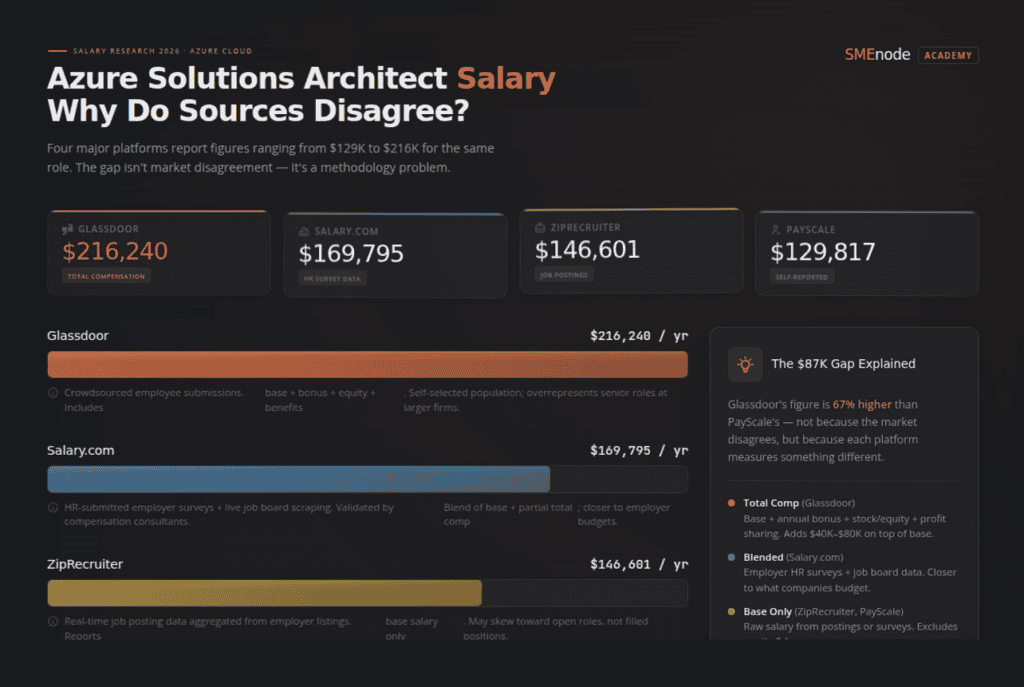
The azure solutions architect salary in 2026 varies quite a bit depending on which source you check. Here’s a side-by-side look at the major salary platforms:
| Source | Average Salary | Range |
|---|---|---|
| ZipRecruiter | $146,601/yr | $127K – $190K |
| Glassdoor | $216,240/yr | $172K – $292K |
| PayScale | $129,817/yr | $94K – $175K |
| Salary.com | $169,795/yr | $143K – $199K |
Why the huge gap between sources?
oor includes total compensation (base + bonus + equity + benefits), while ZipRecruiter and PayScale tend to report base salary only. That’s a distinction most salary guides skip right over.
The middle 50% of Azure architects earn between $127K and $165K in base pay. Factor in bonuses, stock options, and benefits, and you’re looking at total compensation somewhere between $160K and $250K for mid-to-senior roles.
Pretty solid numbers. But they get even more interesting when you break them down by experience.
Want to earn a number like these?
Our live, instructor-led Azure Solutions Architect course preps you for the AZ-305 with real design labs and working architects, so you pass once and step into the pay band above. Book a free demo class today.
Azure Solutions Architect Salary by Experience Level

This is where the real story is. Cloud architecture is one of the few IT fields where the jump from mid-level to senior is often $50K or more.
Entry-Level (0-2 Years)
| Metric | Value |
|---|---|
| Salary Range | $90K – $120K |
| Typical Title | Junior Cloud Architect, Cloud Engineer |
| Common Certs | AZ-900, AZ-104 |
If you’re just getting started, don’t expect architect-level pay on day one. Most entry-level roles are really cloud engineer or administrator positions where you’re building Azure experience. The AZ-900 (Azure Fundamentals) opens the door, and the AZ-104 (Azure Administrator) is where employers start taking you seriously.
Honestly? $90K to $120K for a junior cloud role is strong money. But the real payoff comes when you level up.
If you’re at this stage, SMEnode Academy’s Azure Administrator course covers everything you need for the AZ-104 exam, with hands-on labs on real Azure environments. Not simulators.
Mid-Level (3-7 Years)
| Metric | Value |
|---|---|
| Salary Range | $135K – $165K |
| Typical Title | Cloud Solutions Architect, Azure Architect |
| Common Certs | AZ-305, AZ-500 |
This is where things get interesting. Mid-level architects with the AZ-305 certification see the biggest salary jump relative to their experience. You’re designing cloud solutions, leading migration projects, and making architecture decisions that affect the whole organization.
The thing is, this is also the most competitive band. Everyone’s trying to break into the $150K+ range. What separates the $135K architects from the $165K ones? Usually it’s a combination of the AZ-305 cert plus hands-on experience with specific services like Azure Kubernetes Service, Azure DevOps, or security tools.
Senior/Expert (8+ Years)
| Metric | Value |
|---|---|
| Salary Range | $175K – $215K+ |
| Typical Title | Senior Solutions Architect, Principal Architect |
| Common Certs | AZ-305, multiple speciality certs |
| Total Comp | Up to $300K+ at top companies |
Senior architects at companies like Microsoft, Quisitive, and major consulting firms earn base salaries north of $200K. Microsoft reportedly pays Azure architects an average of $279K in total compensation. At this level, your salary negotiation is less about certifications and more about the business outcomes you’ve delivered.
But certifications still matter. They get your resume past the filters.
Azure Solutions Architect Salary by Location
Where you live (or where your employer is based) makes a $60K+ difference. Sound dramatic? It’s not.
Highest-Paying US States
Location still matters. Even with remote work normalised, where you’re based (or where your employer is based) affects your range significantly.
| State | Average Salary | vs. National Avg |
|---|---|---|
| California | $182,000 | +24% |
| Massachusetts | $175,000 | +19% |
| Washington | $166,000 | +13% |
| New York | $165,000 | +12% |
| Maryland | $168,000 | +14% |
| Connecticut | $163,000 | +11% |
| Colorado | $161,500 | +10% |
California leads the pack at around $182K, followed by Massachusetts and Washington. No surprise there, those states have the highest concentration of tech companies and cloud adoption.
Major Tech Hubs
- Seattle: Around $208K median (Azure’s home turf, basically)
- San Francisco: Around $148K – $185K
- New York City: Around $138K – $175K
- Austin: Around $130K – $160K
- Denver: Around $128K – $155K
Seattle pulls ahead of San Francisco here. Why? Microsoft’s headquarters plus Amazon’s heavy Azure competitor (AWS) presence create intense competition for cloud talent. That drives salaries up.
Canada: Azure Solutions Architect Salaries
Canada rarely shows up in these salary breakdowns. That’s a gap worth filling, especially since Canadian enterprise and government adoption of Azure is accelerating fast.
The short answer: Canadian Azure architects earn competitively with US counterparts once you account for exchange rate and cost of living.
| Location | Average Annual Salary | Source |
|---|---|---|
| Toronto (average) | CA$134,144 | Glassdoor, 2026 |
| Toronto (90th percentile) | CA$220,551 | Glassdoor, 2026 |
| Ontario (average) | CA$154,459 | ZipRecruiter, April 2026 |
| Ontario (90th percentile) | CA$206,500 | ZipRecruiter, April 2026 |
| Canada national average | CA$122,519 | Glassdoor, 2026 |
Across Canada, most salaries fall between CA$100,034 (25th percentile) and CA$152,583 (75th percentile), with top earners reaching CA$189,732 (ZipRecruiter, Glassdoor Canada). Toronto pays roughly 20% above the national average, so location matters inside Canada just as much as it does in the States. British Columbia and Alberta trail Ontario slightly, with Vancouver and Calgary roles typically landing CA$5K to CA$15K below Toronto.
If you’re building a cloud career in Canada, the demand story is real. Cloud and certification-backed IT roles keep growing here, which we cover in our guide to IT certification jobs in Canada for 2026.
Remote Work Impact
Here’s something most salary guides don’t cover. Remote Azure architect roles typically pay 5-15% less than equivalent on-site positions in major tech hubs. But they pay more than local rates in most mid-tier cities.
So if you’re in Dallas making $135K and land a remote role with a San Francisco company paying $160K? That’s a win. You get the higher salary without the Bay Area cost of living.
Some companies are location-agnostic (same pay regardless of where you live). Others adjust based on your zip code. Always ask during the interview process.
The AZ-305 Certification Effect on Salary
The AZ-305 is the single biggest salary lever in the Azure certification path. Period.
Going from AZ-104 to AZ-305 typically means a $30K–$50K salary increase within 12-18 months. Here’s the full certification ladder.
| Certification | Exam | Avg. Salary Range | Typical Roles |
|---|---|---|---|
| Azure Fundamentals | AZ-900 | $65K – $85K | Help Desk, Junior Admin |
| Azure Administrator | AZ-104 | $88K – $161K | Cloud Admin, Systems Engineer |
| Azure Solutions Architect Expert | AZ-305 | $127K – $190K+ | Solutions Architect, Cloud Architect |
| Azure Security Engineer | AZ-500 | $125K – $175K | Security Engineer, SecOps |
| Azure DevOps Engineer Expert | AZ-400 | $130K – $180K | DevOps Engineer, SRE |
See the jump from AZ-104 to AZ-305? That’s the money move.
The AZ-305 exam costs $165 USD and runs 40 to 60 questions over 120 minutes, with a passing score of 700 out of 1000 (Microsoft Learn). One important catch: you can sit AZ-305 on its own, but you can’t earn the “Azure Solutions Architect Expert” credential without also holding the AZ-104 Azure Administrator certification. Plan for both. The other half of this is the AZ-104 exam changes, cost and study plan.
Marcus was a sysadmin making $105K in Atlanta. He’d been studying Azure on his own for about a year when he decided to get serious about certifications. He passed the AZ-900 in March 2024 (no salary change, but it built his confidence). Then AZ-104 in August (got bumped to $118K). Then he spent four months in an Azure Solutions Architect training programme that included live labs and exam prep. He passed AZ-305 in February 2025 and accepted a new position two months later at $156K. Three certs over 14 months. A $51K salary increase. Worth it? You tell me. This sits inside the full Azure certification path, if you want the full route.
Ready to start your certification journey? If you already have AZ-104, the next logical step is AZ-305 training with live instruction. If you’re earlier in your path, start with the Azure Administrator (AZ-104) course to build your foundation first.
Azure Architect vs. Other Cloud Architect Salaries
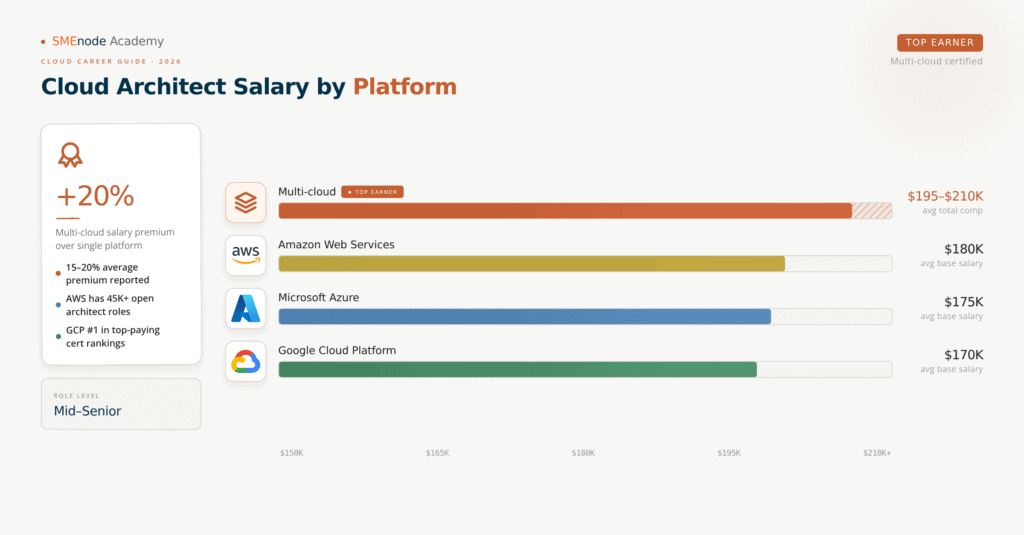
How does the azure cloud architect salary stack up against AWS and GCP? Here’s the comparison:
| Platform | Avg. Architect Salary | Top-End Range |
|---|---|---|
| AWS Solutions Architect | $180,000 | $220K+ |
| Azure Solutions Architect | $175,000 | $215K+ |
| GCP Cloud Architect | $170,000 | $210K+ |
| Multi-Cloud Architect | $195,000 – $210,000 | $250K+ |
AWS pays a small premium, roughly $5K, because it still holds the largest market share. But the gap is narrow, and Azure’s growth is faster. In Q1 2026, AWS held about 28% of the global cloud market, Azure 21%, and Google Cloud 14%, together making up 63% of a market that hit $129 billion in a single quarter (Synergy Research Group). Azure’s 40% year-over-year growth outpaced AWS, driven heavily by AI workloads.
The real winner? Multi-cloud architects. If you can design across Azure and AWS, you command the top band. Curious how the certifications compare head to head? Read our breakdown of AWS vs Azure vs Google Cloud certifications, or see the AWS Solutions Architect salary guide for the direct comparison.
Skills That Boost Your Azure Architect Salary
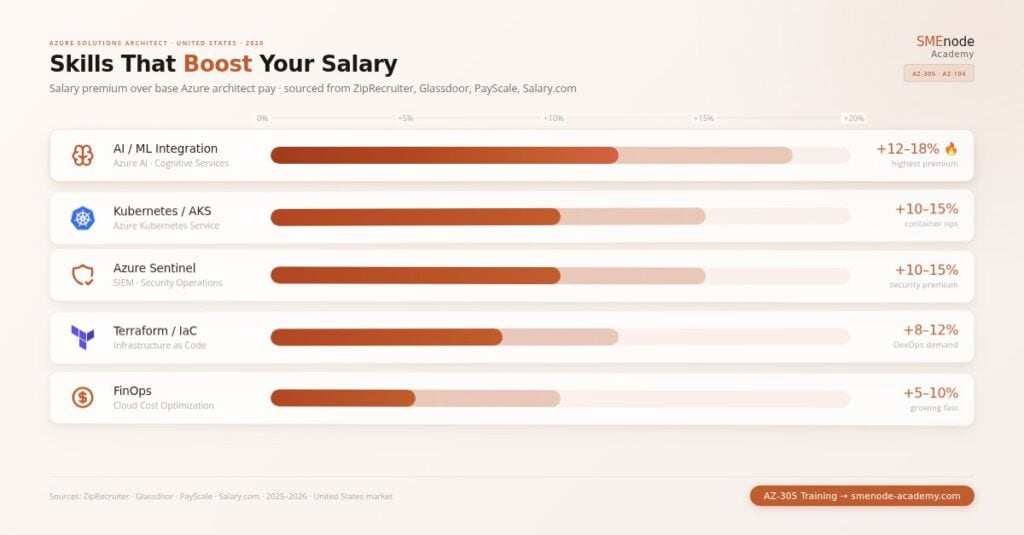
Certifications get you in the door. These skills determine where you land in the range.
AI and Machine Learning Integration: 12-18% premium
This is the hottest skill in Azure right now. Employers need architects who can design environments for Azure OpenAI Service, Azure AI Studio, and AI workloads running on AKS. AI-related job postings jumped 117% year over year (Robert Half, 2026). Architects who can bridge infrastructure design with AI deployment sit at the top of the salary range.
Not an AI expert? You don’t need to be. You need to understand how AI workloads behave in Azure, what GPU compute tiers cost, and how to design secure, scalable pipelines. That’s the architect’s role, not the data scientist’s.
Kubernetes and AKS: 10-15% premium
Container orchestration on Azure Kubernetes Service is expected at enterprise scale. If you can’t speak fluently to AKS cluster design, networking, and autoscaling, you’re leaving money on the table.
Terraform and Infrastructure as Code: 8-12% premium
Manual deployments are becoming rare at enterprise scale. Architects who work fluently in Bicep or Terraform get more offers and better rates. It’s that straightforward.
Azure Security (Sentinel, Defender for Cloud): 10-15% premium
Security architecture is now woven into every AZ-305 engagement. Architects who hold AZ-500 alongside AZ-305 earn noticeably more than those who don’t. And with the pace of cloud security incidents, this isn’t going away.
FinOps and Cost Governance: 5-10% premium
When cloud bills spiral out of control, architects are often the first people in the room. Those who can demonstrate real cost governance track records ask for more. And they get it. CFOs love architects who can defend a budget.
The pattern is clear. AI and security pay the most because the hiring gap is worst there. Robert Half’s 2025 survey of about 250 US technology leaders at director level or above found 87% of those with hiring plans couldn’t find skilled candidates, and named AI, data science, IT operations and cybersecurity as the widest gaps. If you want to add a security specialisation, our Security Engineer course maps well onto the architect track.
Azure Architect vs. Other Cloud Platform Salaries
People ask this constantly. Here’s the honest comparison.
| Platform | Average Salary |
|---|---|
| Multi-Cloud Architects | $195K–$210K |
| AWS Solution Architects | $180K |
| Azure Solutions Architects | $175K |
| GCP Architects | $170K |
AWS pays slightly more on average right now. Synergy Research Group put AWS at 28% of cloud infrastructure services in Q2 2026 against Microsoft’s 20%, so there are simply more AWS jobs. But the gap has narrowed: AWS was above 32% in 2021 and both Microsoft and Google have taken share since.
Azure is growing faster in the enterprise and government sectors, and that’s where the long-term stability is. If you’re in Canada, this matters a lot. Federal and provincial cloud mandates skew heavily toward Azure.
The real premium, though, is in multi-cloud expertise. Architects who are strong in Azure and can speak credibly to AWS networking and GCP data services sit in the top earning
How to Increase Your Azure Solutions Architect Salary
Get Certified (The AZ-305 Effect)
The odds are decent but smaller than most sites claim. In Pearson VUE’s 2025 Value of IT Certification Candidate Report, 32% of certified professionals got a pay rise, and 56% of that group saw it within three months. That works out to roughly 18% of everyone certified. For Azure architects specifically, the AZ-305 is the highest-impact certification you can get.
Quick ROI math: the AZ-305 exam costs $165. Even with a training programme factored in, your total investment is typically under $2,000. If the certification bumps your salary by even $15K (which is conservative based on the data), that’s a 7x to 90x return in the first year alone.
Build In-Demand Skills
Don’t just collect certs. Build real skills alongside them. Spend time in Azure labs working with AKS, configuring Terraform pipelines, and setting up Azure Sentinel. Employers can tell the difference between someone who passed an exam and someone who can actually architect a production environment.
Negotiate With Data
When Danielle was interviewing for a senior Azure architect role in Denver last October, she walked into the negotiation with salary data from Glassdoor, ZipRecruiter, and PayScale, all bookmarked and ready. The initial offer was $155K. She showed the interviewer that the 75th percentile for Azure architects in Colorado was $170K+ and that her AZ-305 plus Kubernetes experience put her in that tier. She countered at $172K. They settled at $168K. That 15-minute conversation was worth $13K a year.
Here’s the deal. Most people don’t negotiate cloud architect offers because the initial number already seems high. But the data says you should. Always.
Job Outlook and Future Trends
The outlook for Azure architects is strong. Here’s why:
- Cloud market growth: The cloud computing market is projected to hit $13.5 billion by the end of 2026. That means more infrastructure, more migration projects, and more demand for architects
- Salary growth: Industry analysts project 4-6% annual salary increases for experienced Azure architects, outpacing most other IT roles
- AI-driven demand: 94% of organizations rely on cloud for critical tasks, and AI integration is creating entirely new categories of architecture work
- Hiring gap: in Robert Half’s 2025 survey of about 250 US technology leaders, 87% of those with hiring plans said they can’t find skilled candidates. That’s good news if you’re on the supply side of the equation
The one shift to watch: employers increasingly want architects who understand AI workloads and cost governance, not just classic infrastructure design. Skill up there and you stay ahead of the pay curve.
Frequently Asked Questions
Is the Azure Solutions Architect certification worth it?
Yes. The AZ-305 is the highest-paying Azure certification, with average salaries between $127K and $190K+. The exam costs $165, and even factoring in training costs, most professionals see a positive ROI within the first few months through salary increases or new job offers.
How long does it take to become an Azure Solutions Architect?
Most people need 2-4 years of Azure experience before they’re ready for a Solutions Architect role. The certification path typically goes AZ-900 (1-2 months) → AZ-104 (2-3 months) → AZ-305 (3-4 months). With structured training, you can compress the certification timeline significantly.
What’s the starting salary for an Azure Solutions Architect?
Entry-level cloud roles that lead to architect positions start around $90K to $120K. Junior professionals with the AZ-104 certification and 1-2 years of hands-on Azure experience typically land in this range.
Azure vs AWS: which architect earns more?
AWS architects earn slightly more on average ($180K vs $175K). But the gap is small and shrinking. Multi-cloud architects who know both platforms earn the most, averaging $195K to $210K.
Can I get an Azure architect job without experience?
Not directly. Solutions Architect roles require hands-on cloud experience. But you can build toward it quickly. Start with an Azure Administrator role (AZ-104 certified), get 2-3 years of production experience, then pursue the AZ-305. It’s a realistic path from zero to architect in 3-4 years.
What’s Your Next Move?
The math on this career is hard to argue with. Azure Solutions Architects earn $127K to $215K+, demand keeps climbing on the back of AI, and one certification, the AZ-305, moves your salary more than anything else you can do.
Here’s the takeaway in five lines:
- US average sits near $146,601, with senior architects clearing $175K to $215K+.
- Canada averages CA$122,500 nationally, rising past CA$147K in Toronto.
- AZ-305 is the single biggest pay lever, and it needs AZ-104 alongside it.
- AI, security, and Kubernetes skills add the biggest premiums.
- Negotiating with percentile data is worth $10K to $15K on its own.
If you’re ready to earn the credential that drives all of this, our live, instructor-led Azure Solutions Architect course preps you for AZ-305 with real design labs, not just slides. New to Azure? Start with the Azure Administrator (AZ-104) course, the required prerequisite. And for self-paced hands-on practice, the SMEnode Labs Azure workbook gives you lab kits you can run on your own schedule.
Your salary follows your skills. Build the ones that pay.