
Eighteen months. That’s the honest timeline from zero to a network engineer title, studying around a full-time job.
Not six months. Not “90 days to six figures.” Eighteen, give or take.
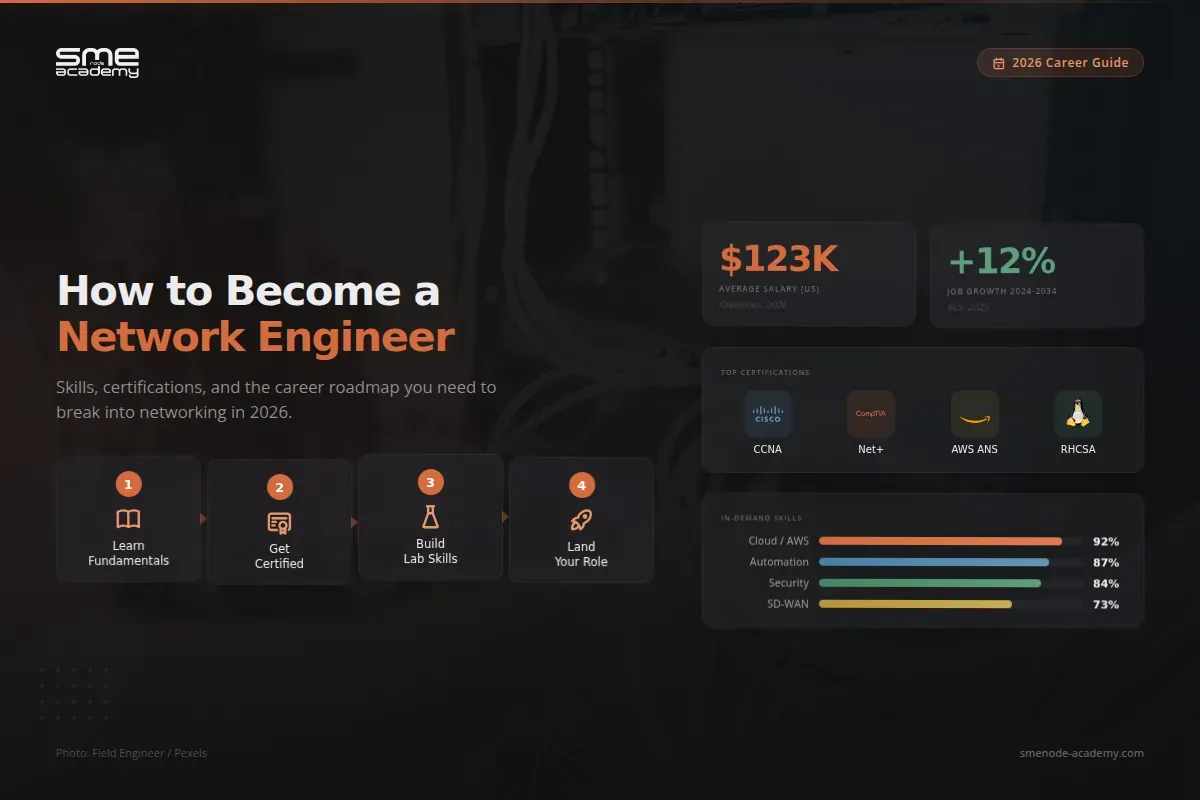
Here’s the whole roadmap before you scroll:
| Phase | Months | What you do | Cost |
|---|---|---|---|
| 1. Fundamentals | 1-3 | OSI, TCP/IP, subnetting, build a lab | $0 |
| 2. First cert | 3-7 | Network+ or CCNA, pass one | $300-$399 |
| 3. First job | 6-12 | Help desk or NOC, apply while studying | $0 |
| 4. Specialise | 13-18+ | Cloud, security or automation + CCNP | $300-$900 |
That’s it. That’s the roadmap. Everything below is the detail that decides whether you actually finish it.
One thing to get straight first, because it changes which job you’re aiming at.
The US Bureau of Labor Statistics tracks two roles people call “network engineer,” and they’re moving in opposite directions. Computer network architects: median pay $130,390, projected to grow 12% from 2024 to 2034, about 11,200 openings a year. Network and computer systems administrators: projected to decline 4% over the same decade.
Same field. Opposite trajectories.
So the roadmap below isn’t neutral. It points at the architect side, which means design and automation skills, not ticket-closing.
Phase 1: Fundamentals (months 1-3)
No certification yet. No course purchase yet. Three months of fundamentals, and the only thing you spend is time.
Learn these, in this order:
- The OSI and TCP/IP models – not memorising seven layers, but knowing which layer a problem lives at
- IPv4 addressing and subnetting – by hand, on paper, until it’s boring
- Switching basics, VLANs, trunking, and per-VLAN spanning tree
- Routing basics – static routes first, then OSPF
- The protocols that break – DNS, DHCP, ARP, ICMP
Subnetting is where most people quit. Push through it. Everything after gets easier.
Build the lab in week one
Don’t wait until you “know enough” to start labbing. You don’t learn networking by reading about it, the same way you don’t learn to swim by watching videos.
Free options that run on a normal laptop:
- Cisco Packet Tracer – easiest start, Cisco-only, free with a Netacad account
- GNS3 – real device images, steeper setup
- EVE-NG – multi-vendor, closest to production
Start with Packet Tracer. Move to EVE-NG when Packet Tracer starts feeling fake.
Milestone for phase 1: you can build a three-router topology with two VLANs and working inter-VLAN routing, from a blank canvas, without a tutorial open.
Can’t do that yet? Stay in phase 1. The certification will wait.
Phase 2: Your first certification (months 3-7)
One cert. Not three. Pick one and pass it.
| CompTIA Network+ | Cisco CCNA | |
|---|---|---|
| Cost | $399 USD | $300 USD |
| Vendor | Neutral | Cisco |
| Difficulty | Easier | Harder |
| Best if | You want DoD 8140 roles or zero background | You want enterprise networking jobs |
| Recognition | Broad, entry-level | The one hiring managers name |
Prices checked 16 August 2026. CompTIA raised prices across its lineup on 1 June 2026, which is why Network+ now costs more than CCNA. That surprises people. It surprised us.
Here’s the uncomfortable part. Network+ costs $99 more and carries less weight with enterprise hiring managers. If you have any technical background at all, go straight to CCNA and skip Network+ entirely.
Network+ still makes sense in two cases: you’re targeting US government work where DoD 8140 approval matters, or you’re starting from genuinely zero and need the easier win to stay motivated. Both are real reasons. Neither applies to most people.
Budget realistically. The exam fee isn’t the total. Most people spend $600 to $3,000 all-in once you count study material, lab time and retakes.
And retakes happen. Fail the CCNA and you pay the full $300 again. No discount.
Our Network+ training runs live twice a week, so you can test the format before committing to a longer track. If you already know you’re going Cisco, the CCNA course is the direct route. Either way, pair it with a workbook from SMEnode Labs for the lab reps, because passing the exam and configuring a real network are two different skills.
Related: Network+ vs CCNA goes deeper on the choice, and the CCNA salary guide has the pay data by experience level.
Want the full roadmap in one place?
We put together a free PDF that covers every phase, certification, salary range and specialisation track, so you don’t have to piece it together yourself.
Phase 3: The first job (months 6-12)
Notice the overlap. Months 6 to 12 run alongside phase 2, on purpose.
Start applying before you’re certified. Most people wait until they have the badge, then start applying, then wait three more months for a response. That’s a wasted quarter.
Realistic first titles:
- Help desk / service desk technician
- NOC technician
- Desktop support with network exposure
- Junior network administrator
- Field technician
None of these say “network engineer.” That’s fine. That’s the point.
The move that shortens this phase: get network work inside whatever job you already have. Volunteer for the switch replacement. Ask to shadow the firewall change. Take the tickets nobody wants because they involve routing. Six months of that beats a year of pure help desk on a CV.
Do you need a degree? No. Roughly 62% of network engineers have a bachelor’s and 21% an associate degree, per Research.com’s career data, which also means a meaningful share have neither. Certifications plus demonstrable lab work substitute fine at entry level. A degree helps most later, at architect roles in large enterprises and government.
Honestly? The lab you built in phase 1 does more for your first interview than a diploma does.
Phase 4: Specialise (months 13-18 and beyond)
Generalist network engineers are the ones feeling squeezed. Specialists aren’t.
Pick one lane:
Cloud networking. VPCs, hybrid connectivity, transit gateways. This is where the architect growth is. Start with AWS Solutions Architect or Azure Solutions Architect.
Network security. Firewalls, VPNs, segmentation, zero trust. Highest demand, and the least likely to be automated away.
Network automation. Python, Ansible, APIs, infrastructure as code. The smallest talent pool, so you get the most bargaining power. CCNA Automation is the entry point.
Enterprise depth. CCNP, then eventually CCIE Enterprise or CCIE Security. CCIE holders average $166,524 a year, with top earners past $220K. First-attempt pass rate sits around 25-30%, so budget years, not months. BGP is the protocol that separates CCNP from CCNA, and it’s the one senior interviews dig into hardest, so learn BGP end to end before you book anything.
Which one? Pick the one your current employer already runs. You’ll get paid to practise.
Not sure which specialisation track fits you?
The roadmap PDF breaks down all four tracks, with the certifications and salary ranges for each.
Will AI replace network engineers?
No, but it’s already changing which network engineers get hired.
AI handles pattern work well: config generation, log triage, anomaly detection, first-pass troubleshooting. That’s most of what an L1 does. Those roles are thinning, which matches the BLS 4% decline projection for systems administrators.
What AI doesn’t do is design a network under real constraints, own a change window at 2am, or explain to a CFO why the resilient option costs more. That’s architect work, and BLS projects 12% growth for it.
The read: automation is eating the bottom of the ladder while widening the top. Which is exactly why phase 4 isn’t optional.
Network engineer salary in 2026
Numbers move by source and by title, so here’s the range rather than one figure:
| Source | Figure | What it measures |
|---|---|---|
| BLS | $130,390 | Computer network architects, median, 2024 |
| Glassdoor | $123,627 | Network engineer, US average |
| ZipRecruiter | $109,040 | Network engineer, US average, Aug 2026 |
| Market range | $87K-$130K | Most US network engineers |
| CCIE holders | $166,524 | Average, top earners $220K+ |
Mid-career pay converges near $110K. The jump to $130K+ tracks with the architect title, not with years served.
Sources: BLS Occupational Outlook Handbook for architect data, with Glassdoor and ZipRecruiter figures as of August 2026.
FAQ
How long does it take to become a network engineer?
About 18 months from zero, studying part-time around a job. Roughly 3 months on fundamentals, 4 months to a first certification, and 6 to 12 months getting into an entry-level role that touches networking. With prior IT experience, 12 months is realistic.
What is the network engineer roadmap in order?
Four phases: fundamentals and a home lab (months 1-3), one certification such as CCNA or Network+ (months 3-7), an entry-level help desk or NOC role (months 6-12), then a specialisation in cloud, security or automation alongside CCNP (months 13-18+).
Can you become a network engineer without a degree?
Yes. About 21% of network engineers hold only an associate degree and a meaningful share hold neither that nor a bachelor’s. Certifications and a documented home lab carry the entry-level interview. A degree matters more later, at architect level in large enterprises and government.
Should I get Network+ or CCNA first?
CCNA, unless you’re targeting US government roles requiring DoD 8140 approval or starting from zero technical background. As of June 2026 CCNA costs $300 and Network+ costs $399, so CCNA is both cheaper and more recognised by enterprise hiring managers.
Is network engineering still worth it in 2026?
For architect-track roles, yes. BLS projects 12% growth for computer network architects through 2034 with about 11,200 openings a year. Systems administrator roles are projected to decline 4%, so the answer depends entirely on which half of the field you aim at.
What does a network engineer roadmap PDF include?
The version linked above covers all four phases on one page, with month markers, current exam costs, the milestone test for each phase, and the specialisation options at the end.
Bottom line
- Eighteen months is the honest timeline. Anyone promising 90 days is selling something.
- Aim at the architect side. BLS has it growing 12% while sysadmin roles shrink 4%.
- One certification, not three. CCNA at $300 beats Network+ at $399 for most people.
- Apply before you’re certified. The overlap between phases 2 and 3 saves you a quarter.
- Specialise by month 18 or you end up in the part of the field AI is squeezing.
Want the accompanied version of this roadmap? Our Network Engineer programme runs the same four phases live, twice a week, with an instructor in your class group who answers when you’re stuck at phase 1 subnetting at 11pm. That’s the part a PDF can’t do.