What is SD-WAN? It’s a technology that separates your network’s control logic from its physical hardware, giving you centralized management over how traffic moves across your entire wide area network. That’s the short version.
Here’s the longer version. SD-WAN (Software-Defined Wide Area Network) takes the concept of software-defined networking and applies it to the connections between your branch offices, data centers, and cloud apps. Instead of relying on expensive MPLS circuits and manually configuring each router, SD-WAN lets you manage everything from a single dashboard. Pretty big shift from how we’ve been doing things for the last 20 years.
And the market agrees. Gartner estimates that by 2026, over 60% of enterprises will have deployed SD-WAN solutions – up from less than 15% in 2019. So if you’re asking what is SD-WAN, you’re asking the right question at the right time.
What Is SD-WAN? The Short Answer

Think of SD-WAN like GPS for your network traffic. Traditional WAN is like driving with a paper map – you pick one route and stick with it, no matter what. SD-WAN? It’s constantly checking traffic conditions and rerouting your data through the fastest, most reliable path available.
At its core, what is SD-WAN doing differently? Three things. First, it decouples the control plane from the data plane. Second, it gives you a centralized controller to manage all your WAN connections. Third, it supports multiple transport types – MPLS, broadband, LTE, 5G – and uses them all intelligently.
Simple as that.
SD-WAN solutions monitor application performance in real-time and make routing decisions based on policies you set. Need your video calls on the most stable link? Done. Want to push web browsing to cheaper broadband? Easy. This kind of wan optimization used to require expensive hardware and hours of manual configuration. Not anymore.
What Is SD-WAN Architecture and How Does It Work?
Understanding what is SD-WAN starts with understanding its sd-wan architecture. Don’t worry – it’s simpler than it sounds.
Think of it like air traffic control. The control tower (controller) decides where planes (data packets) go. The runways and taxiways (data plane) actually move the planes. Separate jobs, separate systems, way more efficient.
The Control Plane vs Data Plane
The sd-wan architecture breaks down into three main layers:
The Orchestration Plane sits at the top. This is your management dashboard – where you set policies, monitor performance, and configure the whole network. Most SD-WAN solutions offer a cloud-based portal for this. One screen, full visibility.
The Control Plane handles the brain work. It takes your policies and translates them into actual routing decisions. Which path should this Zoom call take? Should we failover to LTE? The control plane figures all that out automatically.
The Data Plane does the heavy lifting. These are your physical or virtual edge devices sitting in each branch office. They handle the actual packet forwarding, encryption, and WAN optimization. Cisco SD-WAN uses vEdge and cEdge routers for this layer.
Make sense so far?
What Is SD-WAN’s Role in Cloud Connectivity?

Here’s where things get interesting. Traditional WAN forces cloud traffic to backhaul through your data center before reaching the internet. That’s like driving from New York to Boston by going through Chicago first. Makes no sense.
What is SD-WAN’s answer? Direct cloud connectivity. SD-WAN solutions create optimized paths straight from branch offices to cloud platforms like AWS, Azure, and Microsoft 365. The result? Latency drops by 30-50% for cloud applications. We see this constantly in our Cisco SD-WAN Training labs – students are always surprised by the performance difference.
Plus, sd-wan deployment with cloud connectivity means your network security policies follow the traffic. No gaps, no workarounds.
SD-WAN vs Traditional WAN: Why Companies Are Switching
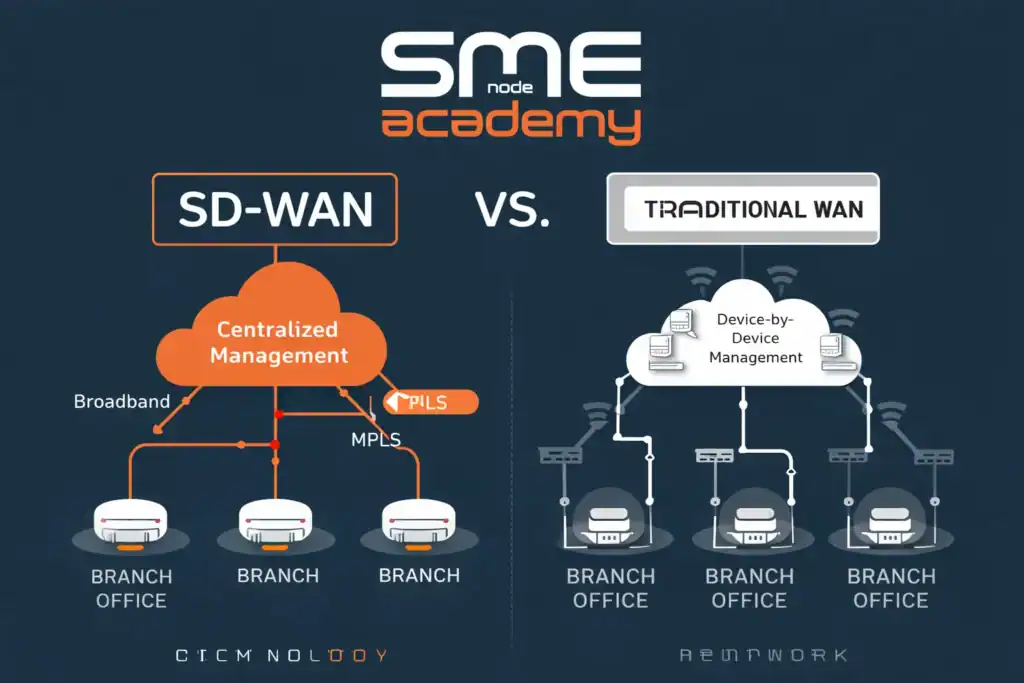
This is the comparison everyone wants to see. And honestly, once you understand the differences, the sd-wan vs traditional wan debate isn’t much of a debate at all.
| Feature | Traditional WAN | SD-WAN |
| Management | Device-by-device (CLI) | Centralized dashboard |
| Transport | MPLS only | MPLS + broadband + LTE + 5G |
| Cloud Access | Backhauled through DC | Direct cloud on-ramps |
| Failover | Manual or slow | Automatic, sub-second |
| Cost | High (MPLS circuits) | 40-60% lower |
| Deployment | Weeks to months | Hours to days |
| Visibility | Limited per-device | Full network-wide view |
| Security | Separate appliances | Built-in encryption + firewall |
The numbers tell the story. Organizations switching from traditional WAN to SD-WAN report 40-60% cost reduction on average. That’s not marketing fluff. When you replace dedicated MPLS links with a mix of broadband connections managed by SD-WAN, the savings are real.
But it’s not just about money. SD-WAN deployment takes hours instead of weeks. Need to spin up a new branch? Ship an edge device, plug it in, and it auto-configures from the central controller. Try doing that with traditional WAN. Yeah. Good luck.
Top SD-WAN Benefits That Actually Matter
You’ll find plenty of lists with 15+ sd-wan benefits online. Most of them repeat the same points. Here are the ones that actually move the needle for real networks:
1. Application-Aware Routing. SD-WAN doesn’t just route packets – it understands applications. It knows the difference between a Zoom call and a file download, and treats them accordingly. This is the single biggest sd-wan benefit for most organizations. We go deeper on how application-aware routing picks a path in its own guide.
2. Cost Reduction Without Sacrifice. Replace expensive MPLS with broadband where it makes sense. Keep MPLS for critical apps. SD-WAN manages both, so you’re not trading performance for savings.
3. Zero-Touch Provisioning. New branch office? Ship the device. The sd-wan deployment handles itself. We’re talking minutes of IT time instead of days.
4. Built-In Network Security. Modern SD-WAN solutions include next-gen firewall, IPS, and encrypted tunnels. Vendors like Cisco and Fortinet have integrated security directly into the sd-wan architecture. No more bolting on separate security appliances.
Worth it? Absolutely.
What Is SD-WAN Deployment Like in Practice?
So what is SD-WAN deployment actually like when you’re the one doing it? Less painful than you’d think.
A typical sd-wan deployment follows four phases. First, assessment – you map your current network, identify applications, and define policies. Second, design – you choose your sd-wan architecture (hub-and-spoke, full mesh, or hybrid). Third, pilot – deploy at 2-3 sites, test everything. Fourth, rollout – push to all locations using zero-touch provisioning.
Most enterprise deployments finish within 4-8 weeks. Compare that to 6-12 months for a traditional WAN overhaul. Big difference.
In our software defined networking training programs, students walk through this entire process in hands-on labs. You configure a full sd-wan deployment from scratch – controllers, edge devices, policies, the whole thing. It’s the best way to actually learn how SD-WAN works.
What Is SD-WAN Used For in Real Networks?
Theory is great. But what is SD-WAN actually doing out there in production? Let’s look at real use cases.
Common SD-WAN Use Cases by Industry
Retail: Thousands of stores, each needing POS connectivity, security cameras, and guest WiFi. SD-WAN manages all of it centrally. Walmart and Target have both deployed SD-WAN across their locations.
Healthcare: HIPAA compliance requires encrypted connections. SD-WAN solutions provide built-in encryption while giving doctors fast access to cloud-based medical records. The network security integration is huge here.
Financial Services: Banks need ultra-low latency for trading applications and rock-solid reliability. SD-WAN’s application-aware routing makes sure critical transactions always get priority. No exceptions.
Manufacturing: IoT devices on the factory floor need reliable connectivity. SD-WAN segments traffic so your IoT sensors don’t compete with email for bandwidth. Smart approach to wan optimization.
Sound familiar? Most organizations with 5+ locations can benefit from SD-WAN. That’s not an exaggeration.
SD-WAN and Network Security Integration
This is where a lot of beginners get confused. What is SD-WAN’s relationship with network security? Are they separate? Combined?
The answer has changed. Early sd-wan solutions focused purely on connectivity and wan optimization. Security was an afterthought. But modern SD-WAN platforms – especially from vendors like Cisco and Fortinet [nofollow] – integrate security directly into the sd-wan architecture.
This approach is called SASE (Secure Access Service Edge). It combines SD-WAN with cloud-delivered network security services: firewall-as-a-service, zero trust access, DNS security, and more. Gartner predicts[nofollow] that by 2026, at least 60% of enterprises will have explicit strategies for SASE adoption.
The takeaway? If you’re learning what is SD-WAN in 2026, you’re also learning modern network security. They’re inseparable now.
How to Start a Career in SD-WAN
Here’s something that might surprise you. SD-WAN engineers are in serious demand. And the pay reflects it.
| Role | Average Salary (USD) | Experience Level |
| SD-WAN Engineer | $110,000 – $145,000 | Mid-Level (3-5 years) |
| Network Architect (SD-WAN) | $140,000 – $180,000 | Senior (5-8 years) |
| CCIE Enterprise (SD-WAN focus) | $150,000 – $220,000 | Expert (8+ years) |
| DevOps/NetOps with SD-WAN | $130,000 – $170,000 | Mid-Senior |
The Bureau of Labor Statistics [nofollow] projects 6% growth for network administrators through 2032. But for SD-WAN specialists specifically? The demand is growing much faster. 87% of organizations report IT talent shortages, and SD-WAN skills are near the top of the list.
SD-WAN Certifications and Training Paths
Want to get into SD-WAN? Here’s the realistic path:
Step 1: Build your networking foundation. You need to understand routing, switching, and basic network security before touching SD-WAN. CCNA is the standard starting point.
Step 2: Learn SD-WAN specifically. Cisco SD-WAN (formerly Viptela) is the market leader. Our Cisco SD-WAN Training program covers everything from basic concepts to advanced sd-wan deployment and troubleshooting. Live classes, hands-on labs, expert instructors. Unlike pre-recorded courses, you can ask questions in real-time and get immediate feedback. We teach this hands-on in our Cisco SD-Access course.
Step 3: Get certified. The Cisco SD-WAN concentration exam (300-415 ENSDWI) is part of the CCNP Enterprise track. This validates your sd-wan architecture and deployment skills to employers.
Step 4: Practice, practice, practice. SD-WAN is hands-on technology. You can’t learn it from textbooks alone. That’s why every student in our program gets unlimited lab access – because real skills come from real practice.
The whole process? About 3-6 months if you’re dedicated. Faster with structured training and mentorship. Every student at SMEnode Academy gets free 1-on-1 mentorship throughout the program. Makes a real difference.
Who Are the Major SD-WAN Vendors?
Understanding what is SD-WAN also means knowing who the major vendors are. Here’s a quick overview of the biggest players:
| Vendor | Solution | Best For |
| Cisco | SD-WAN (Viptela/Meraki) | Enterprise, full-stack networking |
| Fortinet | Secure SD-WAN | Security-first organizations |
| VMware | SD-WAN (VeloCloud) | Cloud-heavy environments |
| Palo Alto Networks | Prisma SD-WAN | Zero trust integration |
| Aruba/HPE | EdgeConnect | Branch-heavy deployments |
Cisco holds the largest market share, which is why most employers look for Cisco SD-WAN Training specifically. But understanding the basics of what is SD-WAN applies across all vendors. The underlying sd-wan architecture principles are the same – only the implementation details differ.
Frequently Asked Questions About SD-WAN
What is SD-WAN in simple terms?
SD-WAN is a technology that uses software to manage wide area network connections. Instead of manually configuring each router, you control everything from a central dashboard. It supports multiple connection types (broadband, MPLS, LTE) and automatically routes traffic based on application needs and network conditions.
Is SD-WAN replacing MPLS?
Not entirely, but it’s changing how MPLS is used. Most sd-wan deployment strategies keep MPLS for critical applications while offloading less sensitive traffic to cheaper broadband links. The result is typically a 40-60% cost reduction. Some organizations do eliminate MPLS completely, but that depends on their specific requirements.
What is SD-WAN’s biggest advantage over traditional WAN?
Centralized management. Instead of logging into each router individually, you set policies once and they apply everywhere. Combined with application-aware routing and cloud connectivity, it’s a fundamental shift in how WANs operate. The sd-wan benefits compound – better performance, lower cost, simpler management, stronger network security.
Do I need coding skills to work with SD-WAN?
Basic scripting helps, but it’s not required to get started. Most sd-wan solutions use GUI-based management. However, knowing Python and REST APIs gives you a major advantage for automation. That’s part of the broader software-defined networking skill set. Our software defined networking training covers both the networking and automation aspects.
How long does it take to learn SD-WAN?
With a solid networking foundation (CCNA level), you can learn SD-WAN fundamentals in 4-6 weeks. Becoming job-ready with deployment and troubleshooting skills takes 3-6 months of structured training with hands-on labs. Self-study takes longer because you miss the real-time feedback that live instruction provides.
Is Learning What Is SD-WAN Worth Your Time in 2026?

Bottom line? Absolutely.
Understanding what is SD-WAN isn’t just about adding another technology to your resume. It’s about understanding where networking is headed. Every major enterprise is either deploying SD-WAN or planning to. The skills gap is real, and the salaries reflect it.
If you’ve read this far, you already understand the fundamentals of what is SD-WAN, how sd-wan architecture works, the key sd-wan benefits, and where the career opportunities are. That’s more than most people know. But knowledge without practice doesn’t get you hired.
Our Cisco SD-WAN Training program takes you from understanding what is SD-WAN to actually configuring and deploying it. Live classes with expert instructors, unlimited hands-on labs, and free mentorship throughout the program. Our courses run longer than competitors – because proper learning takes time.
Ready to get hands-on? Book a free demo class and see if it’s the right fit for you.