Yes, Terraform certification is still worth it in 2026. It’s one of the cheapest credentials in cloud and DevOps at $70.50 USD, and it proves something hiring teams actually test for: that you can build infrastructure as code instead of clicking through a console.
Three things changed since most guides on this topic were written. The 003 exam retired in January 2026 and was replaced by Terraform Associate 004, which tests Terraform 1.12. Terraform now belongs to IBM. And OpenTofu, the open-source fork, has grown into a real option that some teams pick instead.
None of that kills the certification. Two of those changes actually make it more useful. Here’s the honest breakdown.
Quick Answer: Is Terraform Certification Worth It in 2026?
Terraform certification is worth it in 2026 if you’re heading into cloud infrastructure, DevOps, platform engineering, site reliability, or automation. It helps most when your resume is heavy on theory and light on production experience.
It’s a good choice if you:
- Want a low-cost certification that validates a high-demand DevOps skill
- Work with AWS, Azure, GCP, VMware, Kubernetes, or hybrid cloud
- Need a structured Terraform certification study guide
- Want to move from system administration or networking into cloud engineering
- Already know basic cloud concepts and want to add IaC to your profile
- Are preparing for DevOps interviews where Terraform questions come up constantly
It’s not the right first move if you’ve never used the command line, Git, basic networking, or any cloud platform. Start with cloud fundamentals, then add Terraform once you can picture what the infrastructure is doing.
One caveat on the numbers you’ll see elsewhere. HashiCorp reports that 88% of exam takers agree passing an Associate-level exam makes candidates more desirable, and 92% felt more confident afterwards, per its own certification page. That’s a vendor survey of people who already chose to sit the exam, so treat it as directional, not proof.
For a wider view of where Terraform sits in hiring demand, read our guide to DevOps skills employers want in 2026.
What Changed for Terraform Certification in 2026
This is the section most articles skip, and it’s the part that decides whether a study plan you find online is still valid.
The 003 exam is gone
Terraform Associate 003 retired on 2026-01-07. Terraform Associate 004 launched the next day, 2026-01-08.
The difference matters more than a version bump suggests. The 003 exam tested Terraform 1.3. The 004 exam tests Terraform 1.12, according to HashiCorp’s Terraform Associate 004 study path. That’s nine minor releases of new behaviour, and it pulls in things the older exam never touched, including HCP Terraform projects and newer lifecycle and validation features.
| Associate 003 (retired) | Associate 004 (current) | |
|---|---|---|
| Status | Retired 2026-01-07 | Live since 2026-01-08 |
| Terraform version | 1.3 | 1.12 |
| Format | Multiple choice, online proctored | Multiple choice, online proctored |
| Duration | 1 hour | 1 hour |
| Validity | 2 years | 2 years |
Practical takeaway: any study course, practice test, or YouTube playlist built for 003 is out of date. Check the version number before you pay for anything. If you already hold 003, your credential stays valid for its full two years, and you recertify by passing the current exam at the same level or higher.
Terraform belongs to IBM now
IBM completed its acquisition of HashiCorp on 2025-02-27, per IBM’s newsroom announcement. HashiCorp’s business operations moved to IBM on 2025-09-01, and some legacy product names are being folded into IBM’s automation portfolio.
What this means for you as a candidate: nothing dramatic yet. The exam, the pricing, and the two-year validity all held through the transition. What did change is the corporate context around the tool, and that’s worth knowing because it’s a live topic in interviews. If someone asks why their company is evaluating alternatives, IBM ownership plus the licence change is the honest answer.
OpenTofu exists, and it doesn’t make the cert pointless
This is the question hiding behind “is Terraform still relevant in 2026.” So let’s answer it directly.
HashiCorp moved Terraform to the Business Source License in August 2023. The community forked the last open version and created OpenTofu, which stays on MPL-2.0 and is governed by a Linux Foundation committee. It joined the CNCF at sandbox level in 2025. You can track it at opentofu.org.
By mid-2026 OpenTofu sits at roughly 12% adoption among IaC practitioners, while Terraform still holds the largest share of the market. The fork has genuinely diverged: OpenTofu shipped state encryption, for_each on providers, early variable evaluation, and -exclude, none of which exist in Terraform’s open binary.
Here’s why none of that wastes your study time. OpenTofu is a drop-in fork. The HCL you write, the provider model, the state model, the plan and apply workflow, the module structure: all the same. Everything the Associate exam tests transfers directly. Learning Terraform to pass 004 makes you employable on both tools.
What the certification doesn’t cover is the decision itself. So learn the trade-off separately:
| Terraform | OpenTofu | |
|---|---|---|
| Licence | Business Source License 1.1 | MPL-2.0 (OSI approved) |
| Roadmap owner | HashiCorp, now IBM | Linux Foundation committee |
| Hosted service | HCP Terraform | Third party, or self-managed |
| Extra CLI features | Fewer in the open binary | State encryption, provider for_each, -exclude |
| Market share | Largest | ~12% and growing |
Being able to explain that table in an interview is worth more than the certificate itself. Most candidates can’t.
What Is the HashiCorp Certified Terraform Associate?
The HashiCorp Certified Terraform Associate is an associate-level certification for people who understand foundational Terraform concepts and can work with Terraform in practical cloud infrastructure scenarios.
The exam focuses on Terraform fundamentals, not deep provider-specific knowledge. You don’t need to be an AWS expert or an Azure expert first. You should still know enough cloud architecture to understand what you’re building: virtual networks, compute instances, security groups, identity, storage, and basic deployment patterns.
HashiCorp lists the prerequisites as basic terminal skills and an understanding of on-premises and cloud architecture. Professional experience is recommended but not required.
In plain English, the exam checks whether you understand:
- What infrastructure as code means
- How Terraform providers connect to cloud platforms and services
- How Terraform configuration is written in HCL
- How the Terraform workflow works: init, fmt, validate, plan, apply, and destroy
- How Terraform state tracks real infrastructure
- How modules help you organise and reuse configuration
- How remote state, backends, and HCP Terraform support team workflows
- How to manage variables, outputs, dependencies, and sensitive data
Terraform Certification Cost in 2026
The Terraform certification cost for the Associate exam is $70.50 USD plus locally applicable taxes and fees. A free retake is not included. HashiCorp lists it as an online proctored, multiple choice exam lasting 1 hour, and the credential expires after 2 years.
| Item | Terraform Associate (004) | Terraform Authoring and Operations Professional |
|---|---|---|
| Exam fee | $70.50 USD + tax | $295 USD + tax |
| Free retake | No | Yes |
| Duration | 1 hour | 4 hours, includes a 15-minute break |
| Format | Multiple choice | Lab-based and multiple choice |
| Delivery | Online proctored | Online proctored |
| Terraform version tested | 1.12 | 1.6 |
| Valid for | 2 years | 2 years |
Source: HashiCorp’s infrastructure automation certifications page.
Depending on your country, tax can push the Associate checkout total closer to $85. Still cheap. Many cloud exams cost double or more at the professional level.
The real cost is your study time. Most learners need a few weeks of focused labs, especially if Terraform state, modules, and remote workflows are new. And a warning worth $70.50: nobody gets a free voucher by asking. HashiCorp doesn’t run a public discount programme, so the realistic routes to a cheaper exam are conference promotions and employer training budgets. Ask your manager before you pay out of pocket.
Terraform Certification Path: Associate, Then Professional
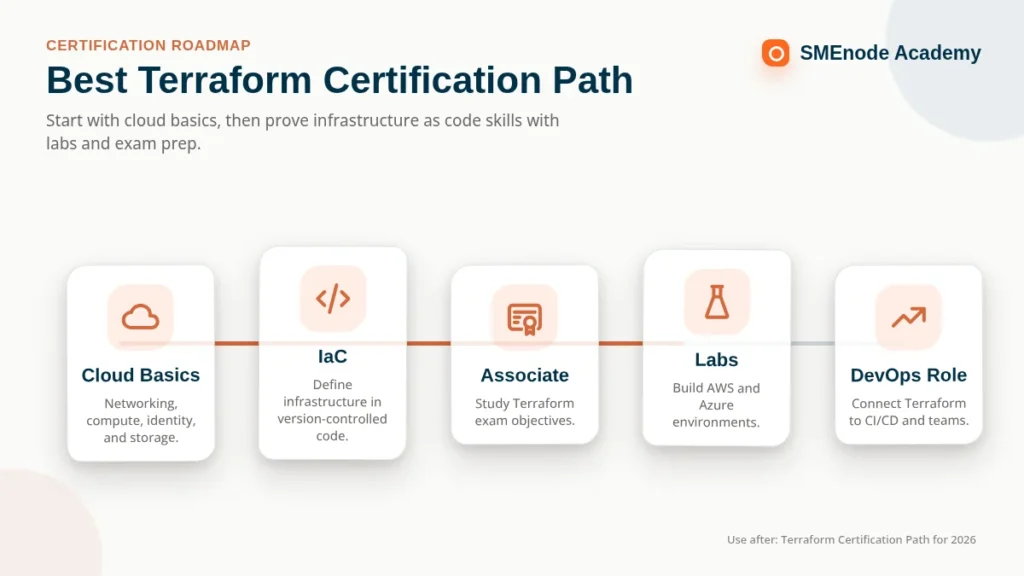
There are two Terraform certifications, and most guides only mention one. That’s a gap worth closing if you’re planning more than a year ahead.
Terraform Associate (004) is the entry point. Multiple choice, one hour, $70.50. It proves you understand the workflow.
Terraform Authoring and Operations Professional is the step up. Four hours, $295, and here’s the important part: it’s lab-based. You write and fix real configuration under time pressure. That format is much harder to fake, which is exactly why it carries more weight with hiring teams. Note that it currently tests Terraform 1.6, an older baseline than the Associate exam.
Sensible sequence for most people:
- Learn one cloud platform well enough to understand its services
- Pass Terraform Associate 004
- Spend 6 to 12 months using Terraform on real work
- Take the Professional exam once you’ve hit real production problems
Don’t jump straight to Professional. The lab format punishes anyone who’s only read about state conflicts instead of causing one.
Our DevOps Engineer course is the closest fit for learners who want Terraform inside a full roadmap, with Linux, cloud, CI/CD, Kubernetes, and monitoring around it. If your target is automation work specifically, look at the Automation Engineer programme instead.
What Does the Terraform Certification Exam Cover?
The Terraform certification exam isn’t just a memory test. It expects you to understand why Terraform behaves the way it does.
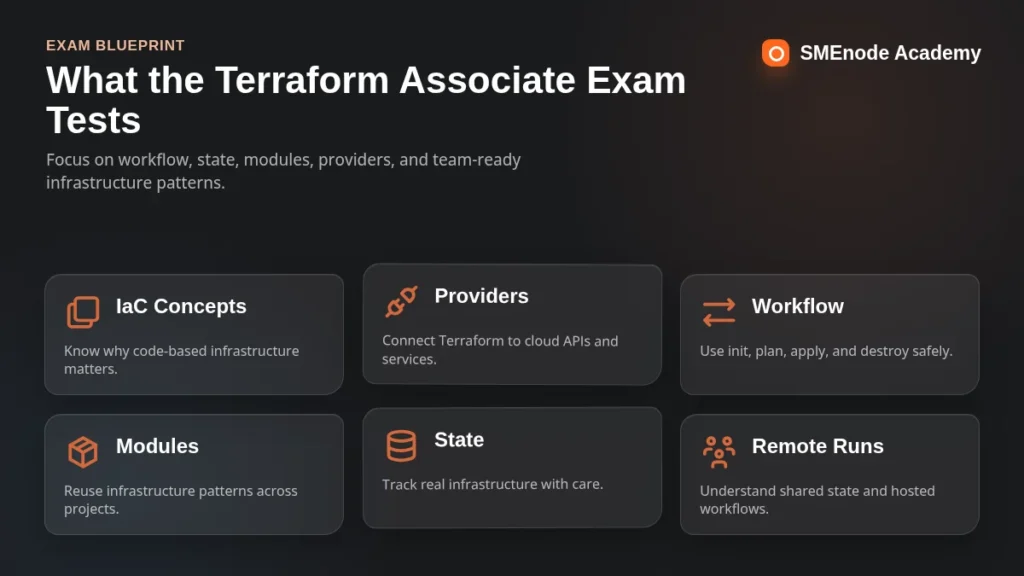
HashiCorp’s official Terraform Associate 004 objectives cover eight areas:
- Infrastructure as code concepts
- Terraform fundamentals
- Core Terraform workflow
- Reading and writing configuration
- Using and creating modules
- Terraform state management
- Infrastructure maintenance and troubleshooting
- HCP Terraform usage
That maps well to the daily work of a DevOps or cloud engineer. You write configuration, connect to providers, generate a plan, apply changes, manage state, organise code into modules, and share workflows with a team.
Infrastructure as Code and IaC
Infrastructure as code, usually shortened to IaC, means defining infrastructure in version-controlled code instead of creating it by hand in a web console. This is the foundation of Terraform.
For a cloud engineer, IaC brings repeatability. For a DevOps engineer, it brings auditability and speed. For a platform team, it creates a shared language for infrastructure requests.
Terraform is popular because it manages many platforms through providers. One team can use it for AWS resources, Azure resources, DNS, Kubernetes, monitoring tools, and SaaS services through the same basic workflow.
Terraform Providers
Terraform providers are plugins that let Terraform talk to APIs. AWS Terraform uses the AWS provider. Azure Terraform uses the AzureRM provider. There are also providers for Google Cloud, Kubernetes, Cloudflare, GitHub, Datadog, and hundreds more.
For the exam, understand provider requirements, provider blocks, version constraints, and how Terraform downloads plugins during terraform init.
Terraform Workflow
The core Terraform workflow is one of the highest-value topics on the exam.
Get comfortable with:
terraform initto prepare a working directoryterraform fmtto format configurationterraform validateto check syntax and basic validityterraform planto review proposed infrastructure changesterraform applyto create or change infrastructureterraform destroyto remove infrastructure Terraform manages
This workflow matters well beyond the exam. It’s how real teams review infrastructure changes before touching production.
Terraform State and Remote State
Terraform state is the topic that separates beginners from job-ready engineers. Terraform uses state to map your configuration to real infrastructure. If state is wrong, missing, or exposed, your workflow gets risky fast.
For the exam, know:
- Why Terraform uses state
- What information state stores
- Why sensitive data in state needs protection
- How local state differs from remote state
- Why state locking matters in team environments
- How HCP Terraform can store state and run Terraform in a shared workflow
For real work, never treat the state file like a casual text file. It can hold sensitive values and it controls the relationship between your code and live resources. Worth knowing: state encryption at rest is one of the features OpenTofu added and Terraform’s open binary still lacks, which is why the topic comes up in tool comparisons.
Terraform Modules
Terraform modules help you organise and reuse infrastructure code. Instead of copying the same VPC, subnet, security group, or storage configuration across projects, you package repeatable logic into a module.
For the exam, know the difference between root modules and child modules, and how inputs, outputs, and source paths work. For job readiness, build your own module instead of only consuming registry modules.
HCP Terraform and Terraform Cloud
HashiCorp uses the HCP Terraform name for the hosted service many people still call Terraform Cloud. The 004 exam expects you to understand how hosted workflows help teams manage runs, state, variables, credentials, policy, and workspace organisation. Projects, a newer HCP Terraform concept, are part of the current objectives.
You don’t need to become an HCP Terraform administrator before the Associate exam. You do need to understand what problem it solves and how it differs from running Terraform on a laptop.
Is the Terraform Associate Exam Hard?
Moderate. It’s one of the easier certification exams in the cloud and DevOps space, and it’s still very possible to fail it by studying the wrong way.
Start with an honest note that most sites gloss over: HashiCorp doesn’t publish the passing score or the number of questions for the Associate exam. If a blog or a course confidently tells you “57 questions, 70% to pass,” that number isn’t sourced from HashiCorp. Treat exact figures with suspicion and aim to be comfortably competent instead of hunting a threshold.
What makes it harder than people expect:
- Questions are scenario-shaped, not definition-shaped. You get a situation and pick the correct behaviour.
- Multi-select questions have close distractors, and partial knowledge doesn’t survive them.
- Some items show you HCL and ask what it does. Reading configuration under time pressure is a skill you build in a terminal, not in a video.
- One hour for the whole exam. There’s no time to reason from first principles about the basics.
What makes it easier:
- No labs. It’s multiple choice.
- No trick provider trivia. It tests Terraform, not deep AWS or Azure knowledge.
- The objectives list is short and public, so there’s little mystery about scope.
Rule of thumb from our live DevOps sessions: if you can explain what terraform plan will do before you run it, and you can explain why remote state locking exists, you’re close. If you’re still memorising command flags, you’re not ready.
Terraform Certification Salary Value: What Can It Actually Do?
Terraform certification can support salary growth. It doesn’t create salary growth on its own. Employers pay for people who can design, build, automate, troubleshoot, and explain infrastructure. The certificate proves one part of that story.
The salary value is strongest when Terraform sits beside other skills:
- AWS or Azure cloud infrastructure
- Linux and networking basics
- Git and CI/CD
- Kubernetes and containers
- Monitoring and incident response
- Security basics for secrets, access control, and policy
If you’re planning a DevOps career, pair this article with our DevOps salary guide for 2026 and DevOps interview questions. Those connect Terraform knowledge to interviews and pay conversations. Automation-focused readers should also check the network automation engineer salary guide.
For cloud-focused learners, Terraform is a strong companion to AWS and Azure. If you’re still choosing a cloud path, read the AWS certification path, the Azure certification guide, the AWS Solutions Architect salary guide, and the Azure Solutions Architect salary guide.
Who Should Take Terraform Certification in 2026?
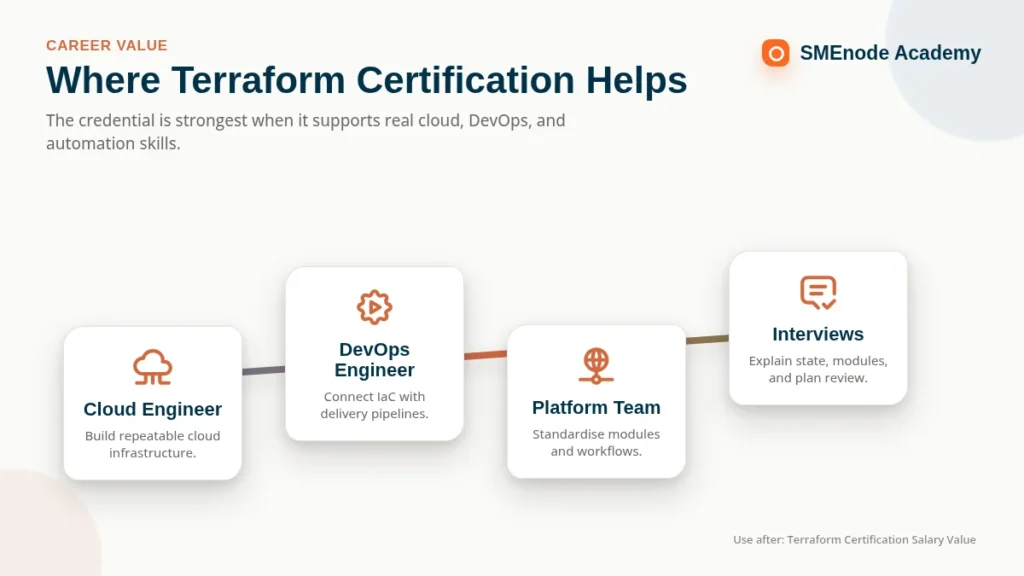
The best candidates already touch infrastructure, or want to.
DevOps Engineers
DevOps engineers should learn Terraform because infrastructure changes are part of the delivery pipeline. Terraform provisions environments, standardises configuration, and cuts manual cloud setup.
If your target role mentions CI/CD, Kubernetes, AWS, Azure, platform engineering, or GitOps, Terraform is relevant.
Cloud Engineers
Cloud engineers use Terraform to create and manage cloud infrastructure repeatably. AWS Terraform and Azure Terraform skills are especially useful, since plenty of teams now want cloud resources defined in Git rather than built by hand in a console.
If you’re considering our AWS Solutions Architect course or Azure Solutions Architect course, Terraform is a smart next layer once you understand the services themselves.
Azure admins who already hold the AZ-104 can use Terraform to automate what they manage manually. See our Azure Administrator course if you’re building that foundation first.
System Administrators
System administrators moving into cloud roles can use Terraform as a bridge from server operations to cloud automation. You don’t need to become a developer, but you do need comfort with Git, configuration files, and command-line workflows.
Network Automation Engineers
Network automation engineers increasingly work with cloud networks, DNS, load balancers, firewalls, and hybrid connectivity. Terraform handles the provisioning layer while Ansible handles configuration.
If you already work with inventory-driven automation, our NetBox Ansible dynamic inventory guide and Ansible inventory explainer show where that fits beside Terraform-managed infrastructure.
4-Week Terraform Certification Study Guide
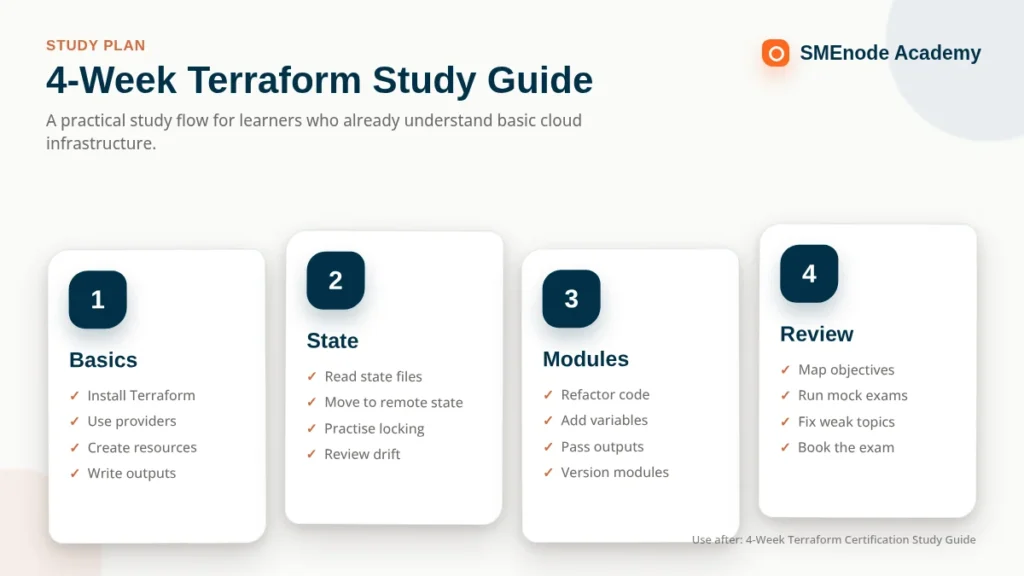
You can prepare for the Terraform Associate exam in 4 weeks if you already know cloud basics. New to cloud? Give yourself 6 to 8 weeks.
Week 1: Terraform Basics and IaC
Focus on infrastructure as code, installation, providers, resources, variables, outputs, and basic commands.
Build:
- A simple AWS EC2 instance or Azure virtual machine
- A storage bucket or storage account
- Basic variables and outputs
- A Git repository for your Terraform code
Study:
- IaC concepts
- Provider requirements
- Resource blocks
- Data sources
terraform init,fmt,validate,plan, andapply
Week 2: State, Remote State, and Workflow
Focus on Terraform state, state locking, backends, and safe workflow habits.
Build:
- A local state example
- A remote state example
- A small multi-resource project
- A plan review checklist
Study:
- Purpose of Terraform state
- Sensitive data in state
- Remote state storage
- State locking
- Refresh, drift, and troubleshooting basics
Week 3: Terraform Modules and Real Projects
Focus on code reuse and structure.
Build:
- A reusable network module
- A compute module
- Environment-specific variables for dev and test
- Outputs that pass values between modules
Study:
- Root module vs child module
- Module inputs and outputs
- Terraform Registry modules
- Version constraints
- Dependency management
Week 4: HCP Terraform, Review, and Practice Questions
Focus on hosted workflows, exam objectives, and weak spots.
Build:
- A small HCP Terraform workspace and project
- Variables stored outside code
- A run that uses remote execution
- A final lab that touches provider, module, state, and output concepts
Study:
- HCP Terraform concepts
- Workspaces and projects
- Remote operations
- The official 004 exam objectives
- Official sample questions
By the end of week 4, you should be able to explain not only what a Terraform command does, but why a team would use it in production.
For structured practice outside class, the DevOps workbook from SMEnode Labs covers the IaC and pipeline labs in a follow-along format.
Best Hands-On Labs Before the Terraform Associate Exam
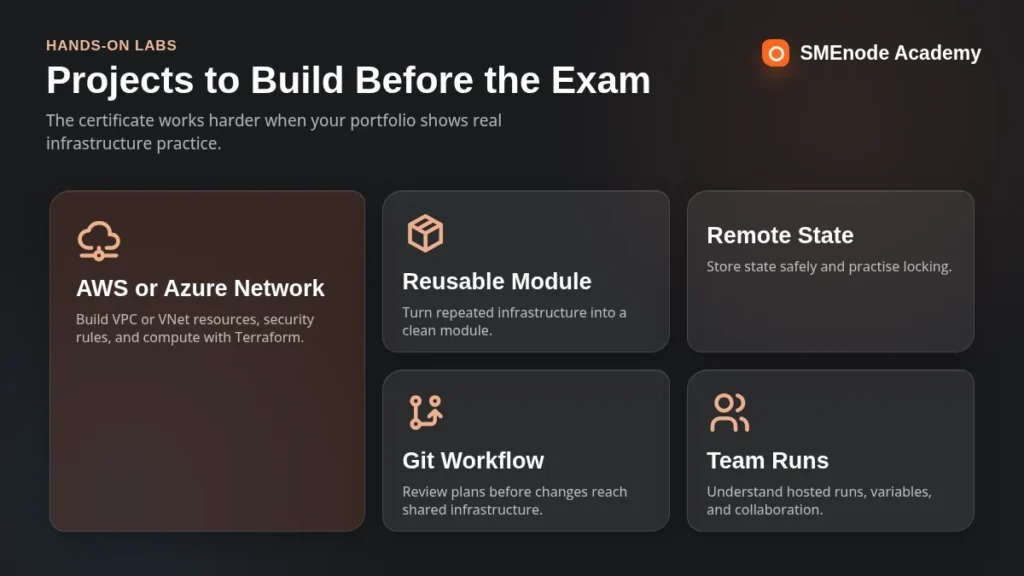
Don’t prepare by watching videos only. The exam is easier when your hands have already made the mistakes.
Lab 1: AWS Terraform VPC
Create a VPC, subnets, route tables, security groups, and one EC2 instance. Teaches provider setup, resource dependencies, variables, outputs, and plan review.
Lab 2: Azure Terraform Network
Create an Azure resource group, virtual network, subnet, network security group, and virtual machine. Useful if your target role is Azure cloud engineer or Azure DevOps engineer.
Lab 3: Terraform Module Refactor
Take a flat Terraform project and refactor it into modules. Create a network module and a compute module. Pass outputs between them.
Lab 4: Remote State and Locking
Move from local state to remote state. Then break it on purpose. Run two applies at once and watch what locking prevents. That failure teaches more than any explanation.
Lab 5: HCP Terraform Workflow
Create a workspace, connect variables, run a plan, review the output, and apply a small change. Gives you practical context for HCP Terraform exam topics.
Lab 6: Run the Same Config on OpenTofu
Take any lab above and run it with tofu instead of terraform. It works. Ten minutes of proof beats an hour of reading about the fork, and it’s a good story in an interview.
Working through containers too? Our Proxmox vs Docker comparison covers where VMs and containers each belong, which is the layer Terraform provisions underneath.
Common Mistakes That Make the Terraform Associate Exam Harder
Most learners don’t struggle because Terraform is hard. They struggle because they study it as trivia instead of workflow.
Avoid these:
- Memorising commands without running them
- Ignoring Terraform state until the final week
- Using only one provider and never reading provider documentation
- Skipping modules because they feel abstract
- Treating remote state as a minor topic
- Studying HCP Terraform only as a product name
- Buying 003-era practice tests by mistake
- Using practice exams without mapping missed questions back to the official objectives
The biggest gap is usually state. If you can explain Terraform state clearly, including why remote state and locking matter, you’re already ahead of most beginners.
Terraform vs AWS and Azure Certifications
Terraform certification and cloud provider certifications solve different problems.
AWS and Azure certifications prove you understand a cloud platform. Terraform certification proves you understand how to define and manage infrastructure as code across platforms.
For most learners, the best order is:
- Learn one cloud platform enough to understand the services
- Learn Terraform to manage that infrastructure as code
- Add DevOps workflow skills such as Git, CI/CD, Kubernetes, and monitoring
Want an AWS-first path? Start with cloud foundations, then AWS Solutions Architect, then Terraform. Prefer Azure? Start with Azure Administrator or Azure Solutions Architect, then Terraform.
The combination beats either one alone. A cloud certification says “I understand this platform.” Terraform certification says “I can manage infrastructure repeatably as code.”
Final Verdict: Is Terraform Certification Still Worth It?
Terraform certification is still worth it in 2026. It’s a practical, cheap credential that supports cloud and DevOps roles, and the 004 refresh means it now reflects a modern Terraform rather than a 2022 one. It isn’t enough by itself. It’s one of the best add-on certifications for engineers who want to prove infrastructure as code skill.
Take it if you’re building a career around:
- Cloud infrastructure
- DevOps engineering
- Platform engineering
- Network automation
- Site reliability engineering
- AWS or Azure automation
- Infrastructure as code and GitOps workflows
Skip it for now if you have no cloud, Linux, Git, or networking foundation. Build those basics first, then come back once you can connect the code to real infrastructure.
And don’t let the OpenTofu debate stall you. The skills are the same on both tools. The licence argument is a business decision, not a reason to postpone learning IaC.
If you want a guided path, our DevOps Engineer course is the closest match. It connects Terraform with Linux, cloud, automation, CI/CD, Kubernetes, monitoring, and hands-on labs, with live instructors and free mentorship, so the certification becomes part of a real skill set instead of a standalone badge.
Frequently Asked Questions
Is Terraform certification worth it in 2026?
Yes. Terraform certification is worth it in 2026 for cloud engineers, DevOps engineers, platform engineers, and automation-focused IT professionals. It’s most valuable paired with hands-on Terraform labs, cloud projects, and a clear understanding of infrastructure as code.
How much does Terraform certification cost?
The Terraform Associate exam costs $70.50 USD plus locally applicable taxes and fees, and a free retake isn’t included. The Terraform Authoring and Operations Professional exam costs $295 USD plus tax and does include a free retake.
Which Terraform exam version is current in 2026?
Terraform Associate 004 is the current version. It launched 2026-01-08 and tests Terraform 1.12. The previous 003 exam retired 2026-01-07 and tested Terraform 1.3, so any study material built for 003 is out of date.
Is the Terraform Associate exam hard?
It’s moderate. The exam is manageable if you’ve used Terraform in labs or real projects, and it gets hard if you only memorise terms. HashiCorp doesn’t publish the passing score or question count, so ignore any source quoting exact figures and focus on understanding providers, modules, state, remote state, and the core workflow.
How long does it take to study for Terraform certification?
Most learners with cloud basics can prepare in 4 to 6 weeks. Beginners who are also learning cloud, Linux, networking, and Git usually need 6 to 8 weeks.
Does Terraform certification expire?
Yes. HashiCorp certifications are valid for 2 years. To recertify, pass an exam for the same product at the same level or higher. You can sit the recertification exam up to 6 months before your credential expires.
Does OpenTofu make Terraform certification useless?
No. OpenTofu is a fork of Terraform that uses the same HCL syntax, provider model, state model, and workflow, so everything the Associate exam tests transfers directly. OpenTofu sits around 12% adoption while Terraform holds the largest market share, and knowing both is an advantage in interviews.
Is Terraform still relevant in 2026?
Yes. Terraform remains the most widely used infrastructure as code tool, and IBM’s acquisition of HashiCorp, completed 2025-02-27, hasn’t changed the exam, the pricing, or the two-year validity. The main shift is that teams now have a credible open-source alternative in OpenTofu, so engineers are expected to understand both.
What is the best Terraform certification path?
Learn cloud basics first, practise Terraform with AWS or Azure labs, study state and modules, then take the Terraform Associate 004 exam. After 6 to 12 months of real Terraform work, consider the lab-based Terraform Authoring and Operations Professional exam. Add CI/CD, Kubernetes, monitoring, and security skills alongside.
Do I need AWS or Azure before learning Terraform?
You don’t need to be an AWS or Azure expert, but you should understand basic cloud infrastructure. Terraform gets much easier once you know what a virtual network, compute instance, security group, IAM role, and storage service are.
Is Terraform certification good for DevOps engineers?
Yes. Terraform certification suits DevOps engineers because infrastructure as code is part of modern CI/CD, cloud deployment, GitOps, and platform engineering workflows.