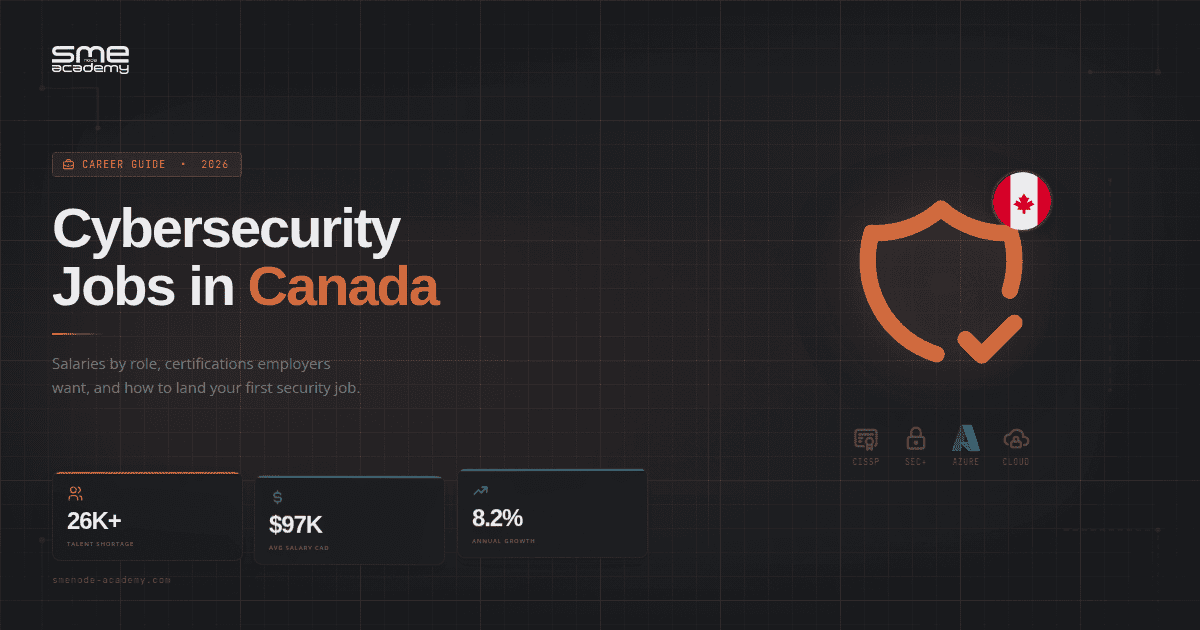
Canada has a shortage of over 26,000 cybersecurity professionals – and that gap isn’t closing. Between March 2025 and February 2026, Canadian employers posted 2,448 unique cybersecurity positions, with monthly demand holding steady between 180 and 270 new openings every single month.
That’s not a temporary spike. That’s a structural talent shortage working in your favour.
This article covers everything you need to know: what cybersecurity jobs actually pay across different roles and cities, what employers want on your resume, which certifications open the most doors, and the exact steps to break into the field – with or without a degree.
If you’re also researching which IT credentials are worth pursuing in Canada right now, our guide to IT Certification Jobs in Canada 2026 covers the broader certification landscape employers are actively hiring for.
Is Cybersecurity in Demand in Canada?
Yes – and the numbers back it up. Canada’s cybersecurity market is projected to grow 8.2% annually through 2029, reaching US$5.68 billion. That growth rate outpaces most other tech sectors by nearly three times.
Employment outlooks from the Government of Canada’s Job Bank rate cybersecurity specialists as good in British Columbia and Alberta, and moderate in Ontario for the 2024-2026 period. The Canadian Centre for Cyber Security explicitly encourages professionals from adjacent fields – networking, IT administration, software development – to pivot into security roles.
The demand is real. The question is whether you’re positioned to meet it.
What Do Cybersecurity Jobs Pay in Canada?
The average cybersecurity salary in Canada sits at CAD $97,538 per year in 2026, though that number shifts considerably depending on your specialisation, seniority, and location.

Here’s the full breakdown by role:
| Role | Entry-Level | Mid-Level | Senior / Lead |
|---|---|---|---|
| SOC Analyst | $55,000–$68,000 | $78,000–$100,000 | $110,000–$130,000 |
| Cybersecurity Analyst | $55,000–$75,000 | $80,000–$105,000 | $115,000–$130,000 |
| Network Security Engineer | $70,000–$85,000 | $90,000–$115,000 | $120,000–$145,000 |
| Penetration Tester | $75,000–$95,000 | $95,000–$130,000 | $130,000–$160,000 |
| Cloud Security Architect | $90,000–$110,000 | $115,000–$145,000 | $150,000–$180,000 |
| CISO | – | $140,000–$180,000 | $200,000–$250,000+ |
Sources: Indeed Canada, Glassdoor Canada, Canadian Cybersecurity Network
Entry-Level Pay
Entry-level cybersecurity positions in Canada start between $55,000 and $75,000 per year. In Ontario, the average hourly rate for entry-level security work hit $33.41 as of May 2026, with most workers earning between $21 and $38 per hour.
The catch: only about 5% of Canadian cybersecurity postings explicitly target entry-level candidates. That makes breaking in the hardest part – but not impossible.
Where in Canada Are the Jobs?

Location matters more than most people expect – both for volume and pay.
| City / Region | Job Volume | Salary Premium | Notes |
|---|---|---|---|
| Toronto (ON) | Highest | High | Most opportunities by volume; competitive |
| Vancouver (BC) | High | Highest | BC leads on average salary nationally |
| Ottawa (ON) | Moderate-High | High | Government and federal contractor demand |
| Calgary (AB) | Moderate | Mid-High | ~10% behind Ontario salaries, lower cost of living |
| Halifax / Winnipeg | Growing | Mid | Emerging hubs, less competition, lower COL |
Source: Canadian Cybersecurity Network
Calgary deserves a mention here. Salaries trail Ontario by roughly 10%, but housing costs are significantly lower. For someone building their career, that trade-off makes a real difference to take-home quality of life.
What Do Employers Actually Want?
Based on the 2,448 positions posted between March 2025 and February 2026, here’s what Canadian cybersecurity employers actually asked for.
Technical Skills in Demand
- Cloud security – Azure security appears in roughly 25% of all postings; AWS in about 16%
- SIEM tools – Splunk, Microsoft Sentinel, IBM QRadar are the most commonly listed platforms. If you want to understand how SOC teams actually use Splunk day-to-day, the Splunk Enterprise course covers it hands-on. Our blog post What Is Splunk Enterprise? also breaks down why it’s become the standard for Canadian security operations teams.
- Extended Detection and Response (XDR) – Tools like Wazuh XDR are showing up more in analyst and SOC job descriptions as organisations move beyond traditional SIEM
- Threat detection and incident response
- Identity and access management (IAM)
- DevSecOps and infrastructure-as-code
- AI security – a fast-growing requirement tied to AI adoption across every industry
Soft Skills That Actually Get You Hired
Hiring managers consistently flag these at the interview stage:
- Analytical thinking – the ability to spot patterns in noise
- Clear written and verbal communication – you’ll write incident reports, brief executives, and explain risks to non-technical stakeholders
- Composure under pressure – security incidents don’t happen at convenient times
- Curiosity – the threat landscape changes fast; comfort with continuous learning is non-negotiable. Reading roundups like Top 5 Critical CVEs of April 2026 is exactly the kind of habit employers notice.
The Top Cybersecurity Certifications Canadian Employers Want

Certifications aren’t optional in this field. They’re the fastest way to signal competence – especially when you’re changing careers or don’t have a four-year degree.
Here’s what the data says employers ask for most often in Canada:
CISSP (Certified Information Systems Security Professional)
The gold standard. CISSP appears in nearly one-third of all Canadian cybersecurity job postings and is the de facto prerequisite for senior roles – security architect, director of security, CISO.
The catch: you need five years of paid, cumulative work experience in at least two of the eight CISSP domains before you can sit the exam. This isn’t a starting cert – it’s where you’re heading. The CCIE Security programme at SMEnode Academy is designed for professionals already in the field who are ready to move into senior security engineering and architecture roles. We go deeper on the FortiOS 7.6 Administrator exam format and domains in its own guide.
Sources: ISC2, Canadian Cybersecurity Network
CompTIA Security+
The best entry point. Security+ covers network security, threat management, and cryptography – enough to qualify for analyst and technician roles at government departments and small-to-mid-sized businesses across Canada.
If you’re starting from zero, this is your first target.
CompTIA CySA+ (Cybersecurity Analyst+)
The natural next step after Security+. CySA+ focuses on threat intelligence, SIEM tools, and security analytics – exactly what SOC analyst and mid-level analyst roles require.
Cloud Security Certifications
Given that Azure and AWS appear in 40%+ of Canadian postings combined, cloud security credentials have become near-mandatory for many roles:
- Microsoft Certified: Security, Compliance, and Identity Fundamentals (SC-900) – entry-level Azure security
- AWS Certified Security – Specialty – for AWS-focused roles
- CompTIA Cloud+ – vendor-neutral cloud security foundation
The Azure Administrator course at SMEnode Academy covers the Azure infrastructure fundamentals you’ll need before tackling Azure security specialisations.
Fortinet NSE4
Highly relevant for network security and firewall-focused roles. Fortinet restructured its entire certification programme in October 2025, and exam fees dropped from $400 to $200 – making this a much more accessible credential. Our Fortinet NSE4 Exam Cost 2026 post covers the full fee breakdown and what to expect. For live instructor-led prep, the Fortinet NSE4 course is a direct path to exam-ready skills.
If you’re comparing Fortinet to Cisco’s security tracks, Fortinet NSE4 vs Cisco Security gives you an honest comparison for career planning. There’s a full walkthrough of what the July 2026 Fortinet NSE changes mean for you.
SSCP (Systems Security Certified Practitioner)
A solid entry-level cert from ISC2 that requires only one year of work experience. It opens doors to systems administrator, security analyst, and network security administrator roles. A good bridge on the path to CISSP.
CEH (Certified Ethical Hacker)
Specifically relevant for penetration testing and red team roles. If you’re interested in offensive security work, CEH is commonly listed alongside OSCP in Canadian pen test job postings.
Can You Get a Cybersecurity Job in Canada Without a Degree?
Yes. And this is backed by real hiring data.
An ISC2 survey found that more than 90% of hiring managers would consider candidates with relevant IT work experience or an entry-level certification over someone with only a degree and no practical experience. The reality is that a two-year college diploma combined with Security+ and hands-on lab experience is often more competitive than a four-year computer science degree with no practical security work.
What does matter:
- Certifications (see above)
- Hands-on lab experience – virtual labs, home environments, and simulation platforms
- A portfolio – CTF (Capture the Flag) competition writeups, a personal lab, documented projects
- Transferable IT experience – help desk, network administration, and sysadmin backgrounds all translate directly
Source: Herzing College
How to Get Into Cybersecurity in Canada: A Realistic Path

This isn’t about finding a shortcut. It’s about making the right moves in the right order.
Step 1: Build an IT Foundation
Security work assumes you understand how networks, operating systems, and systems communicate. If you don’t have that yet, start there.
Good entry points: CompTIA A+, Network+, basic Linux commands, and networking fundamentals like subnetting, routing, and TCP/IP. Many people pivot from help desk or networking roles – this is a well-worn path. Our guide on How to Become a Network Engineer in 2026 covers the foundational skills that feed directly into security career paths.
Step 2: Get Your First Security Certification
CompTIA Security+ is the target for most people. It’s vendor-neutral, widely recognised by Canadian government departments and private employers, and gives you the foundational vocabulary for every security conversation you’ll have.
If you prefer ISC2’s ecosystem, SSCP is an alternative that requires only one year of experience and maps clearly onto the path to CISSP.
Step 3: Add a Cloud Credential
Given how dominant Azure and AWS are in Canadian job postings, pair your security cert with at least one cloud security credential. SC-900 (Microsoft) is free to study for and low-cost to sit – a quick win that immediately makes your resume more relevant.
Step 4: Get Hands-On with Security Tools
Certifications tell employers what you know. Tool experience shows them what you can do.
Start with SIEM fundamentals. Tools like Splunk Enterprise and Wazuh XDR are exactly what SOC analyst job postings ask for by name. Knowing how to write Splunk queries, build dashboards, and triage alerts is a concrete skill – not a general concept.
Step 5: Apply for Operate and Maintain Roles First
The data is clear: SOC analyst, vulnerability analyst, and security operations roles have the highest entry-level volume in Canada. These are your entry points.
Don’t wait until you feel ready. Apply when you have Security+ and your cloud foundation. Entry-level roles are designed to grow you.
Step 6: Build Your Network
Recruiters in Canadian cybersecurity actively use LinkedIn to find candidates. A complete profile with certifications listed, a brief summary of your skills, and connections to people in the industry dramatically increases your visibility.
Join communities: (ISC2) chapters, ISACA Canada, local BSides security conferences, and the Canadian Cybersecurity Network.
Emerging Areas: Where Demand Is Growing Fastest
If you want to position yourself for the next five years, these specialisations are seeing accelerating demand in Canada:
- AI Security – as AI adoption expands, so does the attack surface. Understanding how to secure AI systems and defend against AI-enabled attacks is already showing up in job postings. For context on how AI is reshaping technical salaries across the industry, the AI Engineer Salary in 2026 breakdown is a useful reference point.
- Cloud Security – not slowing down. Every industry is still mid-migration
- DevSecOps – security integrated into development pipelines; high demand, premium pay
- OT/ICS Security – operational technology in energy, utilities, and manufacturing; growing with critical infrastructure investment
- Quantum-Safe Cryptography – early-stage but gaining ground; Canada’s federal government has begun preparing for post-quantum threats
Frequently Asked Questions
Is cybersecurity in demand in Canada?
Yes – significantly. Canada faces a shortage of over 26,000 cybersecurity professionals as of 2025-2026, with 2,448 unique positions posted in just twelve months. The Government of Canada’s Job Bank rates cybersecurity as a “good” outlook in British Columbia and Alberta, and the sector’s market is projected to grow 8.2% annually through 2029. Demand is structural, not cyclical.
How much do cybersecurity professionals make in Canada?
The average cybersecurity salary in Canada is approximately CAD $97,538 per year in 2026. Entry-level positions start between $55,000 and $75,000. Mid-career professionals typically earn $80,000 to $120,000, and senior specialists or architects can earn $130,000 to $180,000. CISOs at large enterprises regularly earn $200,000 to $250,000 or more in total compensation.
What certifications do I need for a cybersecurity job in Canada?
For entry-level roles, CompTIA Security+ is the most widely recognised starting point in Canada. For mid-level positions, CompTIA CySA+ and a cloud security certification (Azure or AWS) strengthen your profile considerably. For senior roles, CISSP appears in roughly one-third of all Canadian cybersecurity job postings. The Canadian Centre for Cyber Security also publishes a certification guide specific to the Canadian market.
Can I get a cybersecurity job in Canada without a degree?
Yes. Over 90% of Canadian cybersecurity hiring managers say they would consider candidates with relevant IT work experience or an entry-level certification over someone with only a degree. A college diploma combined with certifications and hands-on lab practice is competitive for entry-level analyst and SOC roles.
Which city in Canada has the most cybersecurity jobs?
Toronto has the highest volume of cybersecurity job postings by a significant margin. Vancouver follows and also offers the highest average salaries nationally. Ottawa has strong demand driven by federal government and defence contractors. Calgary offers a good value proposition – salaries trail Ontario by about 10%, but the cost of living is substantially lower.
What is the highest paying cybersecurity job in Canada?
CISO (Chief Information Security Officer) roles command the highest compensation, ranging from $140,000 to $180,000 at mid-sized organisations and $200,000 to $250,000 or more at large enterprises or financial institutions. Cloud Security Architects and senior Penetration Testers also sit at the upper end of the pay scale, typically earning $130,000 to $180,000 at the senior level. See whether Splunk Cloud or Enterprise fits your estate for the adjacent piece.
How long does it take to get into cybersecurity in Canada?
With focused effort, most people transitioning from IT backgrounds can land their first security role in 6 to 12 months. The path typically involves completing CompTIA Security+ (3-6 months of study), adding a cloud credential (2-3 months), building a hands-on lab portfolio, and applying to SOC analyst or entry-level security analyst positions. People starting with no IT background should expect 12 to 24 months.
Key Takeaways
- Canada has a shortage of 26,000+ cybersecurity professionals – demand is structural, not a temporary trend
- Average salaries range from $55K at entry level to $250K+ for CISOs
- CISSP is the most-wanted certification in Canada; Security+ is the right starting point
- Azure and AWS security credentials appear in 40%+ of postings combined
- You don’t need a degree – certifications and lab experience are more important
- Toronto has the most volume; Vancouver pays the most; Calgary offers the best value
- SOC analyst, vulnerability analyst, and security operations roles are the best entry points
Start Building the Skills Employers Want
The skills shortage in Canadian cybersecurity is your opportunity – but only if you’re building the right credentials and hands-on experience.
The Security Engineer programme at SMEnode Academy is a live, instructor-led career programme built specifically for this path. You work with practising security professionals, get hands-on with tools like Splunk and Wazuh, and build the practical foundation that Canadian employers are actually hiring for – not just slides and theory.
Prefer to study on your own schedule first? SMEnode Labs offers certification workbooks with integrated lab exercises for the most in-demand security and networking credentials.
The shortage is real. The question is whether you’re ready when the next role posts.