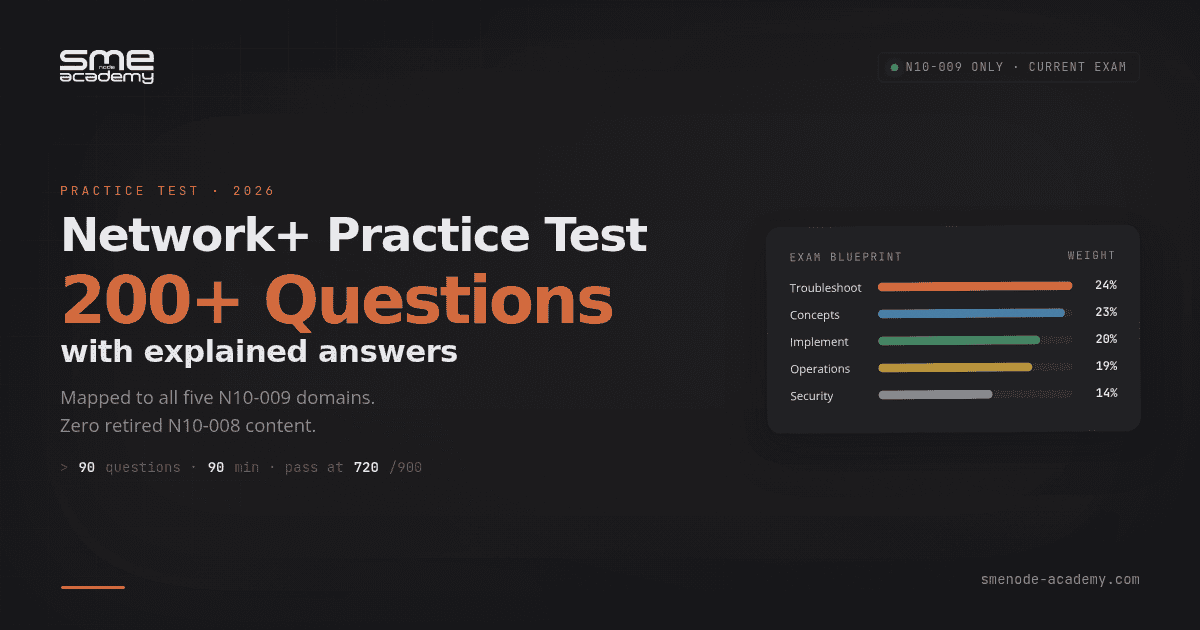
Search for a network plus practice test right now and count how many of the top free results are quizzing you on an exam that no longer exists.
We did exactly that on 2026-08-10. Three of the top eleven free question banks on page one are built on N10-007 or N10-008 wording. N10-008 retired on 2024-12-20. N10-007 retired years before that. People are drilling rollover cable trivia for an exam that stopped asking about rollover cables.
You already know practice questions are the fastest way to find your weak spots. The problem isn’t finding questions, it’s finding questions that match the exam you actually booked.
So here’s what’s below: 40 exam-style questions written against the current N10-009 objectives, sorted into the five real domains at their real weightings, each with the correct answer and a plain explanation of why the other options fail. Plus a section on how to spot a stale question bank in 10 seconds, and five questions on topics the old banks never test at all.
Let’s cover how the exam works, then get to the questions.
How the N10-009 Network+ Exam Works in 2026
Quick answer: up to 90 questions, 90 minutes, and you need 720 on a scale of 100 to 900 to pass.
That works out to roughly one minute per question. Read that again, because it changes how you should practise.
| Exam fact | Detail |
|---|---|
| Exam code | N10-009 (Network+ V9) |
| Questions | Maximum of 90 |
| Time | 90 minutes |
| Passing score | 720 (scale of 100 to 900) |
| Question types | Multiple choice plus performance-based (PBQs) |
| Launched | 2024-06-20 |
| Price | $399 USD direct from CompTIA |
| Recommended experience | 9 to 12 months in networking |
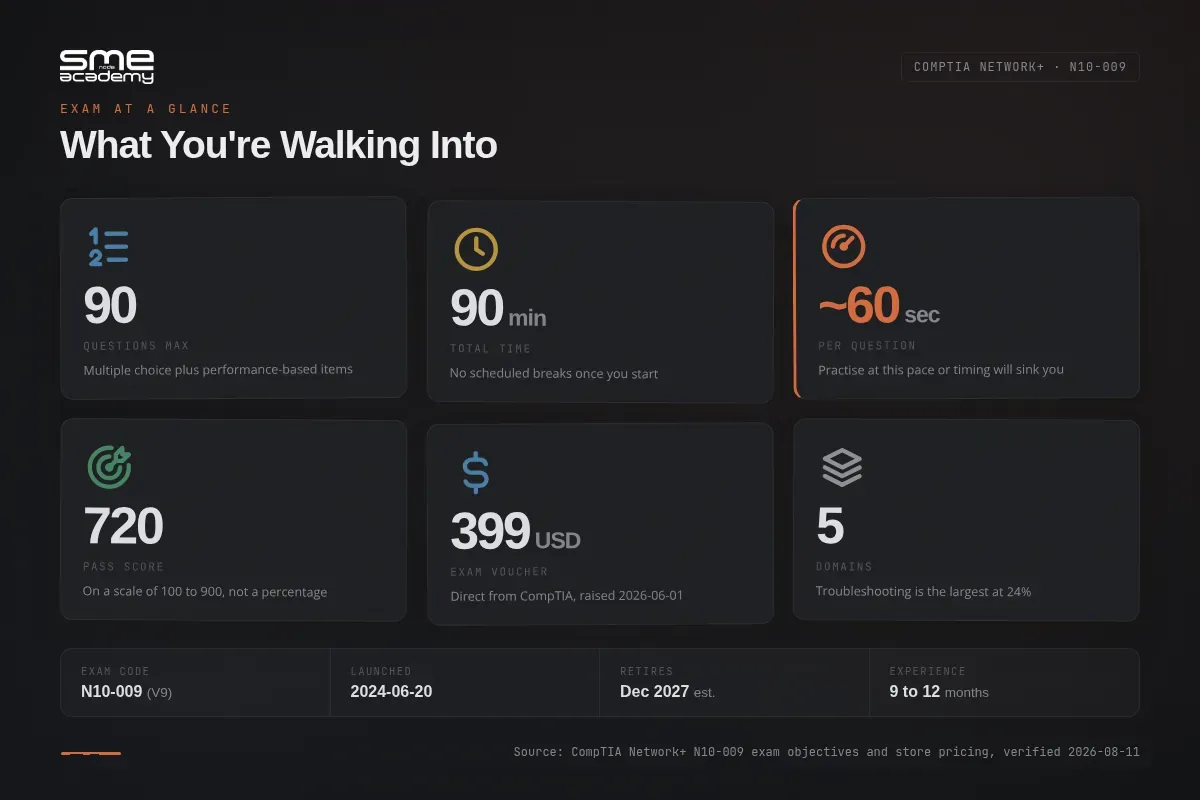
The mechanics come straight from CompTIA’s Network+ certification page. Price went up on 2026-06-01 across CompTIA’s whole lineup, so budget $399 rather than the $390 you’ll see quoted in older posts.
N10-009 is the only live version. It’s expected to run until roughly December 2027 based on CompTIA’s usual three-year cycle and the published exam retirement dates. If a study resource doesn’t say “N10-009” on it, close the tab.
Here’s how the five domains are weighted. Study time should follow these numbers, not your comfort zone:
| Domain | Exam Weight |
|---|---|
| Network Troubleshooting | 24% |
| Networking Concepts | 23% |
| Network Implementation | 20% |
| Network Operations | 19% |
| Network Security | 14% |
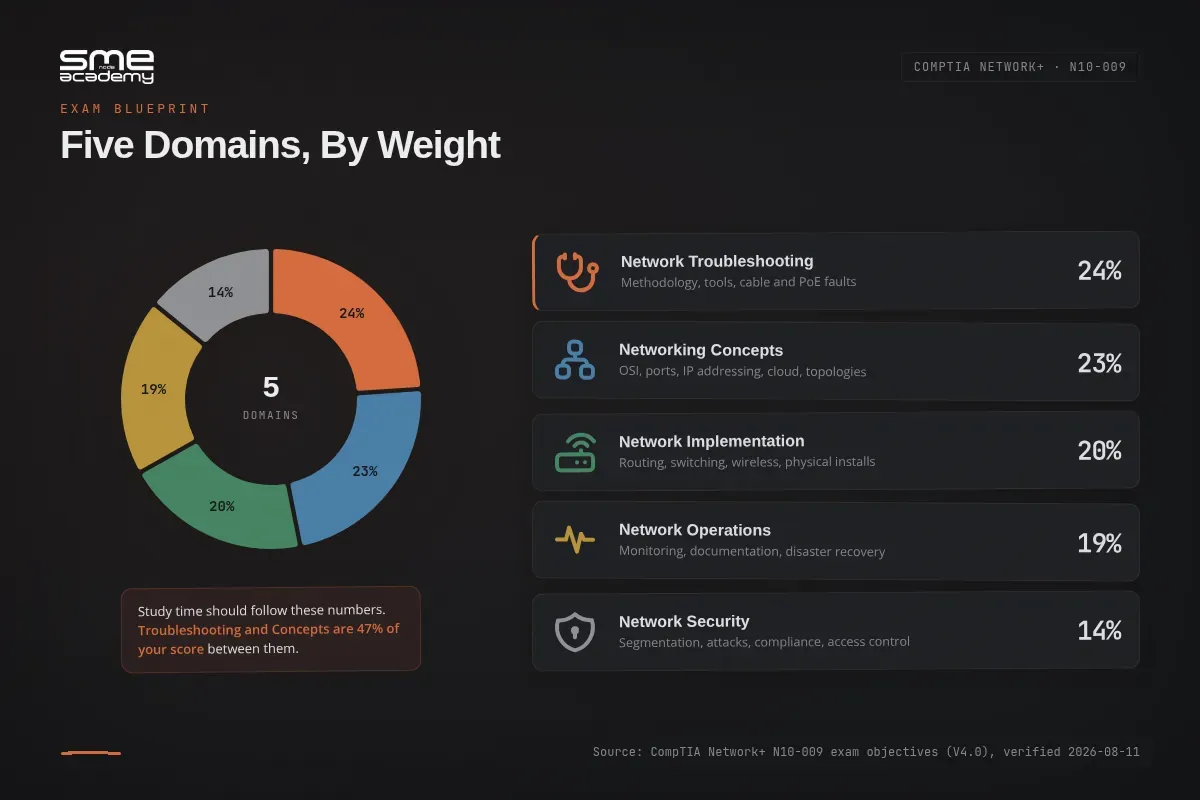
Notice what changed. Troubleshooting is now the biggest single domain at 24%, and security shrank to 14%. Candidates coming off an N10-008 study plan usually have this backwards, because on the old blueprint security carried more weight and troubleshooting carried less.
Want the full set, not just the 40 below? Get all 200+ N10-009 practice questions free → They come sorted by domain with an answer key, and the Network+ course they sit inside costs nothing.
How to Spot an Out-of-Date Network+ Practice Test
This is the check nobody else on page one gives you, and it’ll save you weeks.
Scan any free question bank for these four tells. Any one of them means the content predates N10-009:
- Rollover cable or console pinout questions. Cut from the objectives. So were opens, shorts, and duplex mismatch troubleshooting.
- Long 802.11 standard memorisation tables. The detailed legacy standards list is gone, along with RSSI, EIRP, antenna placement, and site surveys.
- NIC teaming, multipathing, or load balancing questions. All removed.
- Nothing on zero trust, VXLAN, SASE, or infrastructure as code. These are new in N10-009. A bank with zero coverage of them was written for an older exam.
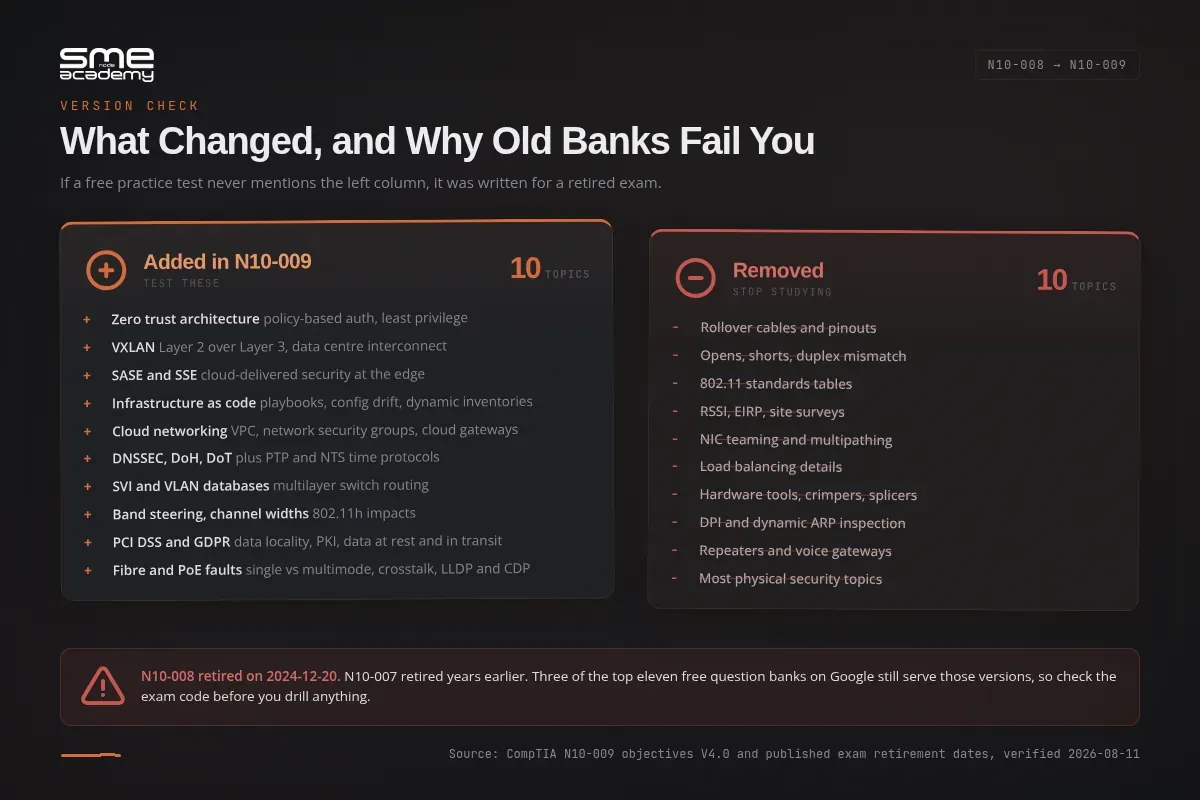
Sina, one of our students, spent five weeks last spring grinding through a free 500-question bank she’d bookmarked. She was hitting 88% consistently and felt ready. Then she took a proper N10-009 mock and dropped to 61%. Not because she’d forgotten anything. Because a fifth of the mock asked about cloud gateways, DNS over HTTPS, and IaC drift, and her bank had never mentioned any of them once. She re-drilled the new objectives for 11 days and passed with a 784. The wasted part wasn’t the studying, it was studying the wrong blueprint.
Now the questions. Each section maps to one exam domain.
Networking Concepts Practice Questions (23%)
OSI and TCP/IP models, ports and protocols, IPv4 and IPv6 addressing, subnetting, topologies, and cloud networking.
Q1. A switch decides where to forward a frame. Which OSI layer is it working at, and what address does it use? A) Layer 1, using the port number B) Layer 2, using the destination MAC address C) Layer 3, using the destination IP address D) Layer 4, using the TCP port
Answer: B. A standard switch reads the destination MAC address and checks its MAC address table, which is Layer 2 work. Routers use destination IP at Layer 3 (option C). Layer 1 moves bits with no addressing at all, and Layer 4 ports belong to TCP and UDP.
Q2. Which port and protocol combination gives you an encrypted remote command line? A) TCP 23, Telnet B) TCP 22, SSH C) UDP 69, TFTP D) TCP 21, FTP
Answer: B. SSH runs on TCP 22 and encrypts the whole session. Telnet on TCP 23 sends credentials in clear text, which is why it fails every secure-configuration question. TFTP and FTP transfer files and neither one encrypts by default.
Q3. How many usable host addresses does a /26 subnet provide? A) 64 B) 62 C) 30 D) 126
Answer: B (62). A /26 leaves 6 host bits, so 2^6 = 64 total addresses. Drop the network address and the broadcast address and 62 remain. Option A is the classic mistake, counting both reserved addresses as usable. C is a /27 and D is a /25.
Q4. A workstation can’t reach anything on the network and shows the address 169.254.18.7. What happened? A) It was assigned a public IP by mistake B) It’s using a valid private address from the DHCP scope C) It failed to reach a DHCP server and self-assigned an APIPA address D) Its subnet mask is wrong
Answer: C. The 169.254.0.0/16 range is APIPA, which a host assigns itself when no DHCP server answers. It’s a symptom, not a configuration. Check the DHCP server, the relay agent, and the switch port VLAN before you touch the client.
Q5. Which prefix identifies an IPv6 link-local address? A) 2000::/3 B) fc00::/7 C) fe80::/10 D) ff00::/8
Answer: C (fe80::/10). Every IPv6-enabled interface generates a link-local address automatically, and it’s only valid on that one link. Global unicast starts at 2000::/3, unique local at fc00::/7, and multicast at ff00::/8.
Q6. What is the valid host range for 10.20.30.64/27? A) 10.20.30.64 to 10.20.30.95 B) 10.20.30.65 to 10.20.30.95 C) 10.20.30.65 to 10.20.30.94 D) 10.20.30.64 to 10.20.30.94
Answer: C. A /27 has a block size of 32, so this subnet spans .64 through .95. The network address is .64 and the broadcast is .95, leaving .65 to .94 for hosts. Both ends get trimmed, and forgetting the broadcast address is the single most common subnetting error we see in class.
Q7. Why do modern data centres use a spine-and-leaf design instead of the older three-tier model? A) It uses fewer cables overall B) It gives predictable, equal-hop paths for heavy east-west traffic C) It removes the need for any Layer 3 routing D) It only works with a single vendor
Answer: B. Server-to-server (east-west) traffic dominates virtualised data centres, and spine-and-leaf gives every leaf the same one-hop path to every spine. Three-tier core-distribution-access was built for north-south traffic heading out to the internet. Spine-and-leaf usually needs more cabling, not less.
Q8. In a public cloud, what does a network security group do? A) Provides a private IP range for your resources B) Filters inbound and outbound traffic to cloud resources using rules C) Connects your on-premises network to the cloud D) Balances traffic across availability zones
Answer: B. A network security group is rule-based traffic filtering, effectively a cloud firewall applied to instances or subnets. The private IP range is the VPC or VNet (option A), and the site-to-cloud link is a VPN or direct connection through a cloud gateway (option C).
Confused about where VLANs end and subnets begin? That distinction shows up in both the concepts and implementation domains, and our guide on VLAN vs subnet settles it with a diagram.
Network Implementation Practice Questions (20%)
Routing, switching, wireless standards, and physical installations.
Q9. What does an 802.1Q tag add to an Ethernet frame? A) A 4-byte field carrying the VLAN ID B) An encryption header C) The destination MAC address D) A quality-of-service queue number only
Answer: A. 802.1Q inserts a 4-byte tag holding the 12-bit VLAN ID, which is how one trunk link carries traffic for many VLANs. It includes priority bits for QoS, but that’s not all it does, and it provides no encryption whatsoever.
Q10. What is a switch virtual interface (SVI) used for? A) Connecting two switches with a trunk B) Giving a VLAN a Layer 3 interface so a multilayer switch can route between VLANs C) Creating a virtual machine on a switch D) Mirroring traffic to a monitoring port
Answer: B. An SVI is a logical Layer 3 interface tied to a VLAN, which is how a multilayer switch does inter-VLAN routing without a separate router. SVIs are new to the N10-009 objectives, so older banks skip them entirely.
Q11. Which routing protocol is a link-state protocol that builds a full topology map? A) RIP B) OSPF C) BGP D) EIGRP
Answer: B (OSPF). Open Shortest Path First floods link-state advertisements so every router builds the same topology database, then runs Dijkstra to pick shortest paths. RIP is distance-vector using hop count. BGP is a path-vector protocol used between autonomous systems.
Q12. Which 2.4 GHz channels don’t overlap in North America? A) 1, 5, and 9 B) 1, 6, and 11 C) 2, 7, and 12 D) All channels overlap
Answer: B (1, 6, and 11). 2.4 GHz channels are 5 MHz apart but roughly 20 MHz wide, so only 1, 6, and 11 stay clear of each other. Any other combination causes co-channel interference and retransmissions. This is why 2.4 GHz gets crowded fast in offices and apartment blocks.
Q13. What does band steering do on a dual-band access point? A) Blocks 2.4 GHz clients from connecting B) Pushes capable clients onto the less congested 5 GHz band C) Increases transmit power on both bands D) Splits the SSID into two names
Answer: B. Band steering nudges dual-band-capable clients to 5 GHz so the busier 2.4 GHz band is left for devices that can only use it. It doesn’t block anything and it doesn’t need separate SSIDs. Band steering and channel widths are both new N10-009 additions.
Q14. How much power does 802.3at (PoE+) deliver at the switch port? A) 15.4 W B) 30 W C) 60 W D) 90 W
Answer: B (30 W). 802.3af provides 15.4 W, 802.3at (PoE+) provides 30 W, and 802.3bt reaches 60 W or 90 W depending on type. Knowing these numbers matters for troubleshooting too, because an AP that boots then reboots under load is usually starved for power.
Q15. A 4 km fibre run between two buildings keeps failing after an installer swaps in new transceivers. Which cable and optic pairing was most likely correct originally? A) Multimode fibre with 850 nm optics B) Single-mode fibre with 1310 nm optics C) Cat 6a copper with RJ-45 D) Multimode fibre with 1550 nm optics
Answer: B. Multimode is limited to a few hundred metres by modal dispersion (about 550 m for 1000BASE-SX on OM2, and roughly 300 m at 10G on OM3), so a 4 km run needs single-mode with a longer wavelength optic. Copper dies at 100 m. Mixing single-mode fibre with multimode transceivers, or the reverse, is a named N10-009 troubleshooting item, and our single mode vs multimode fibre comparison breaks down the distances.
Network+ tests that a trunk carries many VLANs. It doesn’t ask what spanning tree does with them. That’s where CCNA picks up, and the answer is one tree per VLAN: our guide on per-VLAN spanning tree (PVST) covers root bridge election, the Extended System ID, and the config that makes both uplinks forward.
Network Operations Practice Questions (19%)
Monitoring, documentation, disaster recovery, change management, and time protocols.
Q16. What’s the difference between RPO and RTO? A) RPO is how long recovery takes, RTO is how much data you can lose B) RPO is how much data you can lose, RTO is how long recovery takes C) They mean the same thing D) RPO applies to hardware, RTO applies to software
Answer: B. Recovery Point Objective is the maximum acceptable data loss, measured backwards in time from the failure, which drives your backup frequency. Recovery Time Objective is the maximum acceptable downtime, which drives your restore capability. Exams love to swap these two.
Q17. An SNMP trap differs from SNMP polling because a trap is: A) Sent by the management station on a schedule B) Sent by the managed device when an event occurs C) Encrypted in all SNMP versions D) Only used for interface counters
Answer: B. A trap is device-initiated and unsolicited, so the device tells the manager the moment something happens. Polling is manager-initiated on an interval. Only SNMPv3 adds authentication and encryption, which is why v1 and v2c fail secure-configuration questions.
Q18. In syslog, which severity level is the most urgent? A) 0, Emergency B) 1, Alert C) 7, Debug D) 5, Notice
Answer: A (0, Emergency). Syslog severity runs 0 to 7 and counts down in urgency, so 0 Emergency is the worst and 7 Debug is the noisiest. Set a device to log at level 7 in production and you’ll bury the real alerts.
Q19. You need to know which hosts are consuming the most bandwidth, but you don’t need packet contents. Which tool fits? A) A full packet capture B) Flow data collection such as NetFlow C) A port scanner D) A cable certifier
Answer: B. Flow data records conversations (source, destination, ports, byte counts) without storing payloads, which is exactly right for a top-talkers question and far lighter on storage. A full capture gets you payloads you don’t need and fills a disk doing it.
Q20. Which disaster recovery site can take over almost immediately? A) Cold site B) Warm site C) Hot site D) Cloud site
Answer: C (hot site). A hot site is fully equipped, running, and holding current data, so failover takes minutes. A warm site has hardware but needs data restored and configuration work. A cold site is space and power only. Cost tracks recovery speed exactly.
Q21. Why would a network use PTP instead of NTP? A) PTP works over the internet, NTP doesn’t B) PTP delivers sub-microsecond accuracy for time-sensitive applications C) PTP is simpler to configure D) PTP encrypts time data
Answer: B. Precision Time Protocol reaches sub-microsecond accuracy using hardware timestamping, which matters for financial trading, industrial control, and broadcast. NTP gets you within milliseconds and that’s plenty for general logging. PTP and NTS are both new to N10-009.
Q22. What problem does a jump box solve? A) It converts fibre to copper for management traffic B) It gives administrators one hardened, monitored entry point into a protected network segment C) It replaces the need for a firewall D) It provides out-of-band console access when the network is down
Answer: B. A jump box (or bastion host) is the single audited hop admins pass through to reach sensitive systems, which shrinks the attack surface to one machine you watch closely. Out-of-band console access is a separate answer, usually a console server on a dedicated management path.
Network Security Practice Questions (14%)
Secure configurations, segmentation, common attacks, and compliance. Smallest domain now, but the questions are unforgiving.
Q23. An attacker floods a switch with thousands of fake source MAC addresses. What are they trying to achieve? A) Overwhelm the CPU so the switch reboots B) Fill the MAC address table so the switch floods frames out all ports C) Change the VLAN assignment on their port D) Disable spanning tree
Answer: B. MAC flooding fills the CAM table, and once it’s full the switch floods unknown unicast frames out every port, letting the attacker sniff traffic that isn’t theirs. Port security with a MAC limit is the fix. MAC flooding is a named N10-009 addition.
Q24. What happens to traffic that doesn’t match any rule in an ACL? A) It’s permitted, because ACLs only block what they name B) It’s dropped, because of the implicit deny at the end C) It’s logged and then permitted D) It’s queued until an administrator reviews it
Answer: B. Every ACL ends with an implicit deny-all, so anything you don’t explicitly permit gets dropped. Write a list of denies with no permit statement and you’ve just blocked everything. This trips up more candidates than any other security question.
Q25. What does DNSSEC actually protect against? A) Someone reading your DNS queries in transit B) Forged or tampered DNS responses, by validating them cryptographically C) DNS server outages D) Excessive DNS query volume
Answer: B. DNSSEC signs records so a resolver can verify a response is authentic and unmodified. It provides origin authentication and integrity, not confidentiality. If you want your queries hidden from onlookers, that’s DNS over HTTPS or DNS over TLS, which is a different objective and a favourite exam trap.
Q26. What does 802.1X provide? A) Wireless encryption for the data frames B) Port-based network access control, authenticating a device before it gets network access C) VLAN trunking between switches D) Time synchronisation for authentication servers
Answer: B. 802.1X authenticates the supplicant (client) through an authenticator (switch or AP) against an authentication server, usually RADIUS, before the port passes normal traffic. It’s access control, not encryption. WPA3-Enterprise uses 802.1X to do the authenticating.
Q27. A retailer must keep cardholder data inside a specific country’s borders. Which two concepts is the exam testing? A) Data locality and PCI DSS compliance B) RPO and RTO C) Zero trust and VXLAN D) MTU and MSS
Answer: A. Data locality covers where data physically lives and which laws apply to it. PCI DSS is the payment card standard the retailer is bound by. GDPR and PCI DSS both appear by name in the N10-009 objectives, which is new, so compliance questions are fair game now.
Ready to fix your weak domains with a real instructor? The Network+ course at SMEnode Academy is free, runs live with recorded sessions, and includes unlimited lab access and 1-on-1 mentorship. No price objection, no catch.
Network Troubleshooting Practice Questions (24%)
The biggest domain on the exam. Methodology, tools, commands, and physical layer faults.
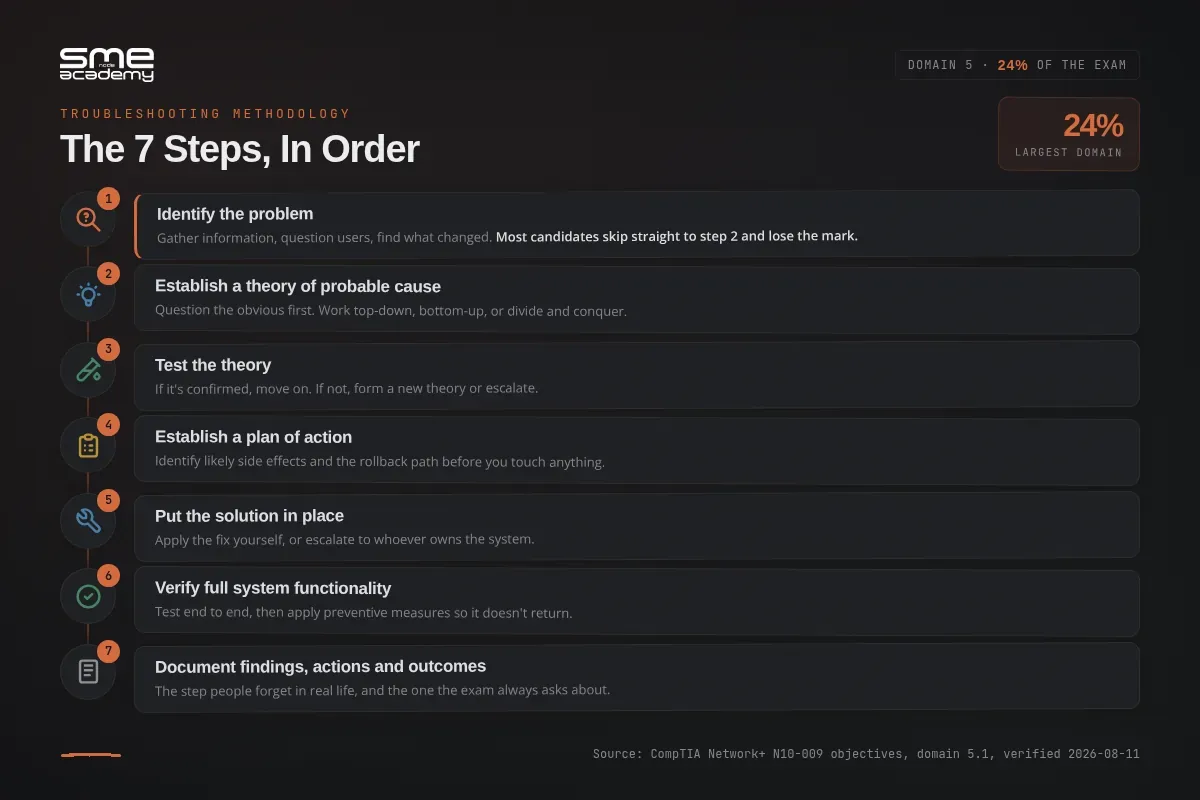
Q28. What’s the first step in CompTIA’s troubleshooting methodology? A) Establish a theory of probable cause B) Identify the problem C) Test the theory D) Establish a plan of action
Answer: B. The order is identify the problem, establish a theory, test the theory, establish a plan, put the solution in place, verify full functionality, then document everything. Skipping straight to a theory is the most common real-world mistake, and the exam checks that you know the sequence.
Q29. Users can reach 10.10.5.20 by IP but not by its hostname. Where’s the fault? A) Default gateway B) DNS resolution C) Physical cabling D) Subnet mask
Answer: B (DNS). If the IP works, Layer 1 through Layer 3 are fine and only name resolution is broken. Check the client’s DNS server setting, then the record itself with nslookup or dig. Cabling or gateway problems would break the IP connection too.
Q30. Which tool shows you the hop-by-hop path to a destination and where it stops? A) ping B) traceroute or tracert C) netstat D) arp
Answer: B. Traceroute sends packets with increasing TTL values so each router along the way replies, which shows the path and the point of failure. Ping only tells you whether the far end answers. Netstat shows local connections and listening ports, and arp maps IP to MAC on the local segment.
Q31. A copper run passes beside fluorescent light ballasts and shows rising CRC errors. Most likely cause? A) The cable is too short B) Electromagnetic interference on an unshielded run C) The switch port speed is set too low D) A duplicate IP address
Answer: B. EMI from ballasts, motors, and power runs corrupts frames on unshielded twisted pair, and corrupted frames fail their CRC check. Reroute the cable, keep distance from the noise source, or move to shielded cable or fibre. A duplicate IP causes intermittent reachability, not CRC errors.
Q32. Two APs on a new install boot fine, then reboot whenever client load rises. What should you check first? A) The wireless channel plan B) The switch’s total PoE power budget C) The SSID configuration D) DNS settings on the controller
Answer: B. APs draw more power under load, and a switch whose PoE budget is oversubscribed will drop power to ports as demand climbs. Check the per-port class and the switch’s total available wattage. PoE troubleshooting is explicitly on the N10-009 objectives.
Q33. A fibre link stays down after a technician replaces a transceiver on one end only. Most likely cause? A) The patch cable is too long B) Mismatched transceiver types or wavelengths between the two ends C) The VLAN isn’t configured D) The MTU is too small
Answer: B. Both ends of a fibre link need matching optics, wavelength, and fibre type. Put a multimode optic against a single-mode one and the link won’t come up, no matter how clean the connectors are. A VLAN problem would let the link come up and pass no traffic, which is a different symptom.
Q34. You need to see what’s directly connected to a switch port in a multi-vendor environment. Which protocol helps? A) CDP B) LLDP C) STP D) VTP
Answer: B (LLDP). Link Layer Discovery Protocol is the vendor-neutral IEEE 802.1AB standard, so it works across mixed hardware. CDP is Cisco’s own version and only sees Cisco neighbours. STP prevents loops and VTP distributes VLAN databases.
Q35. A user reports no connectivity. Which sequence follows a bottom-up approach? A) Test DNS, then the gateway, then the cable B) Check the physical link and NIC lights, then the IP configuration, then the gateway, then name resolution C) Reboot the router, then the switch, then the PC D) Check the application, then the browser, then the cable
Answer: B. Bottom-up starts at Layer 1 and works upward, which is the right instinct when a link light is dark or a cable was recently moved. Top-down (option D style) makes sense when one application fails while everything else works fine. The exam wants you to pick a method and follow it, not guess.
5 N10-009 Questions the Old Banks Never Ask
Every question in this section covers a topic added in N10-009. If a practice test doesn’t touch these, it was written for a retired exam.
Q36. What’s the core principle of a zero trust architecture? A) Trust devices inside the perimeter, verify anything outside it B) Verify every request explicitly and grant least privilege, regardless of location C) Encrypt all traffic and skip authentication D) Replace firewalls with VPN concentrators
Answer: B. Zero trust drops the idea of a trusted internal network. Every request gets authenticated and authorised against policy, and users and devices get only the access they need. Option A describes the traditional perimeter model that zero trust exists to replace.
Q37. What does VXLAN let you do? A) Compress Layer 3 headers to save bandwidth B) Stretch Layer 2 segments across a Layer 3 network using encapsulation C) Replace VLANs on a single access switch D) Route between autonomous systems
Answer: B. VXLAN wraps Layer 2 frames in UDP so a segment can span routed boundaries, which is how data centre interconnect works. Its 24-bit VNI field also breaks the 4,094 VLAN ceiling, giving about 16M segments. Data centre interconnect and Layer 2 encapsulation are both named in the objectives.
Q38. Which pair of features belongs to SD-WAN? A) Transport agnosticism and central policy management B) MAC flooding and CAM table ageing C) Modal dispersion and attenuation D) Syslog severity and trap forwarding
Answer: A. SD-WAN abstracts the underlying transport so MPLS, broadband, and LTE all become usable paths, then applies policy centrally with application awareness and zero-touch provisioning. The other options belong to switching attacks, fibre physics, and monitoring.
Q39. A team manages device configuration with version-controlled templates and playbooks. What are they doing, and what problem does it solve? A) Infrastructure as code, which catches configuration drift and keeps devices compliant B) Network address translation, which conserves public IPs C) Quality of service, which prioritises voice traffic D) Spanning tree, which prevents Layer 2 loops
Answer: A. Infrastructure as code stores the intended state as reusable templates, so you can detect drift, prove compliance, and rebuild identically. Dynamic inventories and upgrade workflows are called out in the objectives too. This entire topic is absent from N10-008 banks.
Q40. What does SASE combine? A) Two switches into one logical device B) Network connectivity such as SD-WAN with cloud-delivered security services C) Multiple fibre strands into one channel D) Wired and wireless management consoles
Answer: B. Secure Access Service Edge merges WAN connectivity with security functions delivered from the cloud, so remote users get the same policy wherever they connect. Security Service Edge is the security-only slice of the same idea. Both appear by name in objective 1.8.
How to Use This Network+ Practice Test to Actually Pass
Answering questions is the easy part. Converting misses into knowledge is what moves your score.
Here’s the method our instructors give every student. For each question you got wrong, write one sentence explaining why the right answer is right. Not the letter, the reason. If you can’t write the sentence, you recognised the answer, you didn’t know it.
Then group your misses by domain and compare against the weightings. Four wrong in troubleshooting and one wrong in security? Troubleshooting is 24% of your exam and security is 14%, so tomorrow’s study hour is obvious. Most candidates split study time evenly across domains, which quietly wastes a third of it.
Practise at exam pace. You get 90 minutes for up to 90 questions, so about a minute each. If a subnetting question takes you three minutes on paper, it’ll wreck your timing on the real thing. Speed comes from repetition, not from rereading a chapter.
Plan for the performance-based questions too. PBQs usually appear early, they eat time, and they’re worth more than a single multiple choice item. Flag them, complete the multiple choice questions first, then come back with your remaining minutes. Walking in without a PBQ plan is how people run out of clock with 15 questions untouched.
Reza came to our Network+ cohort after failing once with a 691, 29 points short. His problem was diagnosable in ten minutes: he’d never timed himself. He knew the material well enough in an untimed setting, and he’d spent 22 minutes on two PBQs on exam day. We put him on 30-question timed sets, four a week, with a hard stop. He retook it 6 weeks later and scored 812. Same knowledge, different clock discipline.
Two more things worth knowing before you book. Network+ sits above Tech+ and below CCNA in difficulty, so if these questions feel steep, our CompTIA Tech+ practice test is the gentler starting point. And if you’re weighing Network+ against Cisco’s entry cert, work through the CCNA practice test and compare how the two feel. The CCNA exam cost breakdown covers the money side of that decision.
For hands-on reps between study sessions, pair these questions with a lab workbook from our sister company SMEnode Labs. The CCNA 200-301 workbook covers the same routing and switching ground Network+ tests, with commands you type instead of options you pick. Workbook plus live class is how most of our students pass first time. Network and systems administration roles keep growing according to the U.S. Bureau of Labor Statistics, and Network+ is still the cleanest first credential into them.
Frequently Asked Questions
How hard is the Network+ exam?
Network+ is harder than most entry certs but easier than CCNA. CompTIA recommends 9 to 12 months of hands-on networking experience, and the 720 out of 900 passing score leaves modest room for error. What makes it hard isn’t depth, it’s breadth: you’re tested across five domains, from subnetting maths to compliance frameworks, in 90 minutes.
What’s the passing score for Network+?
You need 720 on a scale of 100 to 900. That scale isn’t a percentage, so don’t translate 720 into “80% correct”. CompTIA doesn’t publish how many raw questions that equals, and it varies by exam form.
How many questions are on the N10-009 exam?
A maximum of 90 questions in 90 minutes, mixing multiple choice with performance-based questions. You may see fewer than 90. Plan your pacing around one minute per question and bank spare time for the PBQs.
How many people fail Network+?
Nobody outside CompTIA actually knows. CompTIA doesn’t publish pass rates for any of its certifications, so every “70% pass rate” figure you’ll find online is someone’s guess repeated confidently. Treat those numbers as noise and judge your readiness on timed mock scores instead.
Is Network+ or CCNA harder?
CCNA is harder. It runs 120 minutes with more questions, demands Cisco command-line skill, and includes simulation items where you configure real device output. Network+ is vendor-neutral and concept-heavy. Many people do Network+ first, then CCNA, and the overlap makes the second one faster.
Can I pass Network+ with practice tests alone?
Rarely, and it’s a bad bet. Practice tests find your gaps, they don’t fill them. Candidates who pass on questions alone usually already had the hands-on experience CompTIA assumes. Use questions to direct your study, then get into labs, especially for troubleshooting, which is 24% of your score.
Bottom Line
The N10-009 is passable on the first attempt. You need 720 out of 900 in 90 minutes, and the exam rewards people who practised against the current blueprint under a clock.
Three things to take away:
- Check the exam code on every resource. N10-009 or close the tab. Retired N10-007 and N10-008 banks are still ranking on page one and still teaching removed topics.
- Weight your study to troubleshooting and concepts. Together they’re 47% of the exam. Security is only 14%, so stop over-preparing it.
- Time every practice set. One minute per question, PBQs saved for last, no pausing.
You’ve worked through 40 questions here. The full bank has more than 200, sorted by domain with a clean answer key.
Get all 200+ N10-009 practice questions free → They’re bundled with our live Network+ course, which costs nothing, includes lab access and 1-on-1 mentorship, and is the entry point to the Network Engineer career programme if you want the whole path rather than one certificate. Book your seat in the next intake and put a date on the calendar. A deadline beats motivation every time.