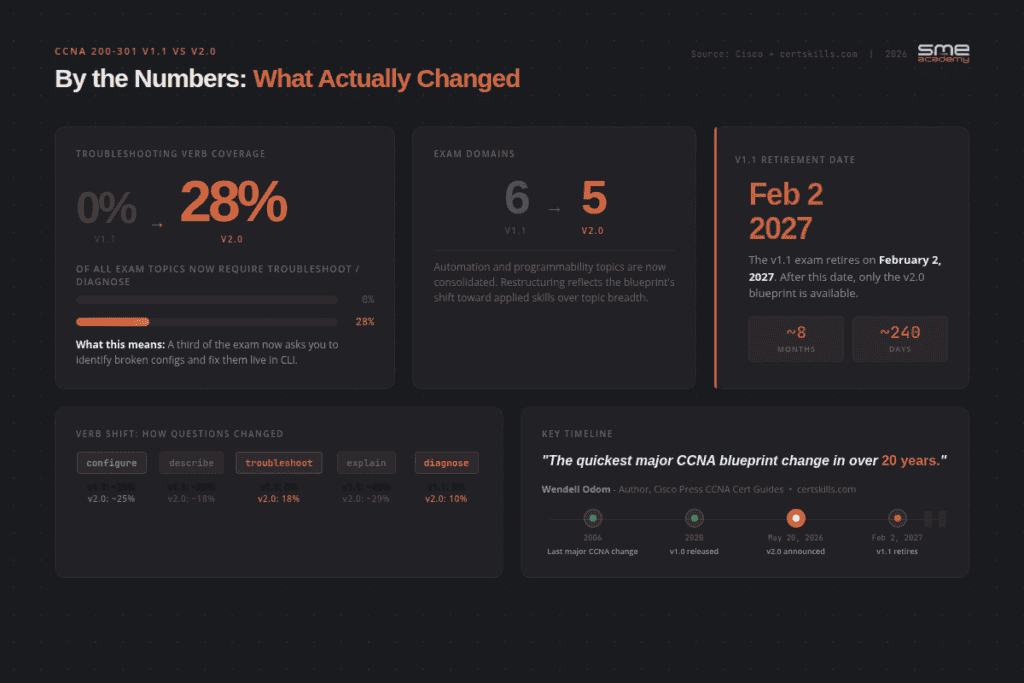
28% of CCNA v2.0 exam topics now require you to troubleshoot a problem. In v1.1, that number was zero.
That single change rewrites how you need to prepare. Cisco announced the v2.0 blueprint on May 20, 2026. V1.1 retires February 2, 2027 – roughly eight months of runway. If you’re currently studying, or deciding whether to start, you need to know which version fits your situation.
This article covers every significant change to the ccna exam topics between v1.1 and v2.0, what got added, what got removed, and a straight answer on whether rushing the old exam makes sense for you.
Should You Take CCNA v1.1 or CCNA v2.0?
V1.1 retires February 2, 2027. If you’ve been on a v1.1 study plan for six months or more and you’re past the halfway mark, finish what you started. You’ve got the runway.
If you’re starting fresh right now in June 2026, lean toward v2.0 from day one. Eight months isn’t enough to safely rush v1.1 on most study timelines – and starting v2.0 means learning material that reflects what modern network engineering jobs actually look like.
Want to compare your options with updated curriculum? SMEnode Academy’s CCNA course is fully updated for v2.0, with troubleshooting labs built directly around the new blueprint.
What Does “Troubleshoot” on the CCNA v2.0 Exam Actually Look Like?
James passed his CCNA in 2023 under v1.0. He memorised spanning tree port states – Blocking, Listening, Learning, Forwarding – and that was enough. His colleague sat a v2.0 beta exam in May 2026.
Her question: a live show spanning-tree output from a misconfigured switch. She had to identify which port should be the root port but wasn’t, explain why, and select the correct command to fix it.
Same topic. Completely different skill being tested. That gap – between “know what it does” and “fix it when it breaks” – is the defining shift in CCNA 200-301 v2.0.
The 5 Biggest Changes to CCNA v2.0 Exam Topics
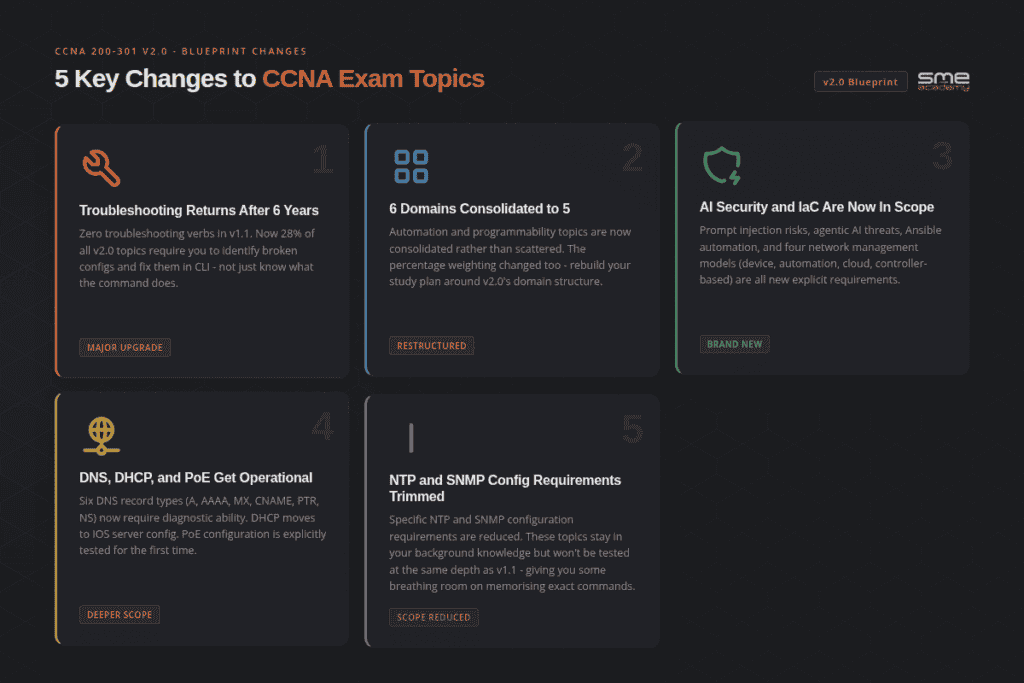
1. Troubleshoot and Diagnose Verbs Cover 28% of Topics
Under v1.0 and v1.1, the word “troubleshoot” appeared in zero topic statements. That wasn’t an accident. Cisco built those versions around foundational knowledge – you needed to understand how things work, not necessarily fix them when they didn’t.
V2.0 reverses this sharply. Right now, 28% of all exam topics carry performance-level verbs – troubleshoot or diagnose. That means roughly a third of the exam asks you to identify a broken configuration and correct it, in a CLI environment, under time pressure.
The study implication is direct. Any topic that carries “troubleshoot” or “diagnose” as its verb needs lab time – multiple sessions where you see the broken state, recognise it from command output, and fix it. Reading alone won’t get you there.
For reference: configure and verify tasks made up roughly 25% of v1.1 topics and stay at a similar level in v2.0. The troubleshooting verbs replace what were previously knowledge-level topics – “explain,” “describe,” “identify” – that you could cover through reading and flashcards.
2. Five Domains Instead of Six – Automation Gets Its Own Block
V1.1 organised exam content across six domains. CCNA v2.0 consolidates to five. This isn’t cosmetic.
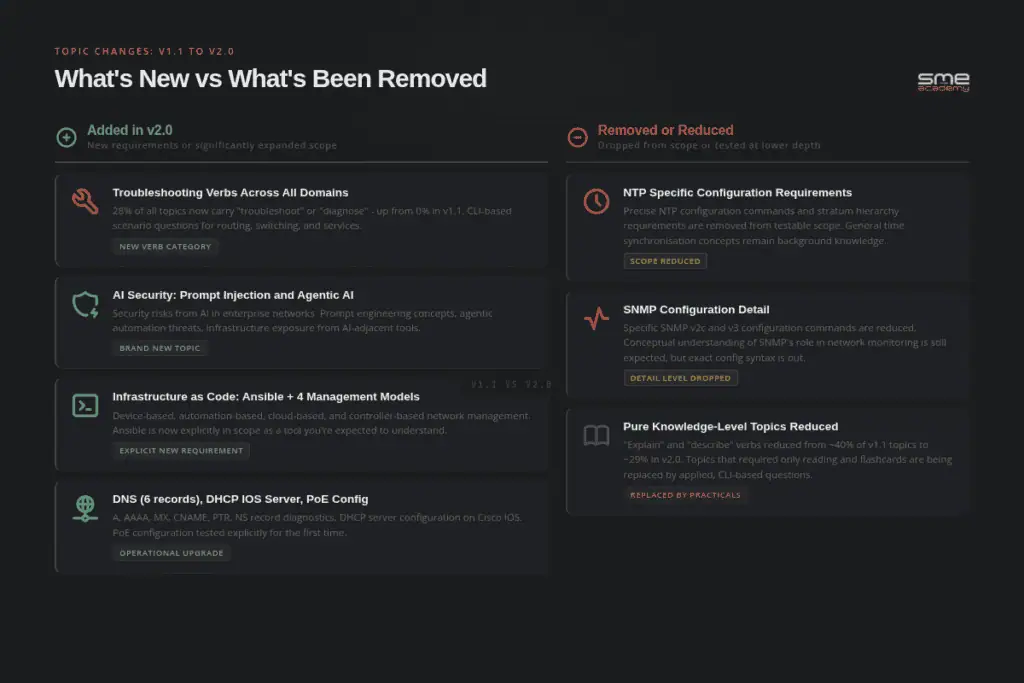
The most notable structural change: automation and programmability topics – previously distributed across separate sections – are now consolidated into a single, clearly weighted domain. Some older management topics were absorbed or repositioned alongside this consolidation.
In v1.1, automation sat at the end of a six-domain structure and was easy to underweight in your study plan. In CCNA v2.0, its position as a distinct consolidated domain signals Cisco expects you to treat it seriously, not as a light finishing section. If you built a study plan around v1.1 domain percentages, rebuilding it around v2.0’s structure is worth a few hours before you open any material.
3. AI Security and Infrastructure as Code Are Completely New
Two areas that didn’t exist anywhere in v1.1 now appear explicitly in v2.0:
AI security covers prompt engineering concepts and agentic AI behaviour. This isn’t deep machine learning theory – Cisco isn’t expecting CCNA candidates to build AI models. The focus is on the security risks that come with AI systems operating on enterprise networks: prompt injection attacks, agentic automation risks, and how to reason about AI-adjacent threats on infrastructure you manage. One focused study session on each concept is enough to be exam-ready.
Infrastructure as Code (IaC) moves from a vague mention to a real, tested requirement. V2.0 distinguishes between four network management approaches: device-based, automation-based, cloud-based, and controller-based. Ansible appears as a specific tool you’re expected to understand at a practitioner level – not just “Ansible automates networks” but what a playbook does and how it maps to a network configuration task. This was touching v1.1’s edges. Now it’s clearly in scope and tested.
4. DNS, DHCP, and PoE Move From Conceptual to Operational
Three staple topics get upgraded from “understand it” to “configure and troubleshoot it”:
DNS diagnostics – You need to work with six primary record types: A, AAAA, MX, CNAME, PTR, NS. V1.1 treated DNS as background awareness. CCNA v2.0 expects you to diagnose DNS resolution failures and understand what each record type does when it goes wrong in a production scenario.
DHCP troubleshooting – This now includes server-side configuration on Cisco IOS, not just client-side awareness. If a DHCP scope is handing out wrong addresses or failing to respond, you need to identify the cause and fix it. Server configuration commands are fair game on the exam.
Power-over-Ethernet (PoE) – PoE configuration is a new explicit topic. As wireless access points and IoT devices dominate access-layer deployments, PoE is increasingly a day-one skill for anyone working with physical network infrastructure. V1.1 didn’t test it. V2.0 does.
5. Some NTP and SNMP Requirements Were Trimmed
Not every change adds difficulty. Cisco removed specific NTP and SNMP configuration requirements from the blueprint. These topics still belong in your general networking knowledge as background context, but the exam won’t test precise SNMP configuration the way v1.1 did.
This reduction gives you some breathing room on those config details – which partly offsets the added depth in the new troubleshooting and AI security areas.
How Do You Decide Which Exam Version to Target?
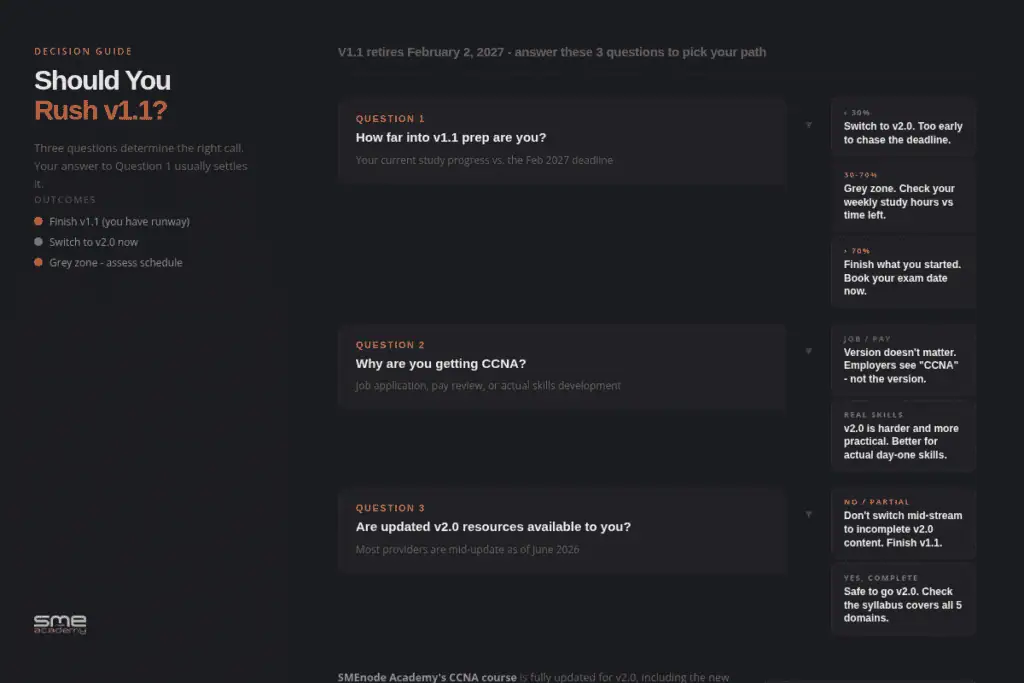
Three questions determine the right call for your situation.
Question 1: How far into v1.1 preparation are you?
Less than 30% through your study plan: stop and switch to v2.0 material. You’re early enough that restarting won’t cost much, and you won’t be chasing a February 2027 deadline while studying material that’s about to be retired.
Between 30-70% through: this is the grey zone. If you can put in 15-20 hours a week consistently, finishing by January 2027 is realistic. If your schedule is unpredictable – work travel, family commitments, anything that creates gaps – switch to v2.0 now before you’re in the same grey zone with less runway.
More than 70% through: finish what you started. Book a date. The v1.1 cert is just as valid as v2.0 from an employer’s perspective, and your sunk study time is nearly at the finish line.
Question 2: Why are you getting CCNA?
If the cert is for a job application or a pay review, the blueprint version doesn’t matter. Hiring managers see “CCNA” – they don’t ask which version you sat. If you want to actually be effective as a network engineer, v2.0 builds more practical skills. The 28% troubleshooting requirement is closer to what the job involves day to day.
Question 3: What study resources do you currently have?
Most training providers are mid-update on v2.0 material as of June 2026. If your current course or programme hasn’t published updated content yet, switching mid-stream could leave you with gaps on the new topics. Check before you commit to a version switch.
Ahmed Finishes What He Started
Ahmed started studying for CCNA in December 2025. By the time Cisco announced v2.0 on May 20, 2026, he was 24 weeks into a structured v1.1 plan and had already cleared two full practice exams with scores above 820.
His first instinct was to restart with v2.0 material. A colleague in his study group talked him out of it.
With eight months until v1.1 retired, Ahmed had enough runway to finish. He booked his exam slot for September 2026, passed with an 872, and moved straight into CCNP prep – well ahead of the February 2027 deadline.
Time you’ve already put in isn’t wasted if you have the runway to cross the finish line.
Who Should Start on CCNA v2.0 Directly
A few situations where jumping straight into v2.0 prep makes more sense:
Career changers starting July 2026 or later. The v1.1 runway is getting short. Don’t start studying material you’d need to relearn – or worse, sit an exam on a rolling deadline.
Students in a structured programme. If your bootcamp or academy is running a v2.0-aligned curriculum, stay with it. Switching mid-course creates gaps, not savings.
People who want the more hands-on cert. The 28% troubleshooting requirement in v2.0 is genuinely harder than v1.1’s knowledge-level equivalent. It’s also more directly useful on the job. If you want to leave your CCNA prep able to actually troubleshoot a network, v2.0 gets you there faster than v1.1 ever did.
Lena’s Fresh Start
Lena finished CompTIA Network+ in May 2026 and immediately started researching CCNA options. She found split advice online – half the posts said rush v1.1, half said wait for v2.0 material to mature.
She looked at three things: the retirement date (February 2, 2027), the availability of updated training (limited but growing quickly), and her study pace from Network+ (roughly eight months start to finish).
Eight months wasn’t enough to safely rush v1.1 given her schedule. She picked v2.0 immediately and aims to sit the exam in early 2027, with enough buffer to avoid any deadline pressure.
The right call depends on your situation – not a general rule that applies to everyone reading the same Reddit thread.
How to Study for CCNA v2.0 Specifically
If you’re going the v2.0 route, a few adjustments to your approach matter more than just buying updated books.
Start with the official blueprint before anything else. Download the CCNA v2.0 exam topic list from Cisco’s Learning Network before you touch any other material. Go through each topic line by line. If the verb is “troubleshoot” or “diagnose,” that topic needs hands-on lab sessions. If the verb is “describe,” reading is enough. Sort your study list by verb type first – it changes where you spend your hours.
DNS and DHCP need real lab runs. Configure a DHCP server on IOS, break it deliberately by pointing the pool at the wrong subnet, then troubleshoot it back. Do the same with DNS – set up A records and CNAME entries in a test environment and practise diagnosing lookup failures. These exact scenarios show up directly in v2.0 questions.
Don’t skip AI security. It’s a small section and easy to underestimate because it’s new. Prompt injection risks and agentic AI concepts won’t dominate your exam, but one focused session on each puts you in good shape without a significant time cost.
Build your lab time into the first half of your plan. Most candidates schedule lab work toward the end. Don’t. With 28% of topics requiring hands-on fixes, you need comfort in the CLI before your final review – not discovering weak spots during it. SMEnode Labs’ CCNA workbooks include lab scenarios built around the v2.0 blueprint. Cisco’s CML platform also offers a free tier for basic routing and switching work.
Get specific with Ansible. IaC isn’t just background theory in v2.0. Get comfortable with what an Ansible playbook actually does at the task level – how it translates a network configuration change into repeatable, declarative instructions. Read a few sample playbooks for IOS configuration tasks. The exam won’t ask you to write them from scratch, but you need to understand what you’re looking at when one is shown to you.
CCNA v1.1 vs CCNA v2.0: Side by Side
| Area | v1.1 | v2.0 |
|---|---|---|
| Domains | 6 | 5 |
| Troubleshoot verbs | 0% of topics | 28% of topics |
| AI security | Not covered | Prompt engineering, agentic AI risks |
| Infrastructure as Code | Minimal mention | Ansible, four management approaches |
| DNS | Conceptual | Six record types + diagnostics |
| DHCP | Client-side concepts | IOS server config + troubleshooting |
| PoE | Not tested | Configuration tested |
| NTP/SNMP specifics | Tested | Reduced scope |
| Exam code | 200-301 | 200-301 |
| Retirement date | Feb 2, 2027 | Not announced |
Frequently Asked Questions About CCNA v2.0
When does CCNA v1.1 retire?
February 2, 2027. After that date, only the v2.0 exam is available for new CCNA attempts.
Is CCNA 200-301 v2.0 harder than v1.1?
In one specific way: yes. The 28% troubleshooting requirement means roughly a third of the exam asks you to fix something in a live CLI environment, not just explain how it works. V1.1 had zero troubleshooting verbs in its entire topic list. Whether you find v2.0 harder overall depends on your background – candidates with hands-on lab experience often find the troubleshooting sections more straightforward than v1.1’s broader knowledge-recall questions.
Can I start studying v2.0 material right now?
Yes. Cisco published the official v2.0 exam topic list on the Cisco Learning Network as of the May 2026 announcement. Most major training providers are updating their content through Q3 2026. SMEnode Academy’s CCNA course is already updated.
If I pass v1.1, do I need to retake the exam for v2.0?
No. A CCNA is a CCNA. If you pass v1.1 before February 2, 2027, your certification is valid for the standard three-year cycle. You don’t need to sit v2.0 to “upgrade” it.
Does CCNA v2.0 expire on a different timeline?
No. Cisco certifications still follow a three-year renewal cycle regardless of which blueprint version you pass. Your recertification options stay the same.
What This Means for Your Next Steps
The ccna exam topics in v2.0 are harder in one specific way: roughly a third require you to do something, not just know something. That’s a better reflection of what network engineering involves on an actual job – and it’s why Wendell Odom, author of the official Cisco Press cert guides, described v2.0 as the quickest major CCNA blueprint change in over 20 years.
Version choice matters less than most people assume. Both give you a valid CCNA. Both require serious preparation. The bigger variable is whether your study plan is realistic for your schedule and your deadline.
If you’re comparing CCNA to the next step in your path, the CCNA vs CCNP breakdown gives you a clear picture of when to go deeper in the Cisco track. If cost is part of your decision, the CCNA exam cost guide covers current voucher pricing and what to budget.
Ready to study? Check the CCNA course schedule at SMEnode Academy. The v2.0 curriculum is live, with lab sessions built directly around the troubleshooting topics that make up 28% of the new exam.
Sources: