A network automation engineer in the US earns between $109,000 and $128,000 per year on average, with senior professionals pulling in $160,000 or more. That’s roughly 15-30% higher than what traditional network engineers make at the same experience level.
Not bad for a role that barely existed a decade ago.
The catch? Gartner says 67% of enterprise networking tasks are still done manually in 2026. That means demand for people who can automate those tasks is only going up. And if you’re wondering what is an automation engineer, how much they actually earn, and whether it’s worth retraining for, you’re in the right place.
You’ll see pay ranges by experience level, the tools and skills that command the highest salaries, and a clear path to getting into this field.
What Is a Network Automation Engineer?
A network automation engineer designs, builds, and maintains systems that replace manual network configuration with code-driven workflows. Instead of logging into 200 switches one by one to push a config change, an automation engineer writes a Python script or Ansible playbook that does it in minutes.
Think of it this way. A traditional network engineer is a skilled mechanic who tunes each engine by hand. An automation engineer builds the robotic assembly line that tunes thousands of engines with zero human error.
The core responsibilities include:
- Writing Python scripts to automate repetitive network tasks
- Building Ansible playbooks for configuration management across hundreds of devices
- Designing CI/CD pipelines for network infrastructure changes
- Creating self-healing systems that detect and fix network issues automatically
- Managing infrastructure as code with Terraform
- Integrating network systems through REST APIs, NETCONF, and YANG models
This isn’t just “networking with some scripting.” It’s a distinct engineering discipline that combines deep networking knowledge with software development skills.
Network Automation Engineer Salary Breakdown (2026)
Here’s what the data actually shows. These numbers come from three of the largest salary tracking platforms, all updated for 2026.
Salary by Percentile
| Percentile | Annual Salary | What This Means |
|---|---|---|
| 25th (entry) | $89,000 – $103,000 | New to automation, 1-2 years experience |
| 50th (mid) | $109,000 – $128,000 | Solid experience, 3-5 years |
| 75th (senior) | $133,500 – $160,000 | Senior engineer, team lead |
| 90th (top) | $143,000 – $228,000 | Principal engineer, architect level |
That top-end number isn’t a typo. Salary.com reports the highest-paid network automation engineers earning up to $228,589 per year. These are typically principal engineers or architects at major tech companies or financial institutions.
The Automation Premium: How Much More Do You Earn?
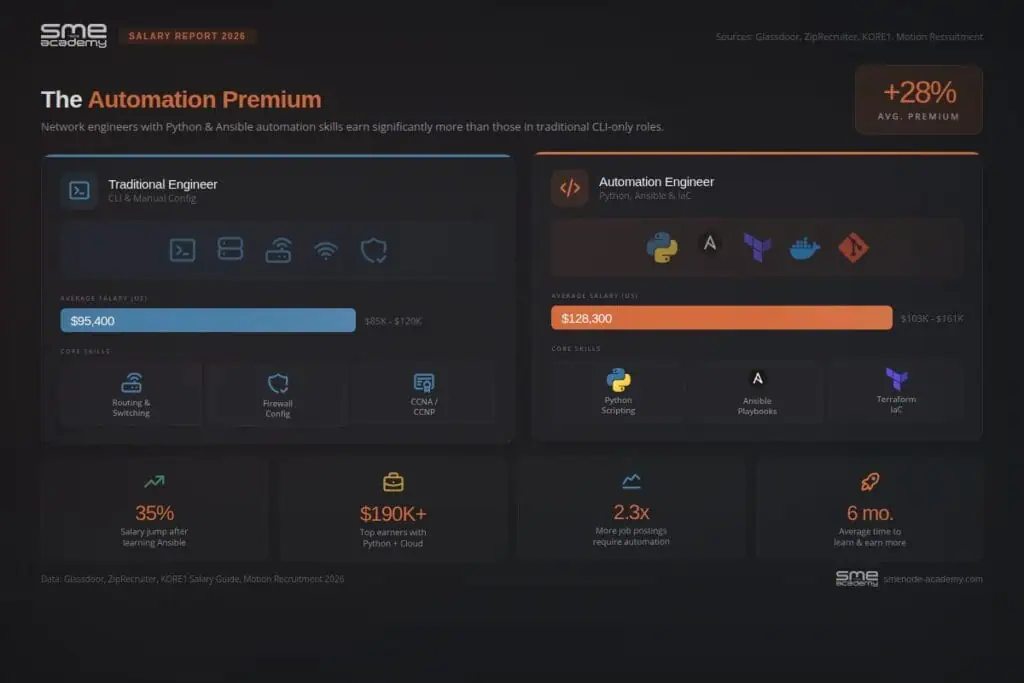
Here’s the number that matters most. Network automation engineers earn 15-30% more than traditional network engineers at the same experience level.
| Role | Average Salary | Difference |
|---|---|---|
| Network Engineer (traditional) | $97,000 – $110,000 | Baseline |
| Network Automation Engineer | $109,000 – $128,000 | +15-25% |
| Senior Network Automation Engineer | $133,000 – $160,000 | +25-35% |
Why the premium? Simple supply and demand. The talent pool for people who understand both networking AND software development is small. Really small. And the demand keeps growing.
Consider what happened to Marcus, a network engineer in Dallas. He spent 6 years doing manual switch configurations for a managed services provider, earning around $95,000. In 2024, he took an automation course, learned Ansible and Python, and started automating his own workflows. Within 8 months, he landed a network automation engineer role at $127,000. Same city. Same industry. A 33% raise just by adding automation skills.
Want to build the same skills Marcus did? SMEnode Academy’s Automation Engineer course covers Python, Ansible, Terraform, and CI/CD for networking, with live instructor-led labs.
Network Automation Engineer Salary by Experience Level
Your pay trajectory in this field depends heavily on how quickly you stack skills and certifications.
Entry-Level (0-2 Years)
Salary range: $89,000 – $109,000
At this level, you’re expected to know the basics. Python scripting, basic Ansible playbook creation, and fundamental networking concepts (CCNA level or equivalent). Most entry-level roles ask for:
- CCNA or equivalent networking certification
- Basic Python proficiency
- Familiarity with version control (Git)
- Understanding of REST APIs
The good news? Entry-level automation engineers still out-earn entry-level traditional network engineers, who typically start around $66,000 to $75,000.
Mid-Level (3-5 Years)
Salary range: $110,000 – $135,000
This is where the money starts getting interesting. Mid-level engineers are building production automation systems, not just scripts. Employers want:
- Advanced Ansible and Terraform skills
- Python libraries like Netmiko, NAPALM, and Nornir
- CI/CD pipeline design for network changes
- CCNP or DevNet Professional certification
- Experience with NETCONF, RESTCONF, and YANG models
Senior Level (5-8+ Years)
Salary range: $135,000 – $175,000+
Senior automation engineers design the strategy. They decide which tools to use, how to structure the automation framework, and how to train the rest of the networking team. At this level:
- Architecture design for enterprise-scale automation
- Multi-vendor, multi-cloud automation (AWS, Azure, GCP networking)
- Team leadership and mentoring
- CCIE or DevNet Expert certifications command top dollar
Architect / Principal (10+ Years)
Salary range: $175,000 – $228,000+
The ceiling is high. Principal engineers and automation architects at Fortune 500 companies or large cloud providers push well past $200K, especially in cities like San Jose, Seattle, and Washington DC.
Network Automation Engineer Salary in Canada
For the Canadian market specifically:
| Metric | Amount (CAD) |
|---|---|
| National average | $80,933/yr |
| Low range | $65,585/yr |
| High range | $129,013/yr |
| Toronto premium | Up to $144,698/yr (+17% above national average) |
Toronto and Vancouver command the highest salaries. If you compare this to the US market, Canadian salaries are lower in absolute terms. But factor in the exchange rate, lower cost of living in many Canadian cities, and universal healthcare, and the gap narrows significantly.
Top Skills That Boost Your Network Automation Salary

Not all skills pay equally. Here’s what actually moves the needle on your compensation, ranked by salary impact.
1. Python (Non-Negotiable)
Python is the language of network automation. Full stop. It hit a 26.14% rating on the TIOBE Index in 2025, the highest any programming language has ever scored. Every serious automation job posting lists Python as a requirement.
But it’s not just “knowing Python.” The libraries matter:
- Netmiko – SSH automation for multi-vendor device management
- NAPALM – Unified API for network device interaction
- Nornir – Orchestration framework for large-scale automation
- pyATS – Cisco’s testing framework for network validation
2. Ansible
Ansible is the most widely used configuration management tool in network automation. It’s agentless (no software to install on network devices), uses simple YAML syntax, and has massive community support.
If you’re new to Ansible for networking, the NetBox Ansible integration guide on our blog walks through building dynamic inventories that actually stay current.
3. Terraform
Terraform dominates the Infrastructure as Code space with over 70% market share. For network automation engineers, Terraform handles the provisioning layer, things like spinning up cloud network resources, managing DNS zones, and configuring load balancers.
4. APIs and Programmability (NETCONF, RESTCONF, gRPC)
Modern network devices expose programmable interfaces. Engineers who can work with NETCONF, RESTCONF, gRPC, and YANG data models are significantly more valuable than those who only know CLI-based automation.
5. CI/CD for Networking
Treating network changes like software deployments, with version control, automated testing, and staged rollouts, is becoming standard practice. Git, GitHub Actions or GitLab CI, and automated testing frameworks are expected skills.
Certifications That Impact Network Automation Salary

Certifications still matter in networking, possibly more than in any other IT discipline.
| Certification | Typical Salary Impact | Time Investment |
|---|---|---|
| CCNA | Baseline ($94,000 avg) | 3-6 months |
| CCNA + automation skills | $100,000 – $140,000 | 6-9 months |
| Cisco DevNet Associate | ~$105,000 | 3-4 months |
| DevNet Professional | ~$120,000 | 6-8 months |
| CCNP + automation | $115,000 – $132,000 | 8-12 months |
Sources: Glassdoor, PayScale, SMEnode Academy research (2026)
The biggest salary jump doesn’t come from one certification alone. It comes from stacking a networking cert (CCNA or CCNP) with automation skills. That combination signals to employers that you can bridge the gap between traditional networking and modern automation.
Take Priya’s story. She earned her CCNA in 2023 and was earning $92,000 as a network engineer in Atlanta. Instead of going straight for CCNP, she invested 6 months learning Python and Ansible through a structured automation course. By mid-2025, she had both her DevNet Associate and hands-on automation experience. Her new role? Network automation engineer at a healthcare company. Salary: $118,000. That’s a 28% increase in under two years.
Curious which Cisco certifications deliver the highest ROI? Check our breakdown of 5 Cisco certifications that boost your salary or the detailed CCNA salary guide by experience level.
Why Network Automation Salaries Keep Rising
Three forces are pushing these salaries higher every year.
1. The 67% Manual Gap
According to Gartner, 67% of enterprise networking activities are still performed manually. That’s a staggering amount of inefficiency in a world where every other IT discipline has embraced automation. The companies that want to close this gap need people who can build the automation. And there aren’t enough of those people.
2. The 3x Growth Prediction
Gartner projects that 30% of enterprises will automate more than half of their network activities by 2026, up from under 10% in 2023. That’s a 3x increase in just three years. The network automation market itself is valued at $7.88 billion in 2025 and projected to reach $12.38 billion by 2030 (MarketsandMarkets).
Source: Gartner, September 2024
3. The Skills Gap Is Severe
Here’s the stat that should get your attention: 92.2% of operations staff report skills shortages, and 26.8% of organisations specifically cite a lack of automation expertise. That means almost every IT team in the world is looking for people with these skills and can’t find them.
When demand is high and supply is low, salaries go up. That’s exactly what’s happening here.
Ready to position yourself for this growing market? The DevOps salary landscape shows a similar trend across the entire automation space.
How to Become a Network Automation Engineer
If you’re a network engineer looking to transition, or someone starting fresh, here’s the practical path.
Step 1: Build Your Networking Foundation
You can’t automate what you don’t understand. Start with solid networking fundamentals, CCNA level at minimum. Understand routing protocols, switching, firewalls, VLANs, and basic network design.
Step 2: Learn Python for Networking
You don’t need to become a full-stack developer. Focus on:
- Data structures (lists, dictionaries, JSON handling)
- Libraries: Netmiko, Paramiko, NAPALM
- Working with APIs (requests library, JSON parsing)
- File handling for configs and templates (Jinja2)
Step 3: Master Ansible for Network Automation
Ansible is your bread and butter. Learn to write playbooks, build dynamic inventories, use network-specific modules (ios_config, nxos_config), and structure projects with roles.
Step 4: Add Infrastructure as Code (Terraform)
Terraform completes the automation stack. Learn provider configuration, state management, and how to automate cloud networking resources.
Step 5: Get Certified
Stack your certifications strategically:
- CCNA (networking foundation)
- DevNet Associate (proves programming and API skills)
- CCNP or DevNet Professional (senior-level credibility)
Step 6: Build a Portfolio
Create real automation projects. Automate a home lab. Build Ansible playbooks that configure virtual routers. Contribute to open-source network automation tools. Employers want to see what you’ve actually built, not just what you’ve studied.
SMEnode Academy’s Automation Engineer programme covers steps 2 through 5 in a structured, live instructor-led format. You get hands-on labs with real network devices, not just theory.
Network Automation Engineer vs Related Roles
How does this salary compare to similar positions?
| Role | Average Salary (2026) | Key Difference |
|---|---|---|
| Network Automation Engineer | $109,000 – $128,000 | Automates network infrastructure |
| DevOps Engineer | $120,000 – $145,000 | Broader scope, app + infra automation |
| Cloud Network Engineer | $115,000 – $140,000 | Cloud-specific networking |
| Traditional Network Engineer | $85,000 – $110,000 | Manual configuration focus |
| Site Reliability Engineer (SRE) | $130,000 – $165,000 | Reliability + automation for all systems |
Sources: Glassdoor, ZipRecruiter, Salary.com (2026)
The network automation engineer role sits in a sweet spot. It pays more than traditional networking but doesn’t require the full software engineering depth of an SRE or DevOps role. And if you want to grow into DevOps or SRE later, network automation is a strong launchpad.
Top-Paying Cities for Network Automation Engineers
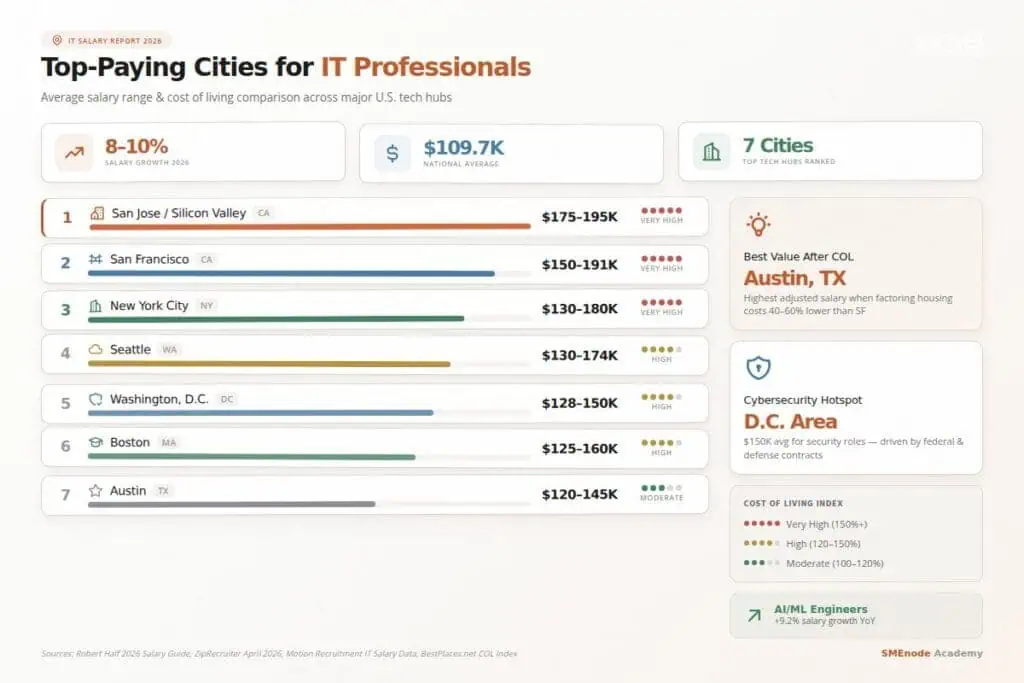
Location still impacts salary significantly, even with remote work options.
| City | Estimated Salary Range | Cost of Living Factor |
|---|---|---|
| San Jose, CA | $145,000 – $173,000 | Very high |
| Seattle, WA | $135,000 – $165,000 | High |
| Washington, DC | $130,000 – $160,000 | High |
| New York, NY | $125,000 – $155,000 | Very high |
| Austin, TX | $115,000 – $140,000 | Moderate |
| Toronto, ON (CAD) | $120,000 – $145,000 | High |
| Dallas, TX | $110,000 – $135,000 | Moderate |
| Remote (US-based) | $105,000 – $140,000 | Varies |
Sources: Glassdoor, ZipRecruiter, Motion Recruitment (2026)
Pro tip: remote roles based in lower cost-of-living areas while paying closer to major metro rates offer the best effective salary. An engineer earning $130,000 remotely from Austin has significantly more purchasing power than someone earning $155,000 in San Jose.
Bottom Line
Network automation engineers earn $109,000 to $128,000 on average in 2026, with senior roles pushing past $160,000 and top earners clearing $228,000. The automation premium over traditional network engineering is real, roughly 15-30% at equivalent experience levels.
The market forces are strongly in your favour. With 67% of networking still manual, a 3x increase in automation adoption predicted by Gartner, and 92% of IT teams reporting skills gaps, demand for qualified automation engineers will only grow.
Your fastest path in:
- Get your networking fundamentals solid (CCNA)
- Learn Python and Ansible specifically for networking
- Add Terraform and CI/CD skills
- Stack a DevNet certification on top
- Build real projects to prove your skills
The salary data is clear. The market trend is clear. The only question is whether you start building these skills now or wait until the competition catches up.