
48% of Canadian IT hiring managers are increasing headcount in 2026. And they’re not looking for degrees. They want certifications. That single stat from Robert Half Canada tells you everything about where IT certification jobs in Canada are heading this year.
So which certifications actually get you hired? Short answer: cybersecurity certs (CISSP, Security+), cloud credentials (AWS Solutions Architect, Azure Administrator), and networking certifications (CCNA, CCNP, CCIE) top the list. IT certification jobs in Canada pay between $55,000 CAD at entry level and well over $200,000 CAD for expert-level roles like CCIE Security or AWS Security Specialty. Certified IT professionals in Canada are earning premiums that non-certified peers simply can’t match.
But the numbers only tell part of the story. The cert you choose, the city you’re in, and how you stack your credentials all matter. A lot. This guide breaks down the IT certification jobs in Canada that employers are actually hiring for right now, with real salary data, city-by-city demand, and the fastest paths to getting hired.
Whether you’re a newcomer targeting your first IT certification jobs in Canada or a mid-career professional looking to level up, the playbook is the same: pick the right cert, get hands-on experience, and position yourself where the demand is highest. Technology jobs in Canada are growing 1.77 times faster than the rest of the economy. That gap isn’t closing anytime soon.
What IT Certification Jobs in Canada Pay the Most?
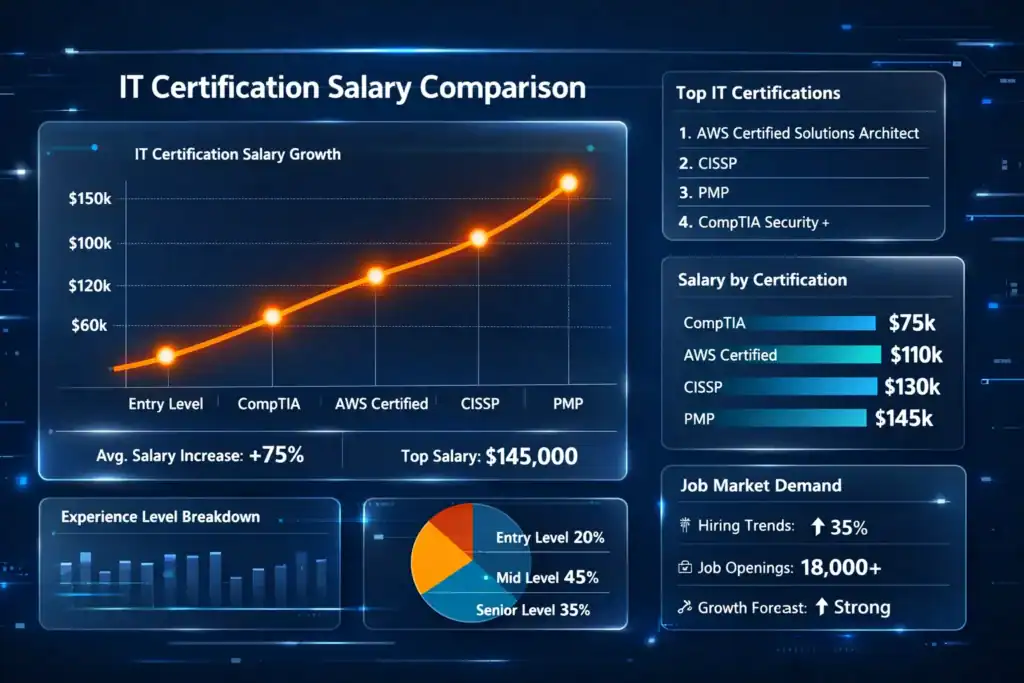
Money talks. So let’s start there. IT certification jobs in Canada span a massive salary range, and your cert choice is the biggest lever you’ve got. Here’s what certified IT professionals actually earn across the country in 2026:
| Certification | Entry Level (CAD) | Mid-Career (CAD) | Senior (CAD) |
| CCIE (all tracks) | $130,000 | $175,000 | $220,000+ |
| CCIE Security | $140,000 | $185,000 | $230,000+ |
| AWS Solutions Architect | $105,000 | $137,000 | $175,000+ |
| Azure Solutions Architect | $100,000 | $142,000 | $180,000+ |
| CCNP (Enterprise/Security) | $98,000 | $119,000 | $165,000+ |
| CISSP | $95,000 | $120,000 | $155,000+ |
| Fortinet NSE4 | $80,000 | $105,000 | $140,000+ |
| DevOps (various certs) | $90,000 | $130,000 | $170,000+ |
| CCNA | $60,000 | $85,000 | $120,000+ |
| CompTIA Security+ | $55,000 | $75,000 | $100,000+ |
Look at that gap between CCNA and CCIE. That’s not just a certification difference. It’s a career-tier jump. And for IT certification jobs in Canada, the expert-level certs consistently command the highest salaries, especially in Toronto and Vancouver.
Here’s what surprised us though. The CCIE salary in Canada has climbed about 8-12% over the past two years. Why? Simple supply and demand. Only about 60,000 CCIE holders exist worldwide. Canada needs more of them.
Also worth mentioning: remote work has changed the salary landscape for IT certification jobs in Canada. Professionals in smaller cities can now access Toronto-level salaries by working remotely for GTA-based companies. That said, on-site and hybrid roles still pay a premium in most cases.
So which cert gives you the best return? For entry-level IT certification jobs in Canada, CCNA offers the fastest path to a paycheck. For maximum earning potential, CCIE Security is hard to beat. And for the broadest job market access, AWS Solutions Architect opens doors across almost every industry.
Which IT Certification Jobs in Canada Are Growing Fastest?

Three areas are absolutely exploding for IT certification jobs in Canada right now: cybersecurity, cloud infrastructure, and DevOps automation.
Cybersecurity leads the pack. And it’s not even close. Quebec’s Bill 25 on personal information protection forced every organization in the province to beef up security teams. Ontario is following similar patterns. The result? Cybersecurity jobs in Canada have seen double-digit growth, with certified professionals getting snapped up within weeks of hitting the market. Cybersecurity jobs in Canada now outnumber qualified candidates by a wide margin.
Cloud adoption is the second biggest driver. Canadian businesses are moving fast on AWS and Azure. Cloud certification salary numbers keep climbing as demand outpaces supply. According to Randstad Canada, cloud architects and engineers rank among the most in-demand IT roles for 2026. If you hold an AWS Solutions Architect or Azure Solutions Architect certification, you’re looking at a cloud certification salary starting above $100K CAD.
DevOps and automation round out the top three. Companies don’t just want engineers who can configure networks anymore. They want people who can automate them. That’s why Cisco’s DevNet track and automation certifications have gained serious traction. Our CCIE Automation program covers exactly this shift.
Sound familiar? If you’ve been watching the Canadian IT job market, none of this is surprising. But here’s the part most people miss: it’s the combination of certs that gets you hired fastest.
For example, a network engineer with CCNP plus AWS certification is far more valuable than someone with just one of those credentials. Why? Because IT certification jobs in Canada increasingly require hybrid skills. Your network doesn’t end at the office firewall anymore. It extends into AWS, Azure, and multi-cloud environments.
The Network Engineer career track and System Engineer track at SMEnode Academy are built around this exact reality. You don’t just learn one platform. You learn how they all connect. And with AI reshaping network operations, AIOps for Networks is becoming a differentiator for senior IT certification jobs in Canada.
Best Certifications for IT Certification Jobs in Canada by Category
Not all certifications are equal. The best one for you depends on which career path you’re targeting. Let’s break down the IT certification jobs in Canada by category so you can see exactly where to invest your time.
Networking IT Certification Jobs in Canada

Networking is the backbone of IT. Always has been. And in Canada, certified network engineers are still in high demand, especially for hybrid cloud environments where on-prem and cloud systems need to talk to each other. If you want stable, well-paying IT certification jobs in Canada, networking is a proven path.
The Cisco certification path is still the gold standard here. Start with CCNA to prove you understand routing, switching, and basic security. CCNA-certified professionals in Canada earn around $60,000-$120,000 CAD depending on experience. Not bad for an entry-level cert. For a deeper look at the numbers, check our CCNA salary breakdown.
From there, CCNP Enterprise takes you to the professional level. And then there’s CCIE. Different league entirely.
Think of it this way. CCNA is your driver’s license. CCIE is your pilot’s license. The CCIE Enterprise and CCIE Data Center tracks are where senior IT certification jobs in Canada live. Robert Half Canada lists CCNP and CCIE as preferred credentials for senior network architect positions, one of the top-paying IT roles in the country.
Also worth noting: Cisco SD-WAN and Cisco ACI skills are increasingly showing up in Canadian job postings. Enterprise networking isn’t just routers and switches anymore.
If you’re aiming for networking IT certification jobs in Canada, the practical experience matters as much as the cert itself. Our courses run longer than typical programs because proper learning takes time. You’ll get unlimited lab access to practice on real equipment, which is what separates candidates who pass interviews from those who don’t.
Security IT Certification Jobs in Canada
Cybersecurity jobs in Canada are growing faster than any other IT segment. Certified IT professionals with security credentials are commanding premium salaries. If there’s one area where IT certification jobs in Canada are practically guaranteed, it’s security.
Where should you start? CompTIA Security+ is the entry point. It’s now the baseline requirement for most system admin and junior security roles across the country. In Quebec, it’s practically non-negotiable, with average salaries around $55,000-$75,000 CAD for entry-level positions.
For mid-career professionals, the CCIE Security certification puts you in elite territory. We’re talking $140,000-$230,000+ CAD. Only about 25-30% of candidates pass on the first attempt. Yeah, it’s brutal. But that difficulty is exactly what makes it valuable. For the full salary picture, see our CCIE Security salary guide.
Beyond Cisco, specialized security tools are huge for IT certification jobs in Canada. Fortinet NSE4 training matters because FortiGate firewalls are everywhere in Canadian enterprises. Splunk Enterprise and Wazuh XDR certifications prove you can handle SIEM and extended detection. These are the tools Canadian SOC teams actually use daily.
Our Security Engineer career track bundles these skills together. Because hiring managers looking to fill security-focused IT certification jobs in Canada don’t want someone with just one cert. They want a security professional who can work across platforms.
Cloud IT Certification Jobs in Canada
Cloud certification salary numbers in Canada are hard to ignore. AWS and Azure dominate the Canadian market, and the demand for certified cloud professionals keeps climbing. Cloud-focused IT certification jobs in Canada are among the most accessible for remote workers too.
AWS track: The AWS Cloud Practitioner is your starting point. It’s foundational, but it proves you understand cloud concepts. The AWS certification program offers multiple specialty tracks. The real money starts with AWS Solutions Architect. In Canada, AWS-certified architects pull in $105,000-$175,000+ CAD. Montreal’s startup ecosystem especially loves AWS credentials. For the full breakdown, read our AWS certifications guide.
Azure track: Microsoft Azure dominates in Canadian financial institutions and government. The Azure Administrator cert is your entry, and Azure Solutions Architect is where the bigger salaries kick in. Quebec-based employers particularly value Azure because of its strong presence in the province’s financial sector.
Here’s the thing. If you’re targeting IT certification jobs in Canada specifically, holding both an AWS and an Azure cert gives you a serious edge. Most Canadian enterprises run multi-cloud environments. Being locked into just one platform limits your options.
Cloud IT certification jobs in Canada also offer strong remote work flexibility. Many cloud architect and cloud engineer roles are fully remote, which means you can live in Calgary and work for a Toronto-based fintech. That salary arbitrage is real, and it makes cloud certifications even more attractive for IT certification jobs in Canada.
DevOps and Automation Certification Jobs

Automation isn’t optional anymore. Every major Canadian employer expects IT professionals to write scripts, manage CI/CD pipelines, and automate repetitive tasks. That’s made DevOps certification one of the fastest-growing categories for IT certification jobs in Canada.
The DevOps Engineer career track covers the full pipeline: containerization, infrastructure as code, monitoring, and deployment automation. DevOps-certified professionals targeting IT certification jobs in Canada earn between $90,000 and $170,000+ CAD.
On the networking side, Cisco’s automation track is gaining ground fast. Start with CCNA Automation to learn network programmability. Then scale up to CCIE Automation if you want to be the person who designs automated network infrastructure for large enterprises.
Big difference between someone who can configure a network and someone who can automate it. Canadian employers know that. And they’re paying accordingly.
On the infrastructure side, don’t overlook virtualization certs. VMware vSphere and VMware NSX training is still relevant for IT certification jobs in Canada, especially in enterprise environments running private cloud. Nutanix NCP and Proxmox VE are gaining traction too, particularly among organizations looking for alternatives to traditional hypervisors.
Why Canadian Employers Prefer Certified IT Professionals
Here’s what hiring managers won’t say on LinkedIn but absolutely think during interviews: degrees tell them you can learn. Certifications tell them you can do the job. That mindset is what makes IT certification jobs in Canada so accessible for people with the right credentials.
The shift toward skills-first hiring is real in Canada. Robert Half reports that 69% of Canadian tech leaders say upskilling current employees is needed to meet 2026 targets. That’s a massive skills gap. And certifications are how employers verify you’ve got what it takes.
The salary premium is real too. Certified IT professionals in Canada earn 15% to 25% more than their non-certified peers, according to multiple Canadian recruitment firms. That’s not a small difference. On a $100K salary, we’re talking $15,000-$25,000 extra per year. Over a career of pursuing IT certification jobs in Canada? That adds up fast.
And it’s not just about salary. 56% of certification holders receive pay increases within 3 months of getting certified. Three months. That’s a pretty quick return on investment.
In our live training sessions, we see this play out constantly. Students from Toronto to Vancouver land interviews within weeks of completing their certifications. The credential opens doors. The hands-on skills they build in live labs are what close the deal.
And here’s something else most career guides skip. Canadian employers value certification recency. A CCNA you earned last year beats a CCIE from 2015 that’s lapsed. Keep your certs current. For IT certification jobs in Canada, showing that you’re actively maintaining and building skills signals commitment to employers.
How Do You Land IT Certification Jobs in Canada as a Newcomer?
If you just landed in Canada, or you’re planning to make the move, this section is for you. IT certification jobs in Canada are genuinely accessible for newcomers, but you need a strategy.
Think of certifications as your work permit for the IT industry. Canadian employers may not recognize your degree from another country, but they absolutely recognize Cisco, AWS, and Microsoft certifications. These are global standards. And they’re the fastest way into IT certification jobs in Canada for international professionals.
Here’s a realistic path for career changers and new immigrants:
Step 1: Start with a foundational cert. CCNA for networking, Security+ for cybersecurity, or AWS Cloud Practitioner for cloud. These get your foot in the door for entry-level IT certification jobs in Canada.
Step 2: Build Canadian work experience. Even contract roles and short-term projects count. Toronto tech jobs are especially open to newcomers with certifications.
Step 3: Stack a second cert. Move from CCNA to CCNP, or from Cloud Practitioner to Solutions Architect. Each additional cert bumps your salary range and opens more doors.
Step 4: Specialize. Once you’ve got 2-3 years of Canadian experience, go deep in one area. Security, cloud, or automation are the highest-demand specialties for IT certification jobs in Canada at the mid-career and senior levels.
One more thing. Live training helps newcomers more than you’d think. Unlike pre-recorded courses, our live sessions let you ask questions in real-time, practice in hands-on labs, and build connections with other IT professionals across Canada. Every student gets free 1-on-1 mentorship throughout the program. That kind of support matters when you’re building a career in a new country.
Top Canadian Cities for IT Certification Jobs

Where you live in Canada significantly impacts your IT certification job prospects. Not all cities are equal. And for IT certification jobs in Canada, geography still plays a major role in both salary and opportunity volume.
| City | Top Demand Areas | Key Employers | Salary Premium |
| Toronto | Cloud, Security, DevOps | Banks, Telecom, Big Tech | Highest in Canada |
| Vancouver | Cloud, AI/ML, Networking | Tech startups, Gaming | High (but high COL) |
| Montreal | AI, Security, AWS | Startups, Finance, Gov | Moderate (best COL ratio) |
| Calgary | Cloud, DevOps, Security | Energy, Finance | Growing fast |
| Ottawa | Security (gov clearance) | Government, Defense | Stable, security premium |
Toronto is Canada’s biggest tech hub. Period. IT certification jobs in Canada are most abundant here. Banks like RBC, TD, and BMO are constantly hiring certified network engineers, security analysts, and cloud architects. If you hold a CCIE or senior AWS certification, Toronto is where the top salaries are for IT certification jobs in Canada.
Montreal is the sleeper pick. Lower cost of living than Toronto, a booming startup ecosystem (especially AI), and strong government demand. Quebec’s privacy regulations (Bill 25) have created extra demand for security-certified professionals. If you’re bilingual? Even better.
Ottawa is unique because of government and defense contracts. Security clearance plus a CISSP or CCIE Security cert? That combination is gold for IT certification jobs in Canada’s capital.
Calgary is the dark horse. The energy sector’s digital transformation is driving strong demand for cloud and DevOps professionals. Lower competition than Toronto means certified professionals often get hired faster.
No matter which city you choose, the pattern is the same for IT certification jobs in Canada: certified professionals get hired faster, earn more, and have better career mobility than non-certified peers. The only variable is which certifications are most valued in each market.
Frequently Asked Questions
What are the best certifications for IT certification jobs in Canada in 2026?
The highest-demand certifications for IT certification jobs in Canada are CCNA and CCIE for networking, AWS Solutions Architect and Azure Administrator for cloud, CompTIA Security+ and CISSP for cybersecurity, and Fortinet NSE4 for firewall security. Your best choice depends on your experience level and career goals. Entry-level candidates should start with CCNA or Security+. Mid-career professionals targeting IT certification jobs in Canada get the biggest salary boost from CCIE, AWS Solutions Architect, or CISSP.
How much do IT certification jobs in Canada pay in 2026?
Salaries for IT certification jobs in Canada range from about $55,000 CAD for entry-level Security+ holders to over $230,000 CAD for CCIE Security certified professionals. The average for certified IT professionals sits around $90,000-$120,000 CAD at the mid-career level. Toronto and Vancouver offer the highest salaries, while Montreal provides the best salary-to-cost-of-living ratio.
Can I get IT certification jobs in Canada without a degree?
Yes. The Canadian tech industry is shifting toward skills-first hiring. Multiple recruitment firms report that employers prioritize certifications and hands-on experience over formal degrees for IT certification jobs in Canada. A CCNA or AWS certification with practical lab experience is often enough to land entry-level roles. That said, stacking multiple certifications accelerates your career progression significantly.
Which Canadian city has the most IT certification jobs?
Toronto has the highest volume of IT certification jobs in Canada, followed by Vancouver, Montreal, Calgary, and Ottawa. Toronto dominates in banking and enterprise IT. Montreal leads in AI and startups. Ottawa offers strong government security roles. Calgary is growing fast in cloud and DevOps positions.
How long does it take to get certified and land a job?
Entry-level certifications like CCNA or Security+ typically take 2-4 months of preparation. With live instructor-led training and hands-on labs, many students get certified faster. After certification, most candidates in high-demand areas land interviews within 2-6 weeks. The entire path from starting your first cert to landing your first IT certification job in Canada can take 3-6 months.
Is live training better than self-study for IT certifications?
For most people, yes. Self-study works for highly disciplined learners, but live training provides real-time Q&A with expert instructors, hands-on lab practice, and structured learning paths that prepare you for IT certification jobs in Canada faster. Learning from videos alone is like learning hockey from YouTube. At some point, you need ice time. Live labs give you that hands-on experience. Our courses run longer than typical programs because proper learning takes time, and every student gets free mentorship throughout.
Bottom Line: Your Next Move
IT certification jobs in Canada aren’t slowing down in 2026. If anything, the talent shortage is making certified professionals more valuable than ever. 48% of IT hiring managers are expanding their teams. 69% say they need to upskill existing staff. The demand is real.
Your fastest path? Pick a certification category (networking, security, cloud, or DevOps), earn a foundational cert, get some Canadian work experience, and keep stacking credentials. The data is clear: certified IT professionals in Canada consistently out-earn their non-certified peers by 15-25%.
Don’t overthink this. The best time to start pursuing IT certification jobs in Canada was a year ago. The second-best time? Right now.
If you want structured preparation with expert instructors, hands-on lab access, and free mentorship, check out SMEnode Academy’s live training programs. We cover the full Cisco track (CCNA through CCIE Enterprise, CCIE Security, CCIE Data Center, and CCIE Automation), plus AWS, Azure, DevOps, and security tools like Fortinet, Splunk, and Wazuh.
IT certification jobs in Canada are waiting. The only question is whether you’re going to get certified and go after them.