$82,000 a year or $112,000. That’s the salary gap between a CCNA holder and someone with a CCNP.
Pretty big difference for one certification level, right?
But here’s the thing. Jumping straight to CCNP isn’t always the smart move. And getting your CCNA first doesn’t mean you’re falling behind. It depends on where you are right now, what jobs you’re targeting, and how much time you can actually commit to studying.
In this guide, we’ll break down the real differences between CCNA and CCNP: salary data with sources, difficulty levels, career paths, exam costs, and the honest answer about which one makes sense for your situation. We’ll also cover all 6 CCNP specialisation tracks and how both certs compare to the CCIE for those thinking long-term.
Let’s get into it.
CCNA vs CCNP: What’s the Actual Difference?
The short version? CCNA is your entry into the Cisco world. CCNP proves you can actually run it.
CCNA (Cisco Certified Network Associate) covers networking fundamentals. You’ll learn routing, switching, security basics, and some automation. It’s designed for people with about a year of networking experience, though plenty of folks pass it with less.
CCNP (Cisco Certified Network Professional) goes deeper. Way deeper. You’re expected to design, deploy, troubleshoot, and manage enterprise networks. Cisco recommends 3 to 5 years of experience before attempting it.
Think of it this way. CCNA is learning to drive. CCNP is learning to build and maintain the roads.
One thing that changed back in 2020: Cisco dropped the prerequisite requirement. You don’t technically need a CCNA to take CCNP exams. But should you skip it? We’ll get to that.
CCNA vs CCNP Exam Details
Here’s a side-by-side comparison of what each certification actually involves:
| CCNA | CCNP | |
|---|---|---|
| Exam Code | 200-301 | Core + 1 Concentration |
| Number of Exams | 1 | 2 |
| Exam Duration | 120 minutes | 120 min (core) + 90 min (concentration) |
| Questions | ~100 | ~90-110 per exam |
| Passing Score | 825/1000 | 825/1000 (both exams) |
| Exam Cost | $330 USD | $700 USD total ($400 + $300) |
| Prerequisites | None | None (CCNA recommended) |
| Validity | 3 years | 3 years |
| Tracks | 1 (general) | 6+ specialisations |
Source: Cisco Certification Exams
The biggest structural difference? CCNP requires two exams. You take one core exam plus one concentration exam from your chosen track.
For a detailed breakdown of CCNA exam fees and how to save on them, check out our CCNA exam cost guide.
All 6 CCNP Tracks in 2026
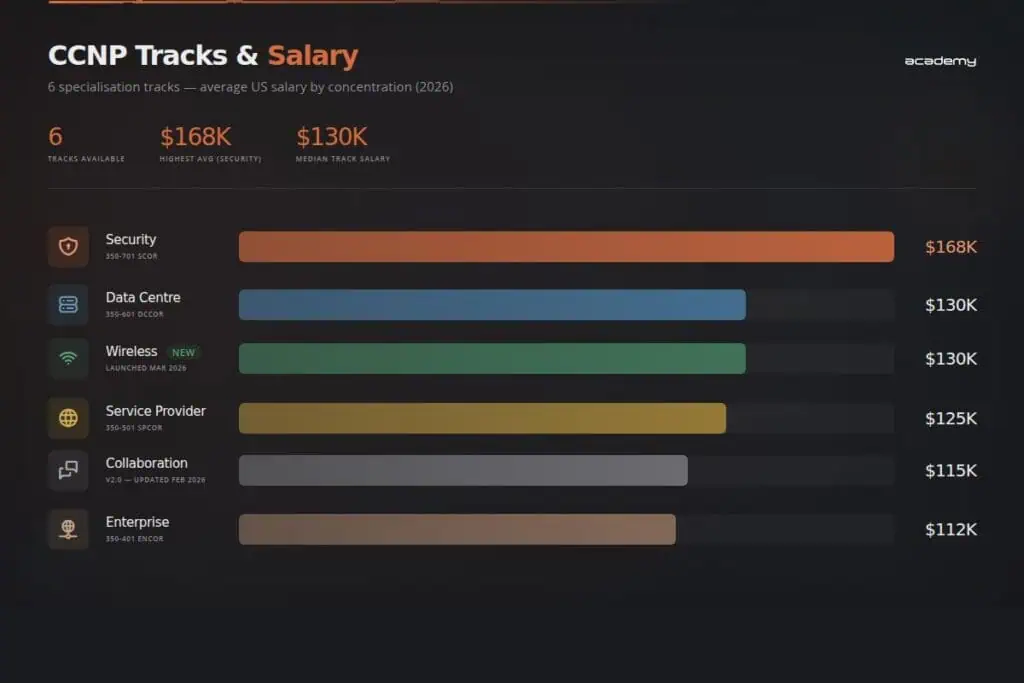
CCNP isn’t just one certification. You can specialise in:
| Track | Core Exam | Best For | Avg Salary |
|---|---|---|---|
| Enterprise | 350-401 ENCOR | Routing, switching, SD-WAN | ~$112K |
| Security | 350-701 SCOR | Firewalls, VPN, threat defence | ~$168K |
| Data Centre | 350-601 DCCOR | ACI, Nexus, UCS, virtualisation | ~$130K |
| Collaboration | v2.0 (updated Feb 2026) | UC, video, contact centre | ~$115K |
| Service Provider | 350-501 SPCOR | ISP routing, MPLS, segment routing | ~$125K |
| Wireless | New track (launched Mar 2026) | Wi-Fi 6E/7, wireless design | ~$130K |
Enterprise is the most popular track. But CCNP Security holders earn the highest salaries, around $168K on average. The brand new Wireless track is worth watching too, as companies pour money into Wi-Fi 6E and 7 deployments.
Each track has 4 to 6 concentration exam options. For Enterprise, you can choose from ENARSI (advanced routing), ENSDWI (SD-WAN), ENSLD (network design), or ENAUTO (automation). Pick the one that matches where you want to take your career.
Want structured preparation for your CCNA? Our live CCNA training course covers the full 200-301 syllabus with instructor-led sessions and hands-on labs.
CCNA vs CCNP Salary: What Do They Actually Pay?
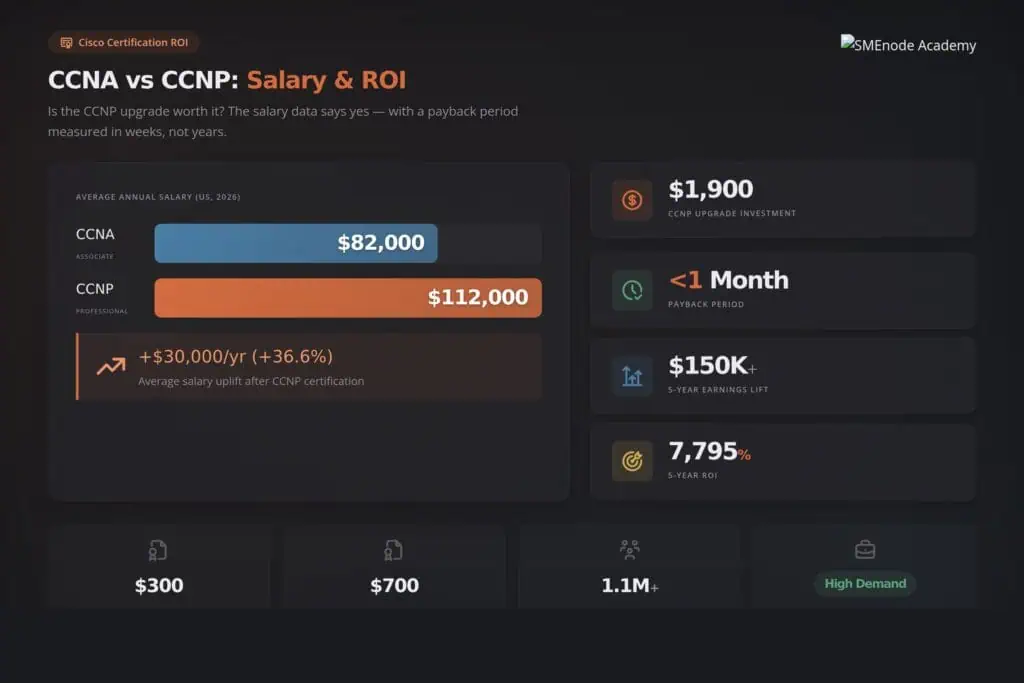
Let’s talk money. This is usually the real reason people are comparing these two certs.
CCNA Salary (2026)
| Source | Average (USD) | Updated |
|---|---|---|
| Glassdoor | $106,345/yr | April 2026 |
| ZipRecruiter | $82,062/yr | April 2026 |
| PayScale | ~$95,000/yr | March 2026 |
The range is wide because it depends heavily on experience and location. Entry-level CCNA roles start around $50K. Mid-career professionals with a CCNA and 5+ years of experience can pull in $90K to $106K.
Here’s a real scenario. Priya had 2 years of help desk experience and was stuck at $52K. She got her CCNA, applied for network support roles, and landed a position at $68K within 3 months. That’s a $16K jump from one certification.
CCNP Salary (2026)
| Source | Average (USD) | Updated |
|---|---|---|
| PayScale (1,640 respondents) | $112,151/yr | March 2026 |
| ZipRecruiter | $109,336/yr | March 2026 |
| Talent.com | $118,750/yr | March 2026 |
CCNP holders earn roughly $15K to $30K more per year than their CCNA-only peers. And it scales with experience:
- Less than 1 year: around $65K
- 5 to 9 years: around $101K
- 10 to 19 years: around $119K
- 20+ years: around $128K
Source: PayScale, based on 1,640 salary reports
Canada Salary Data
For those in Canada, here’s how the numbers break down:
- CCNA: around C$77K average (PayScale Canada)
- CCNP: C$88K median (PayScale, 149 respondents)
Top Canadian cities for CCNP pay: Vancouver (up to C$136K), Calgary (up to C$119K), Toronto (up to C$118K). For more context on the Canadian IT market, see our guide to IT certification jobs in Canada.
For a deeper look at salary data across all Cisco certification levels, we’ve got a full breakdown of Cisco certification salaries from CCNA to CCIE.
The ROI Math: Is CCNP Worth the Investment?
Here’s what the numbers actually look like when you run the calculation:
CCNA ROI:
- Total investment: ~$600 to $3,000 (exam + study materials + optional training)
- Average salary bump: $10K to $16K/year
- Payback period: 1 to 4 months
CCNP ROI (after CCNA):
- Additional investment: ~$1,500 to $5,000 (2 exams + study materials + optional training)
- Average salary bump over CCNA: $15K to $30K/year
- Payback period: 2 to 4 months
Even at the higher end of the investment range, CCNP pays for itself within the first half year. Over a 10-year career, that extra $15K to $30K compounds to $150K to $300K in additional earnings. Just being realistic here, the ROI on CCNP is hard to argue against if you’re in this field for the long haul.
CCNA vs CCNP Difficulty: How Hard Are They?
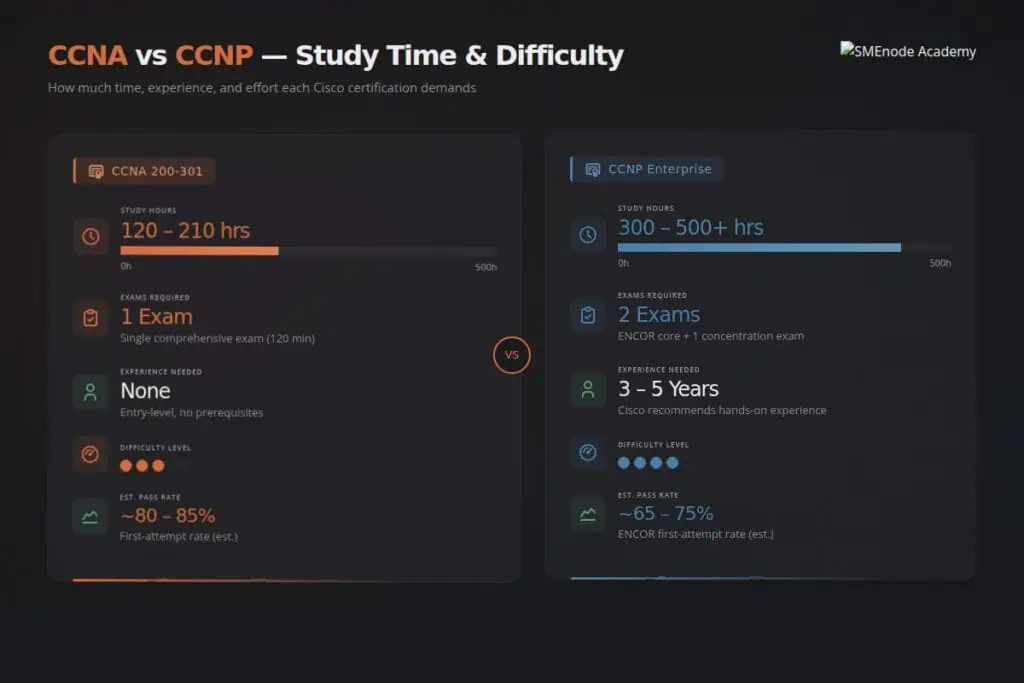
This is where things get honest.
Study Time Comparison
| CCNA | CCNP (both exams) | |
|---|---|---|
| Study Hours | 120-210 hours | 300-500+ hours |
| Typical Timeline | 1 to 6 months | 3 to 9 months |
| Cisco Recommended Experience | 1+ year | 3 to 5 years |
CCNA is manageable for most people. If you’ve got some networking experience, 2 to 3 months of focused study is realistic. Starting from zero? Plan on 4 to 6 months.
CCNP is a different beast entirely. You need to pass two exams, not one. And the content is significantly more advanced. You’re not just learning how things work. You’re learning how to fix them when they break in complex enterprise environments.
Sound familiar? Most people underestimate CCNP.
What Makes CCNP Harder
It’s not just “more content.” The difficulty is qualitatively different:
- CCNA tests whether you understand networking concepts
- CCNP tests whether you can apply them to real enterprise scenarios
CCNA might ask “What does OSPF do?” CCNP asks “Given this network topology with 3 areas, 2 redistribution points, and a route leak, identify the root cause and fix it.”
Here’s a scenario that plays out all the time in our live classes. Marcus passed his CCNA on the first attempt after studying for 3 months. He figured CCNP would take maybe 4 months. Nine months later, he finally passed the ENCOR core exam. The concentration exam took another 2 months after that. Total time: 11 months, not the 4 he planned.
The lesson? Budget your time realistically. CCNP is not “CCNA but harder.” It’s a completely different level of depth.
Career Paths: What Jobs Can You Actually Land?
Your certification level directly affects what roles you qualify for. Here’s what each one opens up:
CCNA Job Titles
- Network Support Engineer
- Junior Network Engineer
- Network Technician
- IT Support Specialist
- Help Desk Engineer
- Network Analyst
Salary range: $50K to $70K (entry), $70K to $106K (experienced)
CCNA is your ticket into networking. It tells employers you understand the fundamentals and can handle day-to-day network operations. There are over 6,500 job postings per week mentioning CCNA, making it one of the most in-demand IT certifications out there.
If you’re deciding between CompTIA Network+ and CCNA as your first cert, we’ve got a full Network+ vs CCNA comparison that breaks down which one makes more sense for different situations.
CCNP Job Titles
- Network Engineer
- Senior Network Engineer
- Network Architect
- Network Security Engineer
- Solutions Architect
- IT Manager
Salary range: $90K to $135K (mid-career), $140K+ (senior)
CCNP signals that you can design and manage enterprise networks independently. It’s increasingly becoming a baseline requirement for senior networking roles. ZipRecruiter data shows 4,800 to 5,100 active job postings requiring CCNP per week in early 2026.
What’s the catch? Experience matters just as much as the certification. A CCNP with 2 years of experience won’t beat a CCNA holder with 8 years of hands-on work. The cert opens doors, but your skills keep them open.
Looking for a structured path into networking? Enrol in our CCNA training course and build the foundation you need, with live instruction and unlimited lab access.
CCNA vs CCNP vs CCIE: The Full Picture
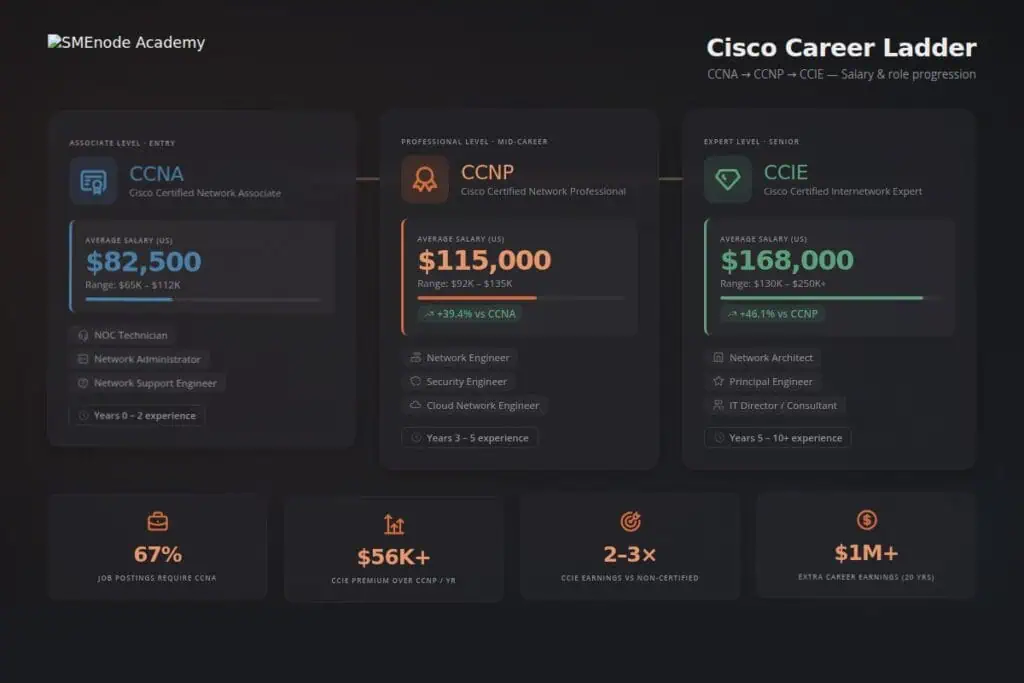
For those thinking about the long game, here’s how all three Cisco certification levels compare:
| Factor | CCNA | CCNP | CCIE |
|---|---|---|---|
| Level | Associate | Professional | Expert |
| Exams | 1 written | 2 written | 1 written + 8-hour lab |
| Total Exam Cost | $330 | $700 | $2,000+ |
| Total Investment | $600 to $3K | $1.5K to $5K | $12K to $19K |
| Study Time | 1 to 6 months | 3 to 9 months | 1 to 2+ years |
| Experience Needed | 1+ year | 3 to 5 years | 5 to 7+ years |
| Average Salary (US) | ~$82K to $106K | ~$112K | ~$166K |
| First-Attempt Pass Rate | Moderate | Lower | ~25 to 30% (lab) |
The CCIE is in a league of its own. Only about 60,000 people worldwide hold one. The lab exam is 8 hours of hands-on configuration and troubleshooting, and roughly 3 out of 4 people fail it on their first try.
But the payoff is real. CCIE holders average around $166K, with CCIE Security specialists clearing $220K or more. Over a 10-year career, that gap adds up to $300K to $500K in extra earnings compared to CCNP.
The typical path is CCNA, then CCNP, then CCIE. And here’s something most people don’t know: the CCNP core exam (like ENCOR for Enterprise) also serves as the CCIE written qualifying exam. So if you pass CCNP, you’re already halfway to CCIE eligibility.
For a detailed look at the full roadmap, check out our CCIE career path guide. And if you’re specifically weighing CCNP against CCIE, our CCIE vs CCNP comparison covers that decision in depth.
Recertification: Keeping Your Cert Active
Both certifications expire after 3 years. But the renewal requirements are quite different:
| CCNA | CCNP | |
|---|---|---|
| Validity | 3 years | 3 years |
| CE Credits Needed | 30 | 80 |
| Exam Alternative | Re-pass CCNA, or pass any CCNP core exam | Re-pass core exam, or pass 2 concentration exams |
| Free CE Options | Cisco Learning Network activities | Same |
Here’s a smart strategy: if you plan to get CCNP eventually, passing the CCNP core exam automatically renews your CCNA. Two birds, one stone.
Source: Cisco Recertification Policy
What Changed in the Cisco Certification Programme for 2026
Cisco made some big moves in early 2026 that affect both certifications. Here’s what you need to know:
February 2026:
- DevNet certs rebranded to “Automation” (DevNet Associate is now CCNA Automation, DevNet Professional is now CCNP Automation)
- Cybersecurity certs also rebranded (now CCNA Cybersecurity and CCNP Cybersecurity)
- CCNP Collaboration updated to v2.0
March 2026:
- Brand new CCNP Wireless and CCIE Wireless tracks launched as standalone paths
- ENCOR exam updated to v1.2, with wireless content removed (it has its own track now)
- Two Enterprise concentration exams retired (300-425 ENWLSD and 300-430 ENWLSI)
CCNA 200-301 Updates:
- AI and machine learning networking topics added
- Expanded STP coverage
- Updated automation content (now includes Ansible and Terraform basics)
- Some troubleshooting topics moved up to CCNP level
These changes actually make the decision easier. CCNA is now more focused on fundamentals plus modern tech like AI networking. CCNP gives you deep specialisation with 6 distinct tracks to choose from.
So Which Cisco Certification Should You Get?
Here’s the honest answer, broken down by where you are right now:
Get CCNA If You:
- Have less than 2 years of networking experience
- Don’t have any Cisco certifications yet
- Want to break into networking from help desk, support, or a different IT field
- Need a certification to meet job requirements quickly
- Are working full-time and can dedicate 2 to 4 months of study
Get CCNP If You:
- Already hold a CCNA (or have equivalent knowledge)
- Have 3+ years of hands-on networking experience
- Want to move into senior engineer, architect, or management roles
- Are targeting roles that pay $100K or more
- Can commit 6 to 9 months of focused preparation
Skip CCNA and Go Straight to CCNP If You:
- Have 5+ years of solid networking experience
- Already understand CCNA-level topics from on-the-job work
- Are confident in subnetting, routing protocols, and basic security
- Have the discipline for a longer, harder study programme
Honestly? For most people, starting with CCNA is the right call. It builds a strong foundation, gets you certified faster, and makes CCNP studying much easier when you’re ready for it.
Here’s one last scenario worth sharing. James had 6 years of network admin experience but no Cisco certs. He skipped CCNA, went straight for CCNP Enterprise, and failed the ENCOR exam twice. He went back, studied CCNA material for 6 weeks to fill in knowledge gaps, then passed ENCOR on his third try. His advice? “Don’t skip the basics. Even if you think you know them.”
Frequently Asked Questions
Can I get CCNP without CCNA?
Yes. Cisco removed the prerequisite in 2020. You can take CCNP exams without holding a CCNA. But Cisco still recommends CCNA-level knowledge, and most successful candidates have either passed the CCNA or have equivalent hands-on experience.
Is CCNP worth it after CCNA?
For most networking professionals, absolutely. CCNP holders earn about $15K to $30K more annually, qualify for senior roles, and have stronger negotiating power. The investment (around $700 in exam fees plus 3 to 9 months of study) typically pays for itself within the first 6 months through higher salary.
How long does it take to go from CCNA to CCNP?
Most people need 6 to 12 months of additional study after getting their CCNA. If you’re working in networking full-time, the hands-on experience helps. Expect 300 to 500 hours of focused study time for both CCNP exams combined.
Which CCNP track pays the most?
CCNP Security commands the highest salaries, averaging around $168K per year. CCNP Enterprise is the most popular track with an average around $112K. The new CCNP Wireless and CCNP Data Centre tracks are also in high demand as companies invest in Wi-Fi 7 and AI infrastructure.
Is CCNA still worth it in 2026?
Yes. There are over 6,500 job postings per week mentioning CCNA. It remains one of the most requested certifications in IT job postings, and it’s your fastest path into networking. Plus, the 2026 exam updates added AI and automation topics, keeping it relevant to where the industry is headed.
What’s the difference between CCNA, CCNP, and CCIE?
CCNA is associate-level (1 exam, $330, ~$82K to $106K salary). CCNP is professional-level (2 exams, $700, ~$112K salary). CCIE is expert-level (written + 8-hour lab, $2,000+, ~$166K salary). Each builds on the previous level and targets progressively senior roles. The typical progression takes 3 to 7 years from CCNA through CCIE.
How do I renew my CCNA or CCNP?
Both certs are valid for 3 years. CCNA requires 30 CE credits or re-passing the exam. CCNP requires 80 CE credits or re-passing the core exam. Pro tip: earning CCNP automatically renews your CCNA, so if you’re planning to upgrade anyway, your CCNA renewal is built in.
Bottom Line
Both CCNA and CCNP are solid investments, but they solve different problems at different career stages. If you’re breaking into networking or have less than 3 years of experience, CCNA gives you the fastest return: one exam, $330, and a realistic path to $70K+ roles within months. If you already have that foundation and want to push past $100K into senior engineering or architecture positions, CCNP is the move that gets you there, with $15K to $30K in extra annual earnings that more than cover the cost. Don’t overthink the decision. Get CCNA first, build real-world skills, then go for CCNP when you’re ready. That’s the path most successful network engineers follow, and it works.