50% OFF on All Courses!
- All Courses
get started
start your journey today
free demo class
upcoming batches
career paths
success stories
Popular:


$112,333. That’s the average CCNA salary in 2026. But here’s what most salary guides won’t tell you – the range is massive. Entry-level roles start around $50K while senior network engineers with CCNA credentials clear $140K or more.
So what determines where you land on that spectrum?
Experience. Location. Specialization. And whether you treat CCNA as just a checkbox or a foundation for real skills. In this guide, we’ll break down CCNA salary by experience level, geography, and job role – with actual numbers from PayScale, Glassdoor, and the Bureau of Labor Statistics.
If you’re wondering whether getting your CCNA certification is worth the investment, these numbers tell the story.
Let’s start with the basics. CCNA salary in 2026 averages $112,333 according to PayScale data. That puts it solidly in the six-figure territory – not bad for what’s considered an entry-level Cisco certification.
But averages hide a lot.
The CCNA salary range spans from roughly $50,000 at the bottom to $140,000+ at the top. That’s almost a 3x difference. Understanding what drives that gap matters more than memorizing the average.
Here’s the quick breakdown of CCNA certified professionals’ earnings:
| Metric | Value |
| Average CCNA Salary | $112,333 |
| Entry-Level Range | $50,000 – $70,000 |
| Mid-Level Range | $75,000 – $100,000 |
| Senior-Level Range | $100,000 – $140,000+ |
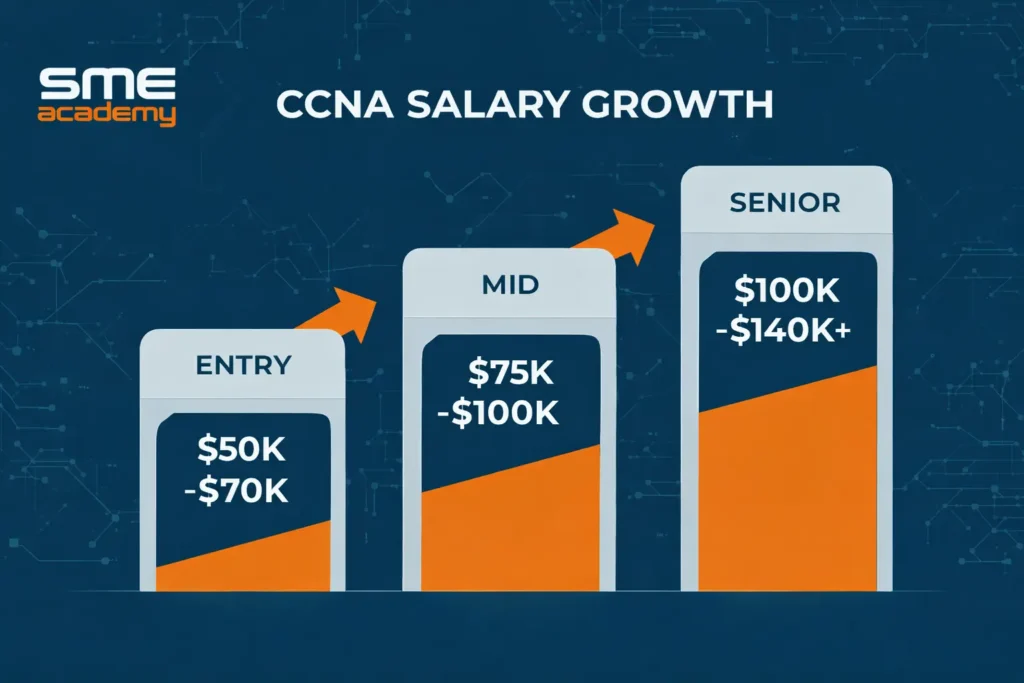
Experience is the biggest factor in CCNA salary. No surprise there. But the growth trajectory is steeper than most people expect.
Fresh CCNA holders typically start between $50,000 and $70,000. That’s for roles like junior network administrator, help desk tier 2, or entry-level network technician.
Worth it? Absolutely.
Consider this: the average IT support salary without certifications hovers around $40K. CCNA adds $10K-$30K right out of the gate. Our CCNA training course costs a fraction of that difference.
This is where things get interesting. Network engineers with 3-5 years of experience and CCNA credentials typically earn $75,000 to $100,000. The jump from entry-level is significant – often 30-40% higher.
At this stage, most professionals pursue CCNP or add specializations. Those who add automation skills see the biggest bumps. We’ll cover that in a moment.
Senior network engineers with CCNA typically earn $100,000 to $140,000+. At this level, CCNA is usually paired with CCNP or specialized certifications.
Here’s the thing. Senior roles often require CCNA as a baseline, not the ceiling. It proves foundational knowledge. But the higher salary comes from demonstrated expertise in specific areas – security, data center, or automation.
| Experience | Salary Range | Typical Roles | Growth Path |
| 0-2 Years | $50K – $70K | Jr. Network Admin, Help Desk | CCNA Specialty |
| 3-5 Years | $75K – $100K | Network Engineer, Systems Admin | CCNP, Automation |
| 6+ Years | $100K – $140K+ | Sr. Network Engineer, Architect | CCIE, Management |

Location matters. A lot. The same CCNA holder earns vastly different salaries depending on geography.
US-based network engineers with CCNA earn the highest globally. But even within the US, there’s a 40-50% difference between markets.
| Region | Average CCNA Salary | Top Markets |
| United States | $112,333 | SF, NYC, Seattle |
| Australia | $85,000 – $95,000 AUD | Sydney, Melbourne |
| United Kingdom | £45,000 – £60,000 | London, Manchester |
| Germany | €50,000 – €65,000 | Munich, Frankfurt |
| Canada | $70,000 – $90,000 CAD | Toronto, Vancouver |
Remote work has changed the equation somewhat. Many US companies now hire globally but peg salaries to local markets. Something to consider.
CCNA opens doors to various IT certification salary levels depending on the role. Network engineer is the most common career path, but it’s not the only option.
Here’s how CCNA salary breaks down by job title:
| Job Role | Average Salary (US) |
| Network Administrator | $65,000 – $85,000 |
| Network Engineer | $80,000 – $110,000 |
| Systems Administrator | $70,000 – $95,000 |
| Security Analyst (with CCNA) | $85,000 – $115,000 |
| Network Automation Engineer | $100,000 – $140,000 |
Notice something? Network automation engineer tops the list. That’s not a coincidence.
The highest CCNA salaries go to professionals who combine networking fundamentals with automation skills. Python, Ansible, and API integration are the key differentiators.
The data backs this up.
CCNA automation salary ranges from $100,000 to $140,000 – roughly 20-30% higher than traditional network roles. According to Cisco’s own job market data, 97% of IT leaders say certified staff with automation skills adds significant value to their teams.
Our CCNA Automation course covers exactly these skills – Python for network engineers, Ansible playbooks, and working with REST APIs. It’s designed to push your CCNA salary into that higher bracket.
The market is shifting. Manual network configuration is becoming automated. Engineers who can script and automate are in demand. Those who can’t? They’re competing for fewer positions.
So you’ve got your CCNA. Now what? Here’s the career path that leads to higher earnings:
1. Build real experience. The first two years after CCNA certification matter most. Get hands-on with production networks. Break things. Fix them. Document everything.
2. Add automation skills. We’ve covered this. Python and Ansible add 20-30% to your salary potential. It’s the highest-ROI skill investment for network engineers right now.
3. Specialize strategically. Security specialists earn more than generalists. Cloud networking is growing fast. Pick a direction that matches market demand.
4. Progress to CCNP. CCNP Enterprise or CCNP Security adds $20K-$40K to your salary ceiling. It’s the natural next step.
5. Consider location. Remote work is increasingly common. If you can land a US-based remote role while living in a lower cost-of-living area, you maximize earnings.
For practice while studying, check out the CCNA Workbook from SMEnode Labs at smenode-labs.com. It’s designed to build the practical skills employers actually test for.
Yes. The average CCNA salary boost of $10K-$30K in the first year alone typically covers the certification cost several times over. According to a global IT skills survey, 56% of professionals receive pay increases within 3 months of earning their certification.
Entry-level CCNA salary ranges from $50,000 to $70,000 depending on location and role. Major tech hubs pay at the higher end. Smaller markets and help desk positions typically start lower but still offer significant premiums over non-certified IT roles.
CCNP typically adds $20K-$40K over CCNA salary. The average CCNP Enterprise holder earns around $144,912 compared to CCNA’s $112,333. However, CCNP requires more experience and a longer certification path.
Many Cisco CCNA jobs list CCNA as the primary requirement. However, adding complementary skills like CompTIA Security+ or cloud certifications (AWS, Azure) can increase both job opportunities and salary potential.

CCNA salary in 2026 ranges from $50K at entry level to $140K+ for senior professionals with automation skills. The certification remains one of the most valuable entry points into IT networking careers.
Your actual CCNA salary depends on experience, location, and specialization. But the data is clear: CCNA certified professionals consistently out-earn their non-certified peers, and automation skills push those numbers even higher.
Ready to get started? Our live CCNA training includes expert instructors, unlimited lab access, and free mentorship throughout your journey. Unlike pre-recorded courses, you’ll get your questions answered in real-time – which matters when you’re building skills that directly impact your earning potential.
Explore our CCNA training course or book a free demo class to see if it’s the right fit.