50% OFF on All Courses!
- All Courses
get started
start your journey today
free demo class
upcoming batches
career paths
success stories
Popular:


$146,601. That’s the average azure solutions architect salary in the United States right now, according to ZipRecruiter. But here’s the thing. Top earners are clearing $200K without breaking a sweat. And entry-level folks? Some are starting below $100K.
So what’s the real number?
It depends. Your experience, location, certifications, and the specific skills you bring to the table all play a role. The salary data floating around online is all over the place, and most of it lacks context.
That’s what this guide fixes. You’ll get actual salary breakdowns by experience level, location, and certification tier. Plus, we’ll cover which skills command the biggest premium, how Azure architect pay compares to AWS and GCP roles, and what you can do right now to push your compensation higher.
Let’s get into it.
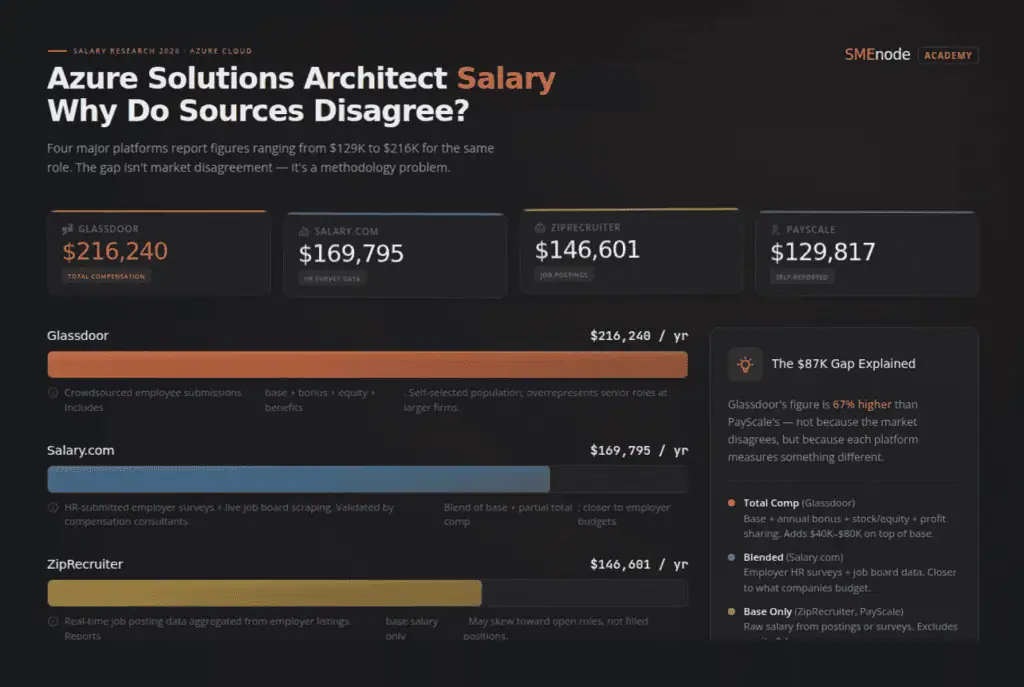
The azure solutions architect salary in 2026 varies quite a bit depending on which source you check. Here’s a side-by-side look at the major salary platforms:
| Source | Average Salary | Range |
|---|---|---|
| ZipRecruiter | $146,601/yr | $127K – $190K |
| Glassdoor | $216,240/yr | $172K – $292K |
| PayScale | $129,817/yr | $94K – $175K |
| Salary.com | $169,795/yr | $143K – $199K |
Why the huge gap between sources?
oor includes total compensation (base + bonus + equity + benefits), while ZipRecruiter and PayScale tend to report base salary only. That’s a distinction most salary guides skip right over.
The middle 50% of Azure architects earn between $127K and $165K in base pay. Factor in bonuses, stock options, and benefits, and you’re looking at total compensation somewhere between $160K and $250K for mid-to-senior roles.
Pretty solid numbers. But they get even more interesting when you break them down by experience.
When Priya started as a cloud administrator in early 2024, she was making $92K at a mid-size financial firm in Chicago. She’d been working with Azure for about two years but didn’t have any Microsoft certifications. After passing the AZ-104 exam that spring, she got a $8K raise. Then she spent six months preparing for the AZ-305 and earned her Azure Solutions Architect Expert certification. By January 2026, she’d moved to a new role paying $148K. That’s a $56K jump in under two years, with certifications as the main driver.
Looking to follow a similar path? SMEnode Academy’s Azure Solutions Architect training prepares you for the AZ-305 exam with live instruction, real labs, and free mentorship from certified architects.

Experience is the single biggest factor in your azure architect salary. It accounts for roughly 40% of the variation in pay, according to industry data. Here’s what each level looks like.
| Metric | Value |
|---|---|
| Salary Range | $90K – $120K |
| Typical Title | Junior Cloud Architect, Cloud Engineer |
| Common Certs | AZ-900, AZ-104 |
If you’re just getting started, don’t expect architect-level pay on day one. Most entry-level roles are really cloud engineer or administrator positions where you’re building Azure experience. The AZ-900 (Azure Fundamentals) opens the door, and the AZ-104 (Azure Administrator) is where employers start taking you seriously.
Honestly? $90K to $120K for a junior cloud role is strong money. But the real payoff comes when you level up.
If you’re at this stage, SMEnode Academy’s Azure Administrator course covers everything you need for the AZ-104 exam, with hands-on labs on real Azure environments. Not simulators.
| Metric | Value |
|---|---|
| Salary Range | $135K – $165K |
| Typical Title | Cloud Solutions Architect, Azure Architect |
| Common Certs | AZ-305, AZ-500 |
This is where things get interesting. Mid-level architects with the AZ-305 certification see the biggest salary jump relative to their experience. You’re designing cloud solutions, leading migration projects, and making architecture decisions that affect the whole organization.
The thing is, this is also the most competitive band. Everyone’s trying to break into the $150K+ range. What separates the $135K architects from the $165K ones? Usually it’s a combination of the AZ-305 cert plus hands-on experience with specific services like Azure Kubernetes Service, Azure DevOps, or security tools.
| Metric | Value |
|---|---|
| Salary Range | $175K – $215K+ |
| Typical Title | Senior Solutions Architect, Principal Architect |
| Common Certs | AZ-305, multiple speciality certs |
| Total Comp | Up to $300K+ at top companies |
Senior architects at companies like Microsoft, Quisitive, and major consulting firms earn base salaries north of $200K. Microsoft reportedly pays Azure architects an average of $279K in total compensation. At this level, your salary negotiation is less about certifications and more about the business outcomes you’ve delivered.
But certifications still matter. They get your resume past the filters.
Where you live (or where your employer is based) makes a $60K+ difference. Sound dramatic? It’s not.
| State | Average Salary | vs. National Avg |
|---|---|---|
| California | $182,000 | +24% |
| Massachusetts | $175,000 | +19% |
| Washington | $166,000 | +13% |
| New York | $165,000 | +12% |
| Maryland | $168,000 | +14% |
| Connecticut | $163,000 | +11% |
| Colorado | $161,500 | +10% |
California leads the pack at around $182K, followed by Massachusetts and Washington. No surprise there, those states have the highest concentration of tech companies and cloud adoption.
Seattle pulls ahead of San Francisco here. Why? Microsoft’s headquarters plus Amazon’s heavy Azure competitor (AWS) presence create intense competition for cloud talent. That drives salaries up.
Here’s something most salary guides don’t cover. Remote Azure architect roles typically pay 5-15% less than equivalent on-site positions in major tech hubs. But they pay more than local rates in most mid-tier cities.
So if you’re in Dallas making $135K and land a remote role with a San Francisco company paying $160K? That’s a win. You get the higher salary without the Bay Area cost of living.
Some companies are location-agnostic (same pay regardless of where you live). Others adjust based on your zip code. Always ask during the interview process.
This is the part no other salary guide shows you properly. Each Azure certification maps to a different salary tier. Here’s the full picture:
| Certification | Exam | Avg. Salary Range | Typical Roles |
|---|---|---|---|
| Azure Fundamentals | AZ-900 | $65K – $85K | Help Desk, Junior Admin |
| Azure Administrator | AZ-104 | $88K – $161K | Cloud Admin, Systems Engineer |
| Azure Solutions Architect Expert | AZ-305 | $127K – $190K+ | Solutions Architect, Cloud Architect |
| Azure Security Engineer | AZ-500 | $125K – $175K | Security Engineer, SecOps |
| Azure DevOps Engineer Expert | AZ-400 | $130K – $180K | DevOps Engineer, SRE |
See the jump from AZ-104 to AZ-305? That’s the money move.
The AZ-305 (Azure Solutions Architect Expert) is consistently the highest-paying Azure certification. And it makes sense. Solutions Architects sit at the intersection of business and technology. They’re the ones designing the cloud strategy, not just running it.
Marcus was a sysadmin making $105K in Atlanta. He’d been studying Azure on his own for about a year when he decided to get serious about certifications. He passed the AZ-900 in March 2024 (no salary change, but it built his confidence). Then AZ-104 in August (got bumped to $118K). Then he spent four months in an Azure Solutions Architect training programme that included live labs and exam prep. He passed AZ-305 in February 2025 and accepted a new position two months later at $156K. Three certs over 14 months. A $51K salary increase. Worth it? You tell me.
Ready to start your certification journey? If you already have AZ-104, the next logical step is AZ-305 training with live instruction. If you’re earlier in your path, start with the Azure Administrator (AZ-104) course to build your foundation first.
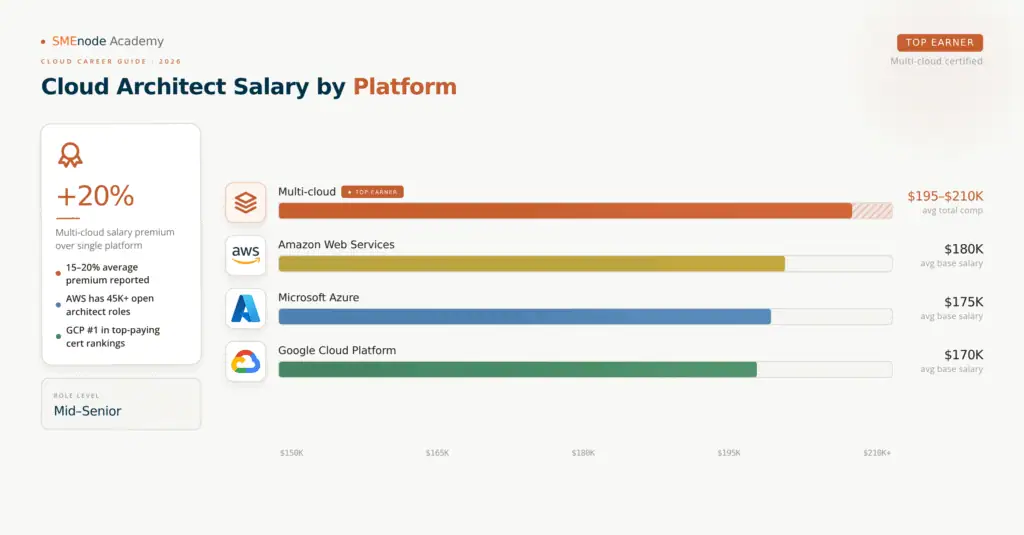
How does the azure cloud architect salary stack up against AWS and GCP? Here’s the comparison:
| Platform | Avg. Architect Salary | Top-End Range |
|---|---|---|
| AWS Solutions Architect | $180,000 | $220K+ |
| Azure Solutions Architect | $175,000 | $215K+ |
| GCP Cloud Architect | $170,000 | $210K+ |
| Multi-Cloud Architect | $195,000 – $210,000 | $250K+ |
AWS architects earn slightly more on average, about $5K higher. But the gap is closing. Azure’s market share has grown steadily, and Microsoft’s enterprise stronghold means Azure architects are in high demand at Fortune 500 companies.
The real money? Multi-cloud. Architects who can design solutions across Azure AND AWS (or all three platforms) command the highest salaries. We’re talking $195K to $210K on average, with top earners well past $250K.
So what does that mean for your career strategy? If you already have Azure certs, adding an AWS certification creates a powerful combination. But if you’re picking one platform to start with, Azure is a strong bet, especially if your target employers are large enterprises.
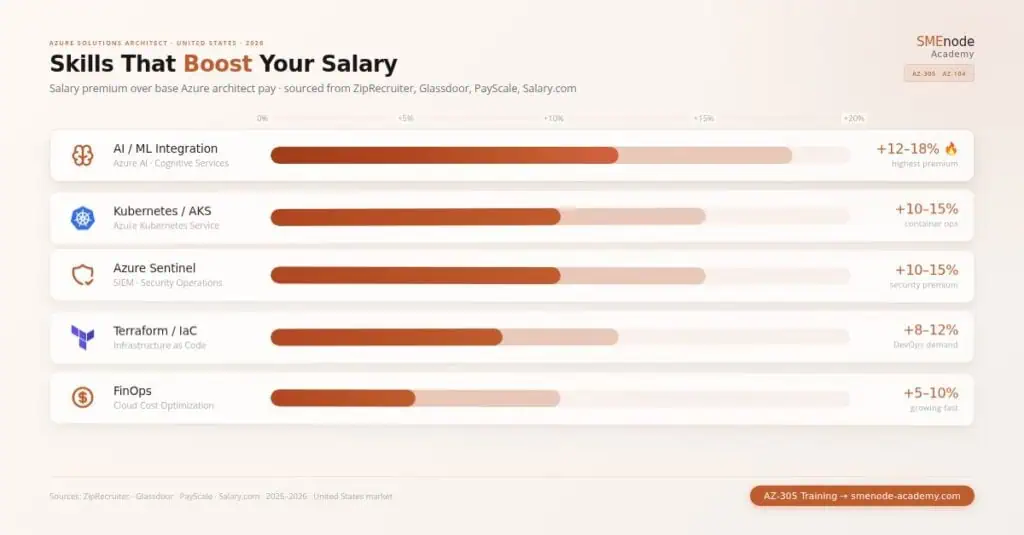
Certifications get you in the door. Skills determine which salary band you land in. Here are the ones that command the biggest premium right now:
Want to really stand out? Stack two or three of these on top of your AZ-305. An Azure Solutions Architect who also knows Kubernetes and Terraform? That’s a $180K+ conversation.
The data is clear: 56% of IT professionals receive a pay increase within three months of earning a new certification. For Azure architects specifically, the AZ-305 is the highest-impact certification you can get.
Quick ROI math: the AZ-305 exam costs $165. Even with a training programme factored in, your total investment is typically under $2,000. If the certification bumps your salary by even $15K (which is conservative based on the data), that’s a 7x to 90x return in the first year alone.
Don’t just collect certs. Build real skills alongside them. Spend time in Azure labs working with AKS, configuring Terraform pipelines, and setting up Azure Sentinel. Employers can tell the difference between someone who passed an exam and someone who can actually architect a production environment.
When Danielle was interviewing for a senior Azure architect role in Denver last October, she walked into the negotiation with salary data from Glassdoor, ZipRecruiter, and PayScale, all bookmarked and ready. The initial offer was $155K. She showed the interviewer that the 75th percentile for Azure architects in Colorado was $170K+ and that her AZ-305 plus Kubernetes experience put her in that tier. She countered at $172K. They settled at $168K. That 15-minute conversation was worth $13K a year.
Here’s the deal. Most people don’t negotiate cloud architect offers because the initial number already seems high. But the data says you should. Always.
The outlook for Azure architects is strong. Here’s why:
Azure architects are in the top 5 most in-demand cloud roles for 2026. The combination of enterprise Azure adoption and the AI boom means this demand isn’t going anywhere soon.
Bottom line: if you’re considering a career in cloud architecture, the window is wide open. And the fastest way to get there is with the right certification and hands-on training. Explore SMEnode Academy’s Azure Solutions Architect programme to see upcoming class schedules and what’s included.
Yes. The AZ-305 is the highest-paying Azure certification, with average salaries between $127K and $190K+. The exam costs $165, and even factoring in training costs, most professionals see a positive ROI within the first few months through salary increases or new job offers.
Most people need 2-4 years of Azure experience before they’re ready for a Solutions Architect role. The certification path typically goes AZ-900 (1-2 months) → AZ-104 (2-3 months) → AZ-305 (3-4 months). With structured training, you can compress the certification timeline significantly.
Entry-level cloud roles that lead to architect positions start around $90K to $120K. Junior professionals with the AZ-104 certification and 1-2 years of hands-on Azure experience typically land in this range.
AWS architects earn slightly more on average ($180K vs $175K). But the gap is small and shrinking. Multi-cloud architects who know both platforms earn the most, averaging $195K to $210K.
Not directly. Solutions Architect roles require hands-on cloud experience. But you can build toward it quickly. Start with an Azure Administrator role (AZ-104 certified), get 2-3 years of production experience, then pursue the AZ-305. It’s a realistic path from zero to architect in 3-4 years.
Here’s what the data tells us. Azure Solutions Architects earn between $127K and $190K+ in 2026, with senior professionals clearing $200K in total compensation. Location, experience, certifications, and speciality skills all push those numbers higher.
The most impactful thing you can do right now? Get certified. The AZ-305 is the single highest-ROI investment for anyone targeting cloud architect roles. Stack it with in-demand skills like Kubernetes or Terraform, and you’re looking at the upper end of every salary range in this guide.
And don’t leave money on the table during negotiations. You have the data now. Use it.
Start your Azure Solutions Architect training at SMEnode Academy → Live classes. Real labs. Free mentorship. Check upcoming schedules and enroll today.