What is Splunk Enterprise? It’s a machine data platform that collects, indexes, and searches log data from every corner of your IT environment – and turns it into real-time security intelligence.
That’s the short version.
The longer version? Splunk Enterprise is what most security operations centers (SOCs) run on. It handles everything from log management and threat detection to compliance reporting and incident response. Over 90% of Fortune 100 companies use it. That’s not a coincidence.
If you’re trying to understand what is Splunk Enterprise, whether you’re entering cybersecurity or evaluating SIEM platforms for your organization, this guide breaks it all down without the marketing fluff.
What Is Splunk Enterprise, Exactly?

Splunk Enterprise is a data analytics and security monitoring platform built around one core idea: machine data is everywhere, and most organizations can’t search or analyze it fast enough to catch threats in time. Splunk fixes that.
Founded in 2003, Splunk became the go-to tool for IT and security teams because it could do something others couldn’t – take messy, unstructured log data from hundreds of sources and make it searchable in seconds.
Think of it like this: Splunk is Google Search for your server logs. Your servers, firewalls, endpoints, cloud apps, and network devices are constantly generating data. Splunk ingests all of it, indexes it, and lets you query it using SPL (Splunk Processing Language) – its own search language.
Security teams use it. IT ops teams use it. DevOps engineers use it. The platform isn’t built for one job. It handles several.
Splunk Enterprise can be deployed on-premises or as a cloud-hosted SaaS service (Splunk Cloud). If you’re deciding between the two, our Splunk Cloud vs Enterprise guide covers pricing, scalability, and control differences in detail.
What Is Splunk Enterprise’s Core Architecture?
Understanding what is Splunk Enterprise means understanding how it actually works under the hood. The architecture has three main layers:
- Forwarders: Lightweight agents installed on endpoints, servers, and network devices. They collect log data and send it to the indexer.
- Indexers: The engine that processes and stores the data. When you run a search, the indexer does the heavy lifting.
- Search Heads: The front-end layer where analysts write SPL queries, build dashboards, and run reports. This is what most users interact with daily.
In large enterprise environments, these components run on separate servers in a clustered setup for high availability and scalability. Smaller environments can run everything on a single instance.
Is Splunk Enterprise a SIEM Platform?
Technically, Splunk Enterprise itself is a data platform, not a purpose-built SIEM. But here’s the thing – in practice, most security teams deploy it exactly as a SIEM platform.
The key distinction is this. A traditional SIEM (Security Information and Event Management) tool is pre-packaged with correlation rules, threat intelligence feeds, and security dashboards right out of the box. Splunk Enterprise needs configuration and the Splunk Enterprise Security (ES) add-on to reach full SIEM functionality.
With Splunk Enterprise Security installed, you get:
- Pre-built correlation searches for known attack patterns
- Risk-based alerting and threat intelligence integration
- Incident review workflows and analyst dashboards
- MITRE ATT&CK framework mapping
According to Gartner’s SIEM Market Guide, Splunk consistently ranks among the top SIEM platform vendors globally. The platform’s flexibility is both its strength and its learning curve.
Most people asking what is Splunk Enterprise are really asking whether it can replace their SIEM. Short answer: yes, with the ES add-on. And for most enterprise environments, it outperforms traditional rigid SIEM tools because it’s built on a flexible data platform first.
Log Management and Data Indexing Explained
At its core, log management is Splunk Enterprise’s foundation. Every device, application, and service in your infrastructure generates logs. Firewalls log every connection attempt. Servers log authentication events. Applications log errors and user activity. Most organizations collect terabytes of this data daily.
A SIEM without good log management is like a smoke alarm with no batteries. You have the hardware. You just can’t actually detect anything.
Splunk Enterprise solves this by:
- Ingesting data from any source: syslog, Windows Event Logs, AWS CloudTrail, Azure Monitor, custom APIs, flat files, databases, and more
- Parsing and normalizing: Splunk structures unstructured data on the fly using source type definitions
- Indexing in real time: data becomes searchable within seconds of ingestion
- Retention and archiving: configurable data retention policies meet compliance requirements for HIPAA, PCI-DSS, and SOC 2
Real-Time Security Monitoring Capabilities
This is where Splunk Enterprise earns its reputation in security monitoring. Once your data is indexed, you can:
- Set real-time alerts on specific log patterns (failed logins, privilege escalation, lateral movement)
- Build dashboards that update every few seconds with live threat data
- Correlate events across multiple data sources to detect multi-stage attacks
- Run threat hunts using SPL queries against months of historical data
Real-time security monitoring isn’t just about dashboards, though. According to IBM’s Cost of a Data Breach Report, organizations using AI and automation to detect threats (like Splunk-powered SOCs) identify breaches 108 days faster than those that don’t. That gap has direct cost implications.
What Is Splunk Enterprise Used For in Real Environments?
Here’s the honest picture. Most people assume Splunk is just for security. That’s not wrong, but it’s incomplete. Security operations is the most common use case, but the platform covers more ground.
So what is Splunk Enterprise actually used for across real enterprise environments? Here’s the breakdown:
| Use Case | Who Benefits |
| Threat Hunting | SOC Analysts |
| Log Management and Indexing | IT Operations, Security Teams |
| Compliance Reporting (PCI-DSS, HIPAA) | GRC and Compliance Teams |
| Incident Response and Forensics | Security Engineers |
| Application Performance Monitoring | DevOps and Developers |
| Cloud Security Monitoring | Cloud Security Architects |
The SOC use case gets the most attention – and for good reason. Most SOC analysts use Splunk every single day. They’re writing SPL searches to hunt threats, investigating alerts, building detection rules, and running incident timelines. Our Splunk Enterprise Security Course is built around exactly these real-world scenarios.
But IT ops teams use it too, for server health monitoring, capacity planning, and application error tracking. DevOps teams pipe their CI/CD pipeline logs into Splunk for deployment monitoring.
The Bureau of Labor Statistics projects 33% growth in information security analyst roles through 2033. Splunk skill is showing up in a significant portion of those job descriptions. That number matters if you’re thinking about your career.
What Is Splunk Enterprise vs. Splunk Free?
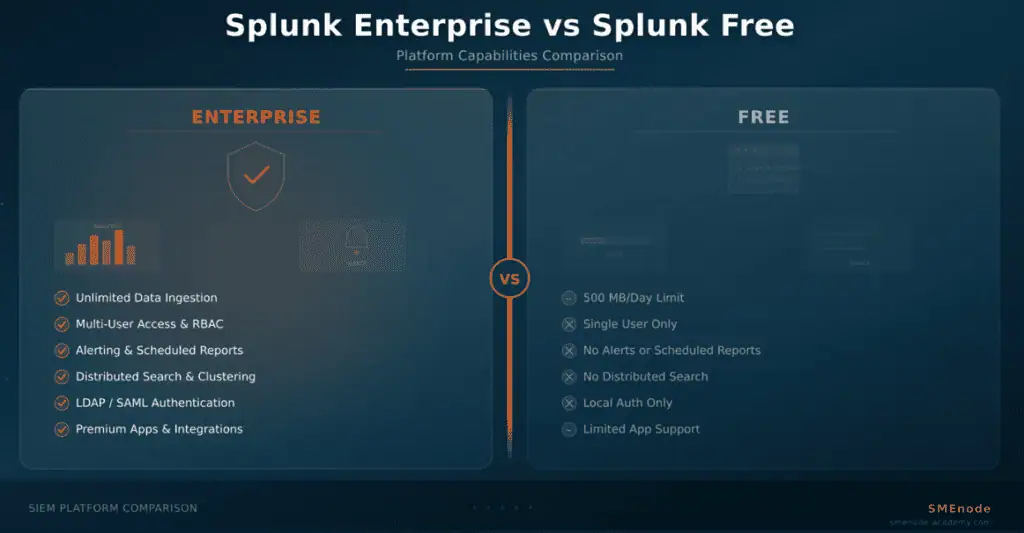
This question comes up constantly. The free version of Splunk (Splunk Free or Splunk Developer License) is useful for learning and testing. But it’s not the same product.
| Feature | Splunk Free | Splunk Enterprise |
| Daily Data Limit | 500 MB/day | Unlimited (licensed by volume) |
| Clustering and High Availability | No | Yes |
| Role-Based Access Control | Basic | Advanced, granular |
| Support | Community only | Splunk official support |
| Splunk Enterprise Security (ES) Add-on | Not available | Available |
| Ideal For | Testing, small projects | Enterprise SOCs, large environments |
What Is Splunk Enterprise Pricing Based On?
Splunk Enterprise’s pricing model is based on daily data ingestion volume – how many gigabytes per day you’re indexing. This is called the ingest-based licensing model.
Most mid-size enterprise environments ingest between 100GB and 500GB per day. Large enterprises can hit several terabytes. Splunk also offers workload-based licensing, which prices based on compute rather than data volume – useful if your data volumes fluctuate.
For exact pricing, you’ll need a quote from Splunk directly via their website. Pricing is not public and varies significantly by region, contract length, and support tier.
Who Should Learn Splunk Enterprise?
If you’re reading this, you’re probably wondering whether Splunk is worth your time to learn. Here’s the honest breakdown.
Splunk skills are directly relevant if you’re in – or aiming for – any of these roles:
- SOC Analyst (Tier 1, 2, or 3): Splunk is used daily for alert triage and threat investigation
- Security Engineer: You’ll build detections, write correlation rules, and manage the Splunk infrastructure
- Threat Hunter: SPL is your primary weapon for proactive hunting across historical data
- IT Operations Engineer: Log monitoring, performance dashboards, and infrastructure health checks all run through Splunk
- Compliance and GRC Analyst: Automated compliance reporting for PCI-DSS, HIPAA, and SOC 2 relies heavily on Splunk
If you’re serious about a security operations career, Splunk isn’t optional. It’s a baseline expectation.
Not sure where to start? Browse our Operational Security Training programs to see the full range of courses available, from SOC fundamentals to advanced threat hunting and SIEM operations.
Ready to build real Splunk skills? Our live Splunk Enterprise Security Course covers SPL, SIEM configuration, threat detection, and hands-on labs in a real Splunk environment. Unlike pre-recorded content, our live sessions let you ask questions in real-time and work through scenarios with expert instructors.
Looking for a broader career path in security? Browse our Operational Security Training programs covering SOC operations, threat hunting, SIEM platforms, and more. Every student gets free 1-on-1 mentorship throughout the program.
Frequently Asked Questions
What is Splunk Enterprise used for?
Splunk Enterprise is used for log management, real-time security monitoring, threat detection, incident response, compliance reporting, and IT operations monitoring. In security environments, it functions as the backbone of SOC operations and is often deployed as a SIEM platform with the Splunk Enterprise Security add-on.
Is Splunk Enterprise a SIEM or SOAR tool?
Splunk Enterprise is primarily a data platform, but with the Splunk Enterprise Security (ES) add-on, it functions as a full SIEM platform. Splunk SOAR (Security Orchestration, Automation, and Response) is a separate product that handles automated response workflows. Many enterprises run both together.
What is Splunk Enterprise vs. Splunk Cloud?
Splunk Enterprise is the on-premises version you install and manage on your own infrastructure. Splunk Cloud is the SaaS version hosted by Splunk. Both use the same SPL search language and core functionality. For a detailed breakdown of scalability, pricing, control, and which deployment fits your team, see our full Splunk Cloud vs Enterprise comparison guide.
How do I start learning Splunk Enterprise?
Start by understanding SPL (Splunk Processing Language), data ingestion basics, and how dashboards and alerts work. Hands-on lab time is essential – reading about Splunk doesn’t prepare you for real SOC work. Our Splunk Enterprise Security Course is structured as a live, instructor-led program that gets you from zero to job-ready with real lab environments and free 1-on-1 mentorship.
Bottom Line
So what is Splunk Enterprise, in plain terms? It’s the platform that turns raw machine data into actionable security intelligence. It’s used in SOCs globally, supports everything from log management to advanced threat hunting, and is consistently ranked among the top SIEM platforms in the industry.
Most SOC analysts, security engineers, and threat hunters work with Splunk daily. If you’re building a career in security operations, understanding what is Splunk Enterprise – and knowing how to use it – isn’t a nice-to-have. It’s expected.
The learning curve is real. SPL takes practice. Building useful detections takes time and lab experience.
That’s exactly what our Splunk Enterprise Security Course at SMEnode Academy is built for. Live online classes, hands-on lab access, and free 1-on-1 mentorship throughout the program. We teach real-world best practices, not just exam topics. If you’re ready to build real skills, start there.