TL;DR – Quick Summary
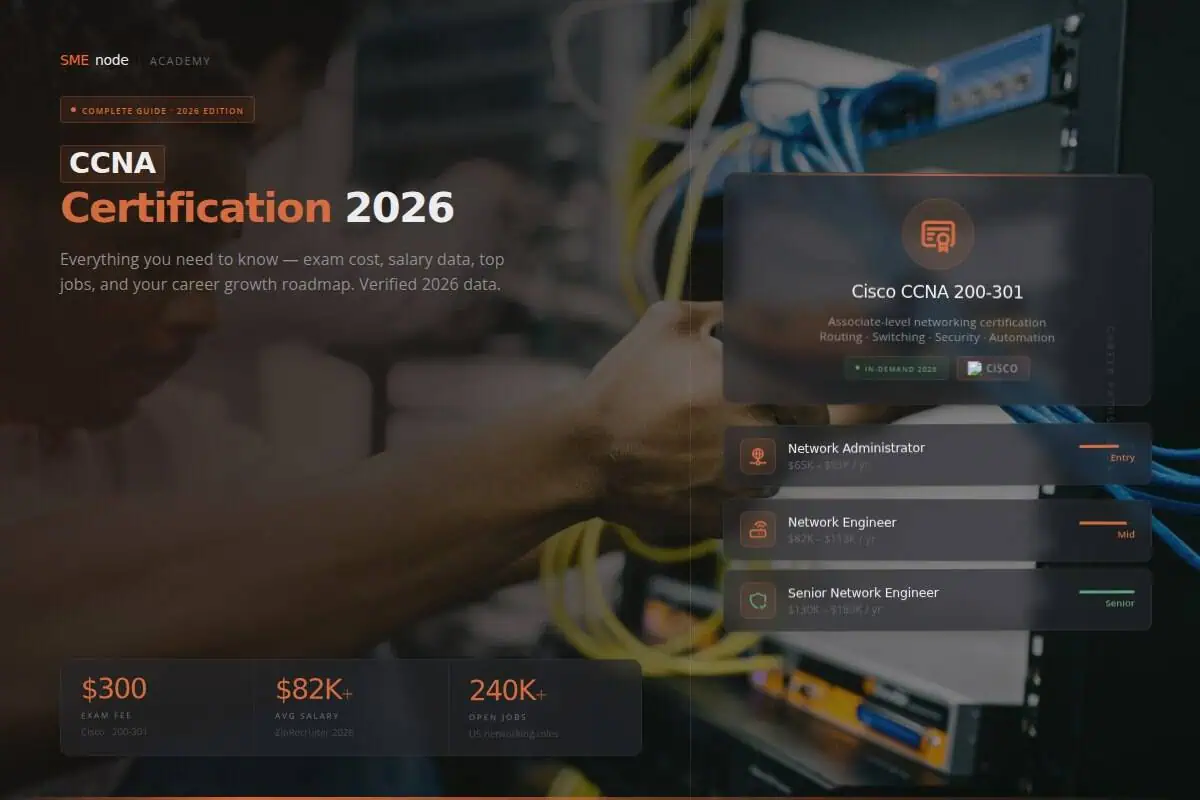
- CCNA Cost: $880–$3,160 total investment
- Average Salary: $112,333 (entry level: $55,000–$70,000)
- Preparation Time: 3–6 months (10-15 hours/week)
- Exam Format: 100-120 questions, 120 minutes, 825/1000 passing score
- Pass Rate: 50-60% (ensure hands-on lab practice)
- Job Outlook: Growing demand in cloud/hybrid environments
If you’re considering a career in networking, you’ve probably heard about CCNA certification. Maybe a friend mentioned it. Or you spotted it in job listings. Either way, you’re wondering if it’s worth your time and money.
Short answer? Yes. But let me explain why – and more importantly, how to actually get certified without wasting months or thousands of dollars.
This guide covers everything you need to know about CCNA certification in 2026: what it costs, what you can earn, what jobs you’ll qualify for, and how to pass the exam on your first try. No fluff. Just the facts.
What Is CCNA Certification?
CCNA certification is Cisco’s entry-level networking credential. Think of it as your professional driver’s license for computer networks. It proves you understand how networks work, how to configure Cisco equipment, and how to troubleshoot common issues.
The CCNA (Cisco Certified Network Associate) validates your skills in network fundamentals, IP connectivity, security basics, automation, and programmability. Cisco redesigned the certification in 2020 to reflect modern networking demands. So if you heard about CCNA years ago, the current version is quite different.
Why does this matter? Because 87% of organizations report IT talent shortages. Companies need people who can manage their networks. CCNA certification tells employers you have those foundational skills.
CCNA Certification Prerequisites
Good news: there are no formal prerequisites for CCNA certification. Cisco doesn’t require previous certifications or specific education. You can register and take the exam whenever you feel ready.
That said, Cisco recommends at least one year of experience implementing and administering Cisco solutions. But here’s the reality – many people pass without any professional experience. They just study harder and practice more in lab environments.
What you actually need:
- Basic understanding of computers and the internet
- Motivation to study consistently for 3-6 months
- Access to practice labs (this is non-negotiable)
- $330 for the exam fee
For the complete exam fee breakdown and money-saving strategies,
see our dedicated guide: CCNA Exam Cost 2026.
Why Hands-On Labs Matter: While Cisco recommends one year of experience, self-study candidates without IT background can pass by dedicating 200+ hours to lab practice. Real equipment familiarity—whether physical or simulated through GNS3—is non-negotiable. Without hands-on configuration experience, the simulation exam questions become nearly impossible
CCNA Certification Timeline
How long does CCNA certification take? Most people need 3-6 months of dedicated study. That’s assuming you study 10-15 hours per week.
If you’re starting from zero networking knowledge, plan for the longer end. Already work in IT? You might manage in 2-3 months with intensive preparation.
Self-study typically takes longer than guided training. Why? Because you spend time figuring out what to study, not just studying. Our live CCNA classes compress this timeline because instructors focus your attention on what actually matters for the exam.
The CCNA 200-301 Exam Explained

The current CCNA exam is called CCNA 200-301. It replaced several older specialized CCNA tracks in 2020, consolidating everything into one comprehensive exam.
CCNA 200-301 Exam Quick Facts
| Exam Detail | Information |
| Exam Code | 200-301 CCNA |
| Number of Questions | 100-120 questions |
| Time Limit | 120 minutes |
| Passing Score | 825 out of 1000 (approximately 82%) |
| Question Types | Multiple choice, drag-and-drop, simulation labs |
| Certification Validity | 3 years |
The CCNA 200-301 exam covers six main domains:
- Network Fundamentals (20%) – OSI model, TCP/IP, cabling, wireless basics
- Network Access (20%) – VLANs, EtherChannel, spanning tree
- IP Connectivity (25%) – Routing protocols, IPv4/IPv6 configuration
- IP Services (10%) – NAT, DHCP, NTP, QoS
- Security Fundamentals (15%) – ACLs, firewall concepts, VPNs
- Automation and Programmability (10%) – SDN, REST APIs, configuration management
Notice IP Connectivity carries the most weight at 25%. That’s where most people either pass or fail. Make sure you can configure routing protocols in your sleep.
CCNA Certification Cost: What You’ll Actually Pay
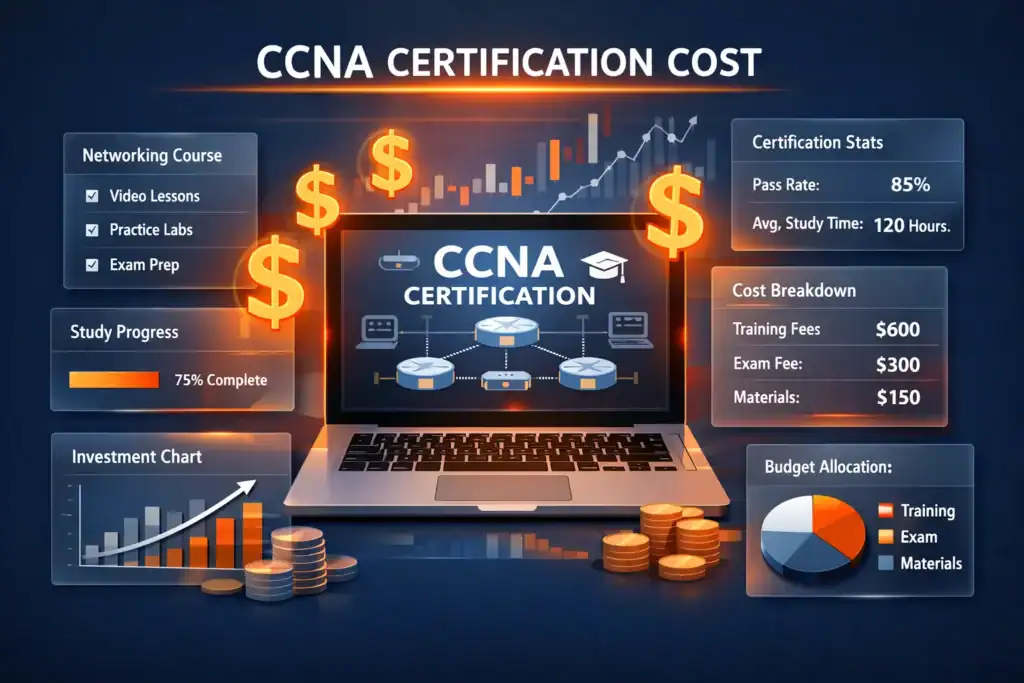
Let’s talk money. The CCNA certification cost breaks down into three main categories: exam fees, study materials, and training.
CCNA Exam Cost Breakdown
It is $330 USD globally. That’s Cisco’s standard pricing, though it may vary slightly by country due to local taxes.
Sound like a lot? Compare it to the salary bump. Even a modest $10,000 annual increase pays for your investment in less than two months. Pretty good ROI.
For detailed pricing information, see our dedicated guide: CCNA Exam Cost 2026.
CCNA Career Outlook: What Can You Earn?
The average salary sits around $112,333 according to recent industry data. But that number varies dramatically based on experience, location, and specific job role.
For a complete breakdown by role and location, read our CCNA Salary: Entry to Senior Level Pay Breakdown.
CCNA Jobs and Career Opportunities

Job Market Reality: Bureau of Labor Statistics data shows network administrator positions growing 5-7% annually through 2032, outpacing overall job growth. Cloud migration, hybrid environments, and enterprise security demands drive this growth. CCNA-certified professionals fill these roles faster than non-certified candidates—employer surveys consistently show 40-60% faster hiring for certified candidates with lab experience.
What CCNA jobs can you actually land? More than you might think.
CCNA certification opens doors to dozens of IT positions. Some require the certification explicitly. Others just prefer candidates who have it. Either way, you’ll have more options than non-certified candidates.
Entry-Level IT Jobs for CCNA Holders
Just getting started? These roles frequently hire CCNA certified candidates:
- Network Technician – $45,000-$60,000
- Help Desk Analyst (Tier 2) – $40,000-$55,000
- Junior Network Administrator – $50,000-$65,000
- NOC Technician – $45,000-$60,000
- IT Support Specialist – $42,000-$58,000
These positions give you hands-on experience while you continue building your skills. Many people use them as stepping stones to network engineer roles within 2-3 years.
Cisco Certified Network Administrator Jobs
Cisco certified network administrator jobs represent the sweet spot for CCNA holders. These roles directly apply what you learned:
| Job Title | Avg Salary | Growth Outlook |
| Network Administrator | $72,000 | Stable |
| Network Engineer | $85,000 | Growing |
| Systems Administrator | $78,000 | Stable |
| Network Security Analyst | $92,000 | High Growth |
| Cloud Network Engineer | $105,000 | High Growth |
According to the Bureau of Labor Statistics, network and computer systems administrator jobs are projected to grow steadily through 2032. The shift to cloud and hybrid environments creates new opportunities, not fewer.
Want to land your first position? Our guide on CCNA Jobs: How to Land Your First Network Position walks through the exact steps. For specific role requirements, see Cisco Certified Network Administrator Jobs: Requirements and Roles.
How to Pass Your CCNA Certification Exam
Alright, let’s get practical. How do you actually pass the CCNA certification exam?
The pass rate hovers around 50-60%. That means roughly half of test-takers fail on their first attempt. Not great odds. But here’s the thing – most failures come down to three mistakes: insufficient lab practice, poor time management during the exam, and underestimating the automation section.
CCNA Practice Test Strategy
Taking a CCNA practice test isn’t just about checking your knowledge. It’s about building exam stamina and identifying weak spots before they cost you $330.
Here’s a practice test strategy that works:
- Start early. Take your first practice test after completing 50% of your study material. Yes, you’ll fail. That’s the point.
- Time yourself. You get 120 minutes for 100-120 questions. That’s about 1 minute per question. Practice at this pace.
- Review every wrong answer. Don’t just note what you got wrong. Understand why you got it wrong.
- Simulate real conditions. No notes, no breaks, no distractions. Build that mental endurance.
For free questions and detailed tips, check out CCNA Practice Test: Free Questions and Exam Tips.
CCNA Practice Exam Resources
Not all CCNA practice exam resources are equal. Some questions are outdated. Others don’t match the actual exam format.
What to look for:
- Questions updated for the current 200-301 exam blueprint
- Mix of multiple choice, drag-and-drop, and simulation questions
- Detailed explanations for both correct and incorrect answers
- Performance tracking to identify weak areas
Our CCNA Practice Exam: Realistic Test Simulation Guide covers the best resources available.
Pro tip: Don’t rely on practice tests alone. You need hands-on lab time. Lots of it. The exam includes simulation questions where you configure actual network devices. If you’ve never touched a CLI, you’ll struggle. Our live CCNA training includes unlimited lab access because we’ve seen too many students fail from lack of practice.
Is CCNA Certification Worth It in 2026?
We’ve covered the costs and potential earnings. But is CCNA certification actually worth it in 2026? Let me give you the honest answer.
For most people: yes. Here’s why.
The IT skills gap keeps widening. Gartner reports that 87% of IT leaders struggle to find qualified networking talent. That shortage drives salaries up and creates opportunities for certified professionals.
CCNA certification provides:
- Credibility – Employers trust Cisco certifications because the exams are genuinely difficult
- Structured learning – The certification path forces you to learn networking properly, not just piecemeal
- Career momentum – 56% of certification holders receive pay increases within 3 months
- Foundation for growth – CCNA is the stepping stone to CCNP, CCIE, and specialized tracks
When might CCNA not be worth it? If you’re already an experienced network professional with a strong track record, certifications matter less. Experience speaks louder at senior levels.
CCNA vs CCNP: What Comes Next?
Once you have your CCNA certification, the next question is obvious: should you pursue CCNP?
The short answer: not immediately. Get some work experience first. CCNA gives you the theory. Real jobs give you the context to understand why things work the way they do.
Most people wait 1-2 years before pursuing CCNP. That’s enough time to apply your CCNA knowledge, hit some real problems, and develop the practical foundation that makes CCNP material click.
For a detailed comparison, read Network + vs CCNA: Which Certification Should You Get First?.
FAQ About CCNA Certification
How long is CCNA certification valid?
CCNA certification is valid for 3 years. To maintain your certification, you can either pass the current CCNA exam again, pass a higher-level exam (like CCNP core), or earn continuing education credits through Cisco’s learning programs.
Can I get a job with just CCNA certification?
Yes. CCNA certification alone qualifies you for entry-level network positions like network technician, junior administrator, and NOC analyst. Many employers specifically list CCNA as a requirement or preferred qualification for these roles.
Is CCNA harder than CompTIA Network+?
Yes, CCNA is significantly harder than Network+. CCNA focuses heavily on Cisco-specific configuration and includes hands-on simulation questions. Network+ is vendor-neutral and more theoretical. CCNA typically requires 2-3 times more study time.
How many times can I take the CCNA exam?
You can take the CCNA exam as many times as needed, but there’s a waiting period. If you fail, you must wait 5 calendar days before your next attempt. Each attempt costs $330.
Should I take a CCNA bootcamp or self-study?
It depends on your learning style and timeline. Self-study costs less but takes longer and has lower pass rates. Bootcamps and live training compress the timeline and provide structured guidance. If you’ve tried self-study before and struggled with consistency, instructor-led training usually delivers better results.
What’s the best way to prepare for CCNA?
The most effective CCNA preparation combines three elements: structured learning (course or official guide), extensive lab practice (200+ hours minimum), and regular practice exams. Don’t skip any of these. Lab practice is where most self-study students fall short.
Start Your CCNA Certification Journey
CCNA certification remains one of the most valuable entry points into networking careers. The CCNA 200-301 exam is challenging, but thousands of people pass it every month. With the right preparation, you can too.
Here’s what we covered:
- CCNA certification costs between $880-$3,160 total, depending on your study approach
- CCNA salary averages $112,333 with significant room for growth
- CCNA jobs range from entry-level technician to senior network engineer
- Passing requires 3-6 months of dedicated study with plenty of lab time
The networking field isn’t going anywhere. Every business needs networks. Every network needs qualified people to manage it. CCNA certification proves you’re one of those people.
Ready to get started? Our live CCNA training program includes expert instruction, unlimited lab access, and free mentorship to help you pass on your first attempt. Unlike pre-recorded courses, you’ll learn from certified engineers who answer your questions in real-time.
Enroll in our CCNA course to start your networking career the right way.